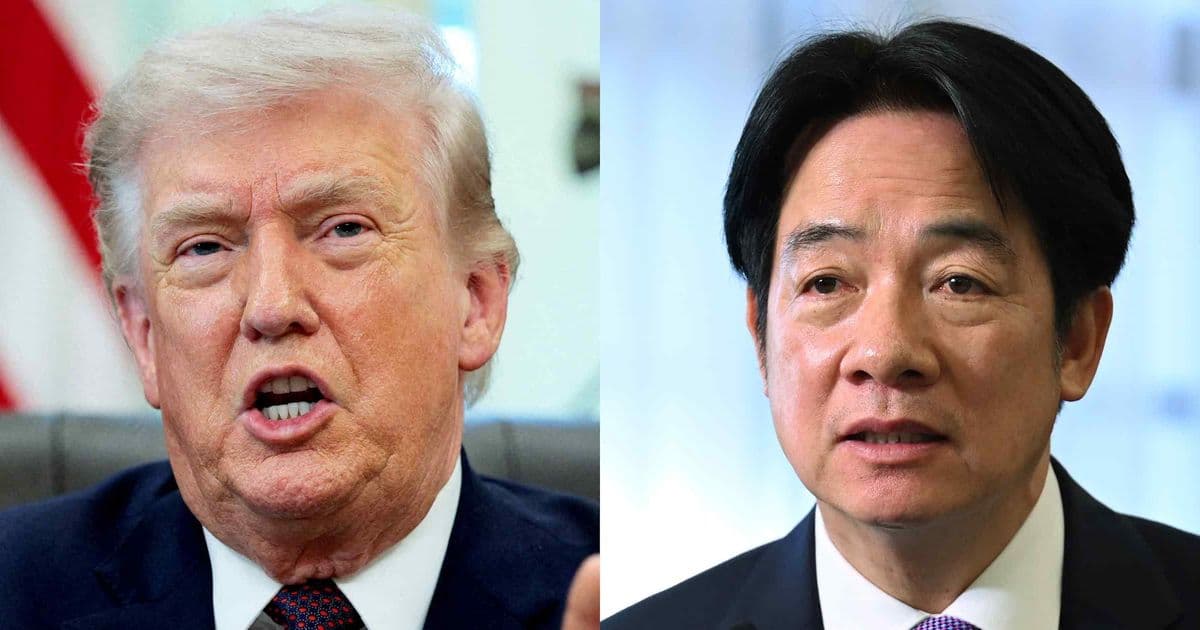
President Donald Trump’s hint that he may speak directly with Taiwan’s Lai Ching‑te has sparked a diplomatic protest from Beijing, which warns Washington to respect the “understanding” reached at the recent Trump‑Xi summit. The episode revives tensions over Taiwan, threatens to delay a pending U.S. arms package, and underscores the fragile balance of cross‑strait relations as both sides navigate a volatile geopolitical market.
Business news
During a press briefing in Tokyo, President Donald Trump said he was considering a phone call with Taiwan’s newly elected President Lai Ching‑te as the United States weighs a $2.3 billion weapons package for the island. Beijing responded within hours, issuing a formal statement that the United States must honor the “understanding” reached at the Trump‑Xi summit a week earlier, which, according to Chinese officials, reaffirmed the “One China” principle.
The Chinese foreign ministry called the U.S. comment “irresponsible” and warned that any deviation from the agreed stance could “undermine regional stability.” The embassy in Washington posted a similar note, urging the American administration to avoid actions that could be interpreted as official recognition of Taiwan’s government.
Market context
The episode arrives at a moment when the U.S. defense sector is eyeing a surge in Taiwan‑related contracts. The pending sale, which includes F‑16V fighters, Patriot missile batteries, and advanced drones, would lift the annual revenue of major contractors such as Lockheed Martin and Raytheon Technologies by roughly $400 million each, according to Bloomberg estimates.
At the same time, Chinese defense firms are expanding export pipelines for anti‑access/area‑denial (A2/AD) systems, aiming to capture markets in Southeast Asia and the Middle East. A delay or cancellation of the U.S. sale could shift procurement decisions toward Chinese platforms, potentially reshaping a market that was projected to reach $12 billion by 2028.
Financial markets have already reacted. The S&P 500 Defense Index slipped 0.6 % after the statement, while the Hang Seng China Enterprises Index rose 0.4 %, reflecting investor sentiment that Beijing may benefit from a cooling of U.S. arms commitments.
What it means
Strategic uncertainty for U.S. suppliers – Companies that have already invested in production lines for the Taiwan package now face a risk of order reduction. A 10‑percent cut would translate into a $40‑million revenue gap for each major contractor, prompting them to re‑allocate capacity toward other regions, such as the Indo‑Pacific naval modernization programs.
Potential shift in Taiwan’s procurement strategy – If Washington backs away, Taipei could look to domestic defense firms like Hanwha Aerospace (which has a joint venture in Taiwan) or consider Chinese‑made surface‑to‑air missiles that are cheaper, albeit with political strings attached. This would alter the competitive dynamics of the Asia‑Pacific defense market.
Signal to investors in Chinese technology firms – Beijing’s swift diplomatic push suggests a broader intent to protect its strategic industries, including semiconductors and rare‑earth supply chains. Companies such as SMIC and China Northern Rare Earth Group may see increased state support, which could affect global pricing and supply stability.
Geopolitical risk premium – The incident adds a new layer of risk to the U.S.–China rivalry index used by sovereign‑wealth funds to price exposure to Asian equities. Analysts at Morgan Stanley have raised the risk premium for Taiwan‑linked assets by 15 basis points, a move that could depress valuations of Taiwanese tech firms that depend on U.S. market access.
Policy implications for the Trump administration – The president’s willingness to signal a direct line to Lai runs counter to the diplomatic language used at the summit, where both leaders emphasized “peaceful development.” If the administration proceeds with the call, it may have to renegotiate the terms of the summit’s joint communiqué, potentially complicating broader trade talks that are still in negotiation.
Overall, the episode underscores how a single diplomatic cue can ripple through defense procurement, capital markets, and the strategic calculus of multinational firms. Stakeholders—from defense manufacturers to semiconductor investors—will be watching closely for any further clarification from Washington or Beijing, as the balance of cross‑strait relations continues to influence both geopolitical stability and market performance.
Comments
Please log in or register to join the discussion