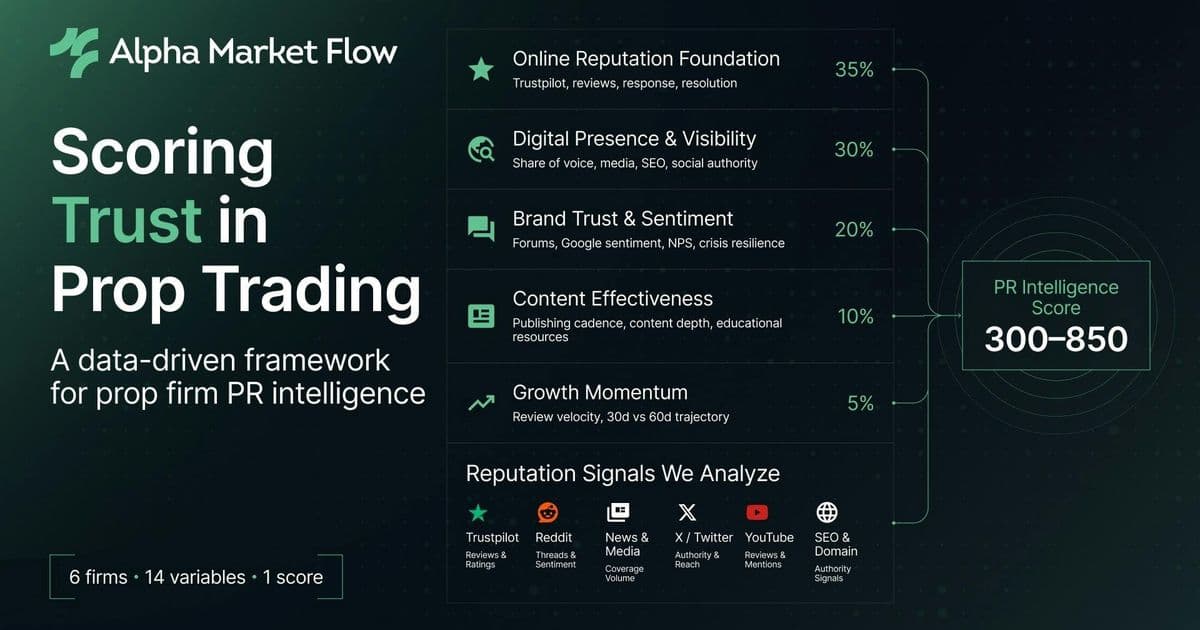
Alpha Market Flow scored six prop‑trading firms on a 300‑850 PR Intelligence scale, revealing that digital presence and complaint‑resolution discipline are the biggest levers for reputation improvement. The average score was 609, with four firms rated Weak. The audit shows that the industry’s structural gap lies in digital infrastructure rather than customer satisfaction.
The First PR Intelligence Audit for Prop Firms: Key Findings
Author: Alpha Market Flow – PR & marketing agency for fintech and Web3 Date: May 21 2026
The problem traders face in the first 90 seconds
When a trader decides to buy a challenge, the decision funnel collapses to a handful of public signals: Trustpilot stars, Reddit threads, YouTube reviews, and forum discussions. Those signals decide whether a trader clicks “Buy” or moves on. Yet most prop firms have never audited the health of those signals.
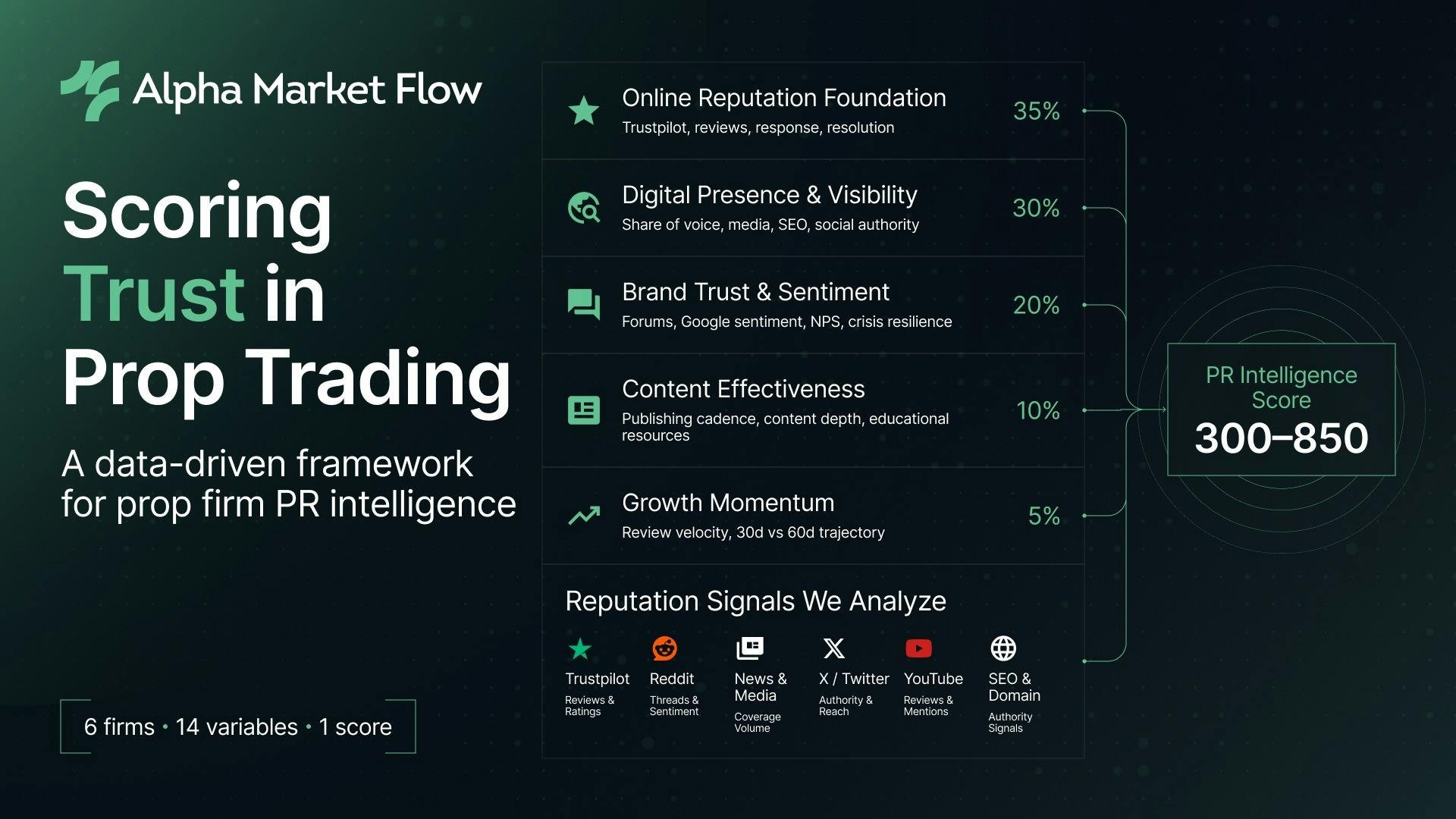
Alpha Market Flow built a PR Intelligence Score that turns the fuzzy notion of “public reputation” into a single, comparable number. The score is derived from 5 weighted categories, 14 sub‑components, and a deterministic data‑collection protocol.
Why a traditional brand audit falls short
Conventional brand audits rely on consultant impressions and narrative reports. They are useful for storytelling but fail on two fronts that matter to a prop firm:
- Objectivity: Opinions cannot be tracked over time. Without hard numbers, a firm cannot tell whether a new social‑media cadence actually improves its reputation.
- Actionability: A vague recommendation like “post more often” does not reveal whether the underlying issue is low media coverage, poor website performance, or a missing complaint‑resolution workflow.
The PR Intelligence Score links every point to a concrete data source – Trustpilot review counts, domain authority, media coverage volume, etc. This makes the score repeatable, comparable, and predictive.
The framework at a glance
| Category | Weight | Cohort average (out of 100) |
|---|---|---|
| Online Reputation Foundation | 35 % | 61.6 |
| Digital Presence & Visibility | 30 % | 44.1 |
| Brand Trust & Sentiment | 20 % | 74.8 |
| Content Effectiveness | 10 % | 33.9 |
| Growth Momentum | 5 % | 56.7 |
The scale runs from 300 to 850, mirroring credit scores to signal a spectrum rather than a pass/fail outcome.
What the averages tell us
- Brand Trust & Sentiment scores are relatively high (74.8). Traders are generally satisfied when they actually use a firm.
- Digital Presence & Visibility lags far behind (44.1). Good experiences are hidden from organic search and editorial media.
- The gap between those two categories is the single most important finding – reputation is strong, but discoverability is weak.
How the data is collected
The audit pulls only publicly available information:
- Trustpilot – review count, star rating, response rate, complaint‑resolution rate, recency.
- Google News – number of articles, tier of publication, date range (last 90 days).
- Reddit & trading forums – sentiment analysis, share of voice.
- Twitter/X & LinkedIn – follower count, engagement metrics.
- SEO tools – domain authority, backlink profile.
Each raw metric is normalized to a 0‑100 bucket, weighted, and summed. An anti‑gaming layer applies penalties when patterns suggest artificial inflation (review spikes, template reviews, reviewer concentration). The final composite is linearly mapped to the 300‑850 range. Because the process is fully deterministic, the same input always yields the same output, and firms can model the impact of specific actions before spending money.
The six‑firm cohort (Jan‑Apr 2026)
| Firm | Score | Band | Top strength | Biggest gap |
|---|---|---|---|---|
| A | 661 | Fair | Strongest digital presence (62.3) | Complaint‑resolution rate (38 %) |
| B | 651 | Fair | Highest sentiment & NPS (87.5) | Declining review momentum, limited media |
| C | 634 | Weak | Best review‑response discipline (74.3) | Zero educational content |
| D | 611 | Weak | Highest NPS proxy (95) | Domain authority (DA 8), no media |
| E | 585 | Weak | Strong sentiment & NPS (82.6) | Near‑zero content output, stagnant momentum |
| F | 513 | Weak | Second‑strongest digital presence (58.5) | Trustpilot crisis – suspended rating, 0 % resolution |
Average score: 609 / 850 Industry median: ≈ 622
Four of six firms fall into the Weak band; none reach Good (700+) or Strong (750+). Even the top firm (661) sits closer to the Weak threshold than to Good, indicating a lot of headroom.
Surprising insights
1. Review volume is not the primary driver
Firm D had 194 Trustpilot reviews and scored 84.6 in the Online Reputation Foundation, while Firm A had 2,990 reviews but only 63.3. A 4.8‑star rating with 100 % response and full complaint resolution outperformed a firm with fifteen times more reviews but a lower star rating and poor follow‑through.
2. Complaint‑resolution discipline is high‑leverage
Resolution rates ranged from 0 % to 100 %. The firms with the highest rates consistently outranked those with better star averages. Implementing a public response workflow costs virtually nothing and can lift a score by 15‑20 points within a month.
3. Content is almost absent
Average Content Effectiveness is 33.9. Only one firm scored above 80 by publishing blogs, video tutorials, and live sessions. The rest leave SEO, domain authority, and trust transfer from education on the table.
4. A Trustpilot crisis is a total‑score event
Firm F’s suspended rating dragged its overall score down to 513, despite a respectable digital‑presence score (58.5). Because the Online Reputation Foundation carries a 35 % weight, a collapse in that category overwhelms any strengths elsewhere.
Five patterns that repeat across the data
- Earned media matters – The two firms with the highest overall scores have at least one Tier‑2 fintech article. The four low‑scorers have none.
- Complaint resolution is the cheapest win – A 15‑point boost is achievable by responding to every public complaint within two weeks.
- Educational content compounds – Firms that publish regularly own search positions and see steady improvements in domain authority.
- Crisis preparedness is essential – A single Trustpilot suspension can erase progress in all other categories.
- Growth momentum is a lagging indicator – Review‑trajectory over 30‑ vs. 60‑day windows correlates weakly with current scores, suggesting that reputation improvements take time to reflect in trader behavior.
What the score bands mean for a prop firm
| Band | Score range | Interpretation |
|---|---|---|
| Elite | 800‑850 | Reputation signals are strong across all categories; organic acquisition dominates paid spend. |
| Strong | 750‑799 | Well‑established brand with minor gaps. |
| Good | 700‑749 | Solid foundation; targeted work in 1‑2 categories unlocks the next tier. |
| Fair | 650‑699 | Moderate reputation; fixable gaps, usually in digital visibility or review momentum. |
| Weak | 300‑649 | Significant gaps across multiple categories; median of the current cohort sits here. |
A firm that moves from Weak (≈ 610) to Fair (≈ 660) can expect better search visibility, higher conversion on challenge pages, and lower paid‑acquisition costs.
Roadmap to improvement
Because each point maps to a specific sub‑component, firms can plot a clear path:
- Complaint‑resolution workflow – Build a public ticketing system, respond to every Trustpilot review within 48 hours, aim for ≥ 80 % resolution. Expected lift: +12‑15 points.
- Earned media placement – Secure one Tier‑2 fintech article. Anticipated lift: +8‑10 points via media‑coverage and backlink effects.
- Review‑request process – Automate post‑challenge emails asking satisfied traders to leave a review. Expected lift: +5‑7 points.
- Content engine – Publish weekly blog posts and short video tutorials. Over 3‑6 months, domain authority and content effectiveness can each rise 15‑20 points.
A firm that executes steps 1‑3 can move from Weak to Fair (650+) within 90 days. Reaching Good (700+) typically requires sustained content work and multiple media placements over 6‑9 months.
Limitations of the first‑generation audit
- Sample size – Six firms provide useful signals but are not enough for statistically robust industry conclusions.
- Weighting – Category weights are expert‑derived, not yet calibrated through regression on a larger dataset.
- Scope – The score does not evaluate trading platform performance, payout reliability, regulatory compliance, or internal operations. A high score does not guarantee safety; a low score does not guarantee failure.
Future releases will incorporate 50+ firms, enabling retrospective analysis of how scores correlate with conversion rates, media growth, and challenge purchase volumes.
What’s next for Alpha Market Flow
We plan to:
- Publish a live dashboard of anonymized scores as the dataset grows.
- Offer a self‑service portal where firms can run “what‑if” scenarios before committing resources.
- Expand the framework to Web3 projects, where reputation signals are even more fragmented.
If your prop firm wants a baseline assessment or wants to test a specific intervention, request a full audit at alphamarketflow.com.
This article was featured in Arweave ViewBlock Terminal Lite.
Comments
Please log in or register to join the discussion