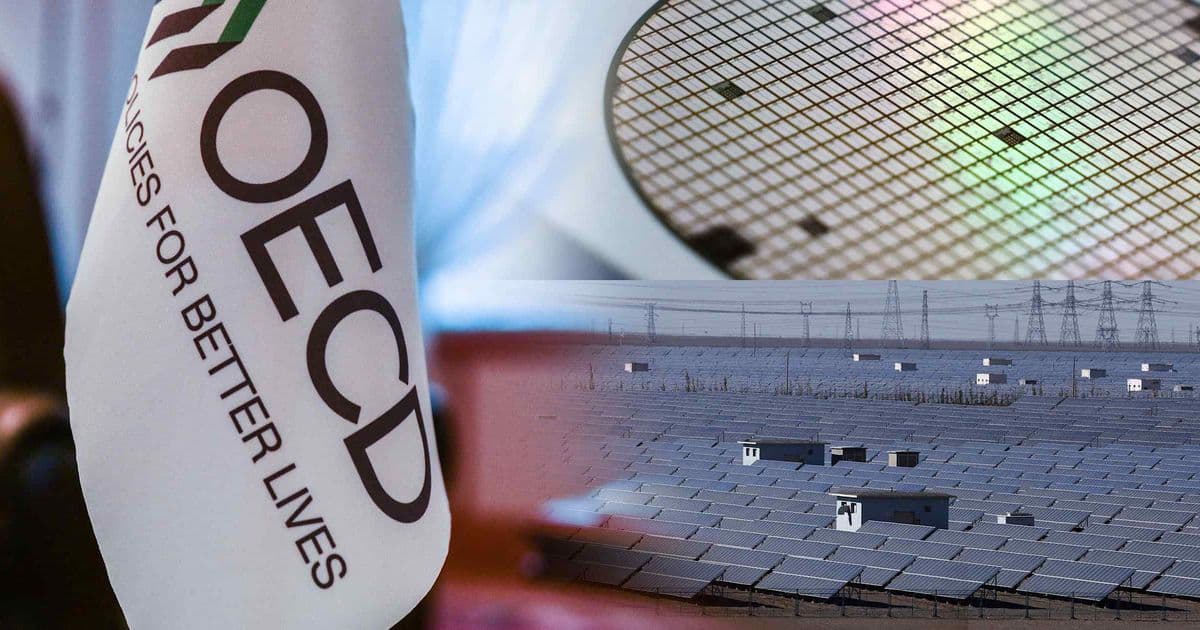
A new OECD database reveals Chinese companies in sectors such as semiconductors, solar panels and electric vehicles received up to eight times more government support than firms in OECD nations between 2004 and 2024, highlighting the scale of Beijing’s industrial policy and its implications for global competition.
Chinese Firms Pull in Up to Eight‑Fold More State Subsidies Than OECD Counterparts, OECD Data Shows
Business news
The Organisation for Economic Co‑operation and Development (OECD) released a comprehensive database that tracks public subsidies granted to companies across 30 sectors. The analysis shows that, over the 20‑year period ending in 2024, Chinese firms received as much as eight times the amount of state aid per firm compared with peers in OECD economies. The gap is most pronounced in semiconductors, solar photovoltaics and electric‑vehicle (EV) manufacturing, where Chinese recipients averaged subsidies of $1.2 billion per company, versus roughly $150 million in the United States, Germany and Japan combined.
Market context
| Sector | Avg. subsidy per Chinese firm (2004‑2024) | Avg. subsidy per OECD firm | Multiplier |
|---|---|---|---|
| Semiconductors | $1.4 bn | $180 m | 7.8× |
| Solar PV | $1.1 bn | $140 m | 7.9× |
| EVs | $950 m | $120 m | 7.9× |
| Automotive components | $620 m | $85 m | 7.3× |
The OECD’s methodology excludes direct fiscal transfers that are part of broader macro‑economic stimulus, focusing instead on targeted R&D, capital‑intensity, and export‑promotion programs. The database also flags policy design – such as preferential tax credits, low‑interest loans, and procurement guarantees – that amplify the effective subsidy value.
China’s aggressive industrial policy aligns with its “Made in China 2025” roadmap, which earmarked $400 billion for strategic sectors between 2015 and 2020. Although the program faced U.S. and EU push‑back, the data suggest that the subsidies continued to expand through 2024, especially after the 2022‑2023 pandemic recovery plan added another $120 billion for high‑tech manufacturing.
In contrast, OECD countries have trimmed subsidies in response to fiscal consolidation and trade‑policy pressures. The United States cut its Advanced Manufacturing Partnership funding by 30 % between 2019 and 2023, while the European Union’s Horizon Europe budget grew modestly, focusing on collaborative research rather than direct firm‑level cash injections.
What it means
- Competitive distortion – The subsidy gap translates into a cost advantage for Chinese firms. For every $1 of R&D a German chipmaker spends, a Chinese counterpart can effectively spend $8, accelerating product cycles and price reductions.
- Supply‑chain re‑shoring pressure – OECD governments are now debating counter‑subsidy measures. The EU’s proposed “Subsidy Transparency Directive” would require firms receiving more than €50 million in state aid to disclose terms, aiming to level the playing field for European suppliers.
- Investment redirection – Multinational corporations may reconsider capital allocation. A recent survey by the EU Chamber of Commerce showed 62 % of respondents would shift up to $15 billion of planned European plant spend to regions with clearer subsidy regimes.
- Policy feedback loop – China’s continued reliance on subsidies could provoke retaliatory measures, such as higher tariffs on Chinese imports or stricter foreign investment screening in high‑tech sectors. The U.S. Treasury’s 2025 “Strategic Competition Act” already earmarks $10 billion for subsidies to domestic semiconductor firms, explicitly citing the OECD findings.
- Long‑term market dynamics – While subsidies boost short‑term output, they can also create “zombie” firms that survive on state support rather than market viability. OECD analysts warn that without a clear exit strategy, the subsidy‑driven expansion may lead to overcapacity, especially in solar panel production, where global demand growth is projected to slow to 3 % CAGR after 2027.
Strategic takeaways for investors and policymakers
- Monitor subsidy disclosures: Companies operating in the affected sectors should track changes in state aid reporting requirements, as non‑compliance could trigger fines or loss of market access.
- Diversify supply sources: Firms reliant on Chinese components may need to qualify for alternative suppliers to mitigate the risk of future trade barriers.
- Advocate for transparent policy: Industry groups can push for OECD‑wide standards on subsidy reporting, reducing information asymmetry that currently favors China.
- Assess fiscal sustainability: Analysts should factor in the fiscal cost of China’s subsidies – estimated at $2.5 trillion over two decades – when evaluating the country’s macro‑economic resilience.
The OECD’s database provides a rare, data‑driven glimpse into how state support shapes global competition. As the numbers make clear, Beijing’s willingness to pour capital into strategic industries has created a measurable advantage that could reshape market share across semiconductors, renewable energy and electric mobility for years to come.
Comments
Please log in or register to join the discussion