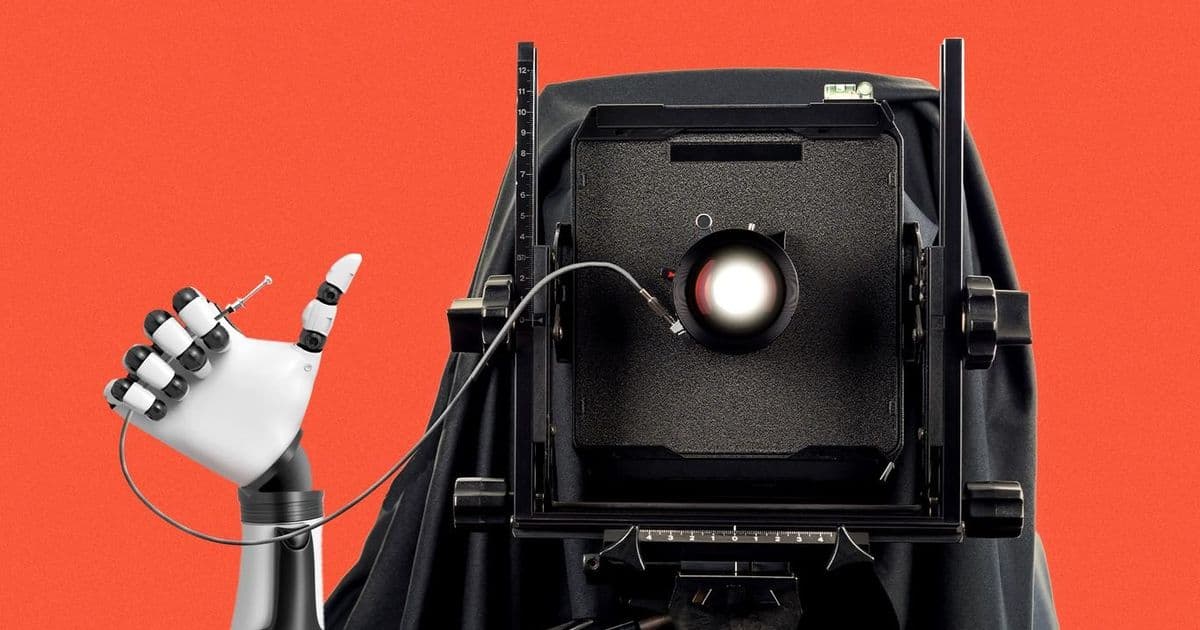
Collov Labs' $23 million Series A funding signals growing investment in AI systems that can interpret visual input and take real-world actions, raising questions about the practical applications and limitations of such technology.
The recent $23 million Series A funding for Collov Labs highlights an emerging trend in artificial intelligence: the shift from purely digital AI systems to those capable of interacting with the physical world. Collov's technology, which enables users to feed images and camera input into models that AI agents can reason over and act upon, represents a significant step toward more embodied AI systems that can navigate and influence our environment.
The Technology Behind Collov's Approach
At its core, Collov has developed a visual interface that bridges the gap between perception and action for AI agents. Unlike traditional computer vision systems that simply analyze visual data, Collov's platform enables AI to interpret visual input and translate those interpretations into real-world actions. This creates a feedback loop where the AI can observe, reason, and act in physical spaces.
The technical architecture likely involves several components:
- Computer vision models for image and video analysis
- Spatial reasoning capabilities to understand object relationships and positions
- Action planning systems that determine appropriate physical responses
- Interface mechanisms to execute those actions through various hardware
This approach moves beyond the limitations of screen-based AI interactions, potentially enabling applications in robotics, smart environments, and augmented reality where AI agents need to understand and manipulate physical spaces.
Evidence of a Growing Trend
Collov's funding comes amid increasing interest in embodied AI and systems that can interact with the physical world. Several parallel developments suggest this is part of a larger shift:
Andon Market's AI-run boutique: As noted in the news, San Francisco's Andon Market represents one of the first retail boutiques run by an AI agent (using Claude Sonnet 4.6), demonstrating practical application of AI in physical commerce.
Instacart founder's AI hedge fund: Apoorva Mehta's new hedge fund Abundance aims to have AI agents run the entire fund, extending AI's operational capabilities beyond specific tasks to comprehensive decision-making.
Anthropic's Project Deal: The AI company demonstrated an AI marketplace where Claude models bought, sold, and negotiated personal belongings on behalf of employees, showcasing AI's ability to handle complex real-world transactions.
Genki Robotics' valuation: Andy Rubin's humanoid robotics startup reached a $1 billion valuation, indicating strong market confidence in physical AI systems.
These developments collectively suggest a maturing ecosystem where AI agents are increasingly expected to understand and interact with the physical world rather than remaining confined to digital environments.
Technical Challenges and Limitations
Despite the enthusiasm, significant technical and practical challenges remain for visual AI systems like Collov's:
Spatial understanding: AI systems still struggle with nuanced spatial reasoning, context comprehension, and understanding of physical laws that humans take for granted.
Action execution: Translating digital decisions into precise physical movements requires sophisticated robotics and sensor integration, introducing additional complexity and potential failure points.
Safety and reliability: Physical AI systems must contend with real-world consequences of errors, requiring robust safety mechanisms that are difficult to implement in complex environments.
Data requirements: Training effective visual-action models requires vast amounts of diverse, real-world data, raising questions about data quality, bias, and privacy.
Energy consumption: Processing visual data and executing physical actions is computationally intensive, potentially creating significant energy demands.
Market Applications and Adoption Signals
The funding for Collov suggests several potential market applications:
Smart environments: Buildings and spaces that can understand and respond to human presence and needs through visual interfaces.
Assistive robotics: Systems that can interpret visual cues to assist people with disabilities or provide support in complex tasks.
Industrial automation: Enhanced manufacturing and logistics systems that can visually assess situations and make appropriate adjustments.
Retail and customer service: As demonstrated by Andon Market, AI systems that can understand customer needs and respond in physical retail settings.
AR/VR interfaces: More natural interactions between users and augmented reality systems that understand visual context.
The $23 million Series A, led by investors who see potential in this space, indicates that venture capital is increasingly betting on the commercial viability of these technologies, though widespread adoption may still face hurdles.
Counter-Perspectives and Skepticism
Not all experts are convinced of the immediate practicality of visual-action AI systems:
The simulation gap: Critics argue that current AI systems primarily operate in controlled environments or simulations, and struggle with the unpredictability of real-world scenarios.
Over-reliance concerns: Some worry that delegating physical interactions to AI systems could reduce human agency and create vulnerabilities in critical systems.
Economic viability questions: The high development and computational costs may limit commercial applications to specialized use cases rather than broad adoption.
Privacy implications: Systems that continuously observe and interact with physical spaces raise significant privacy concerns that may limit deployment in many contexts.
Regulatory uncertainty: As these systems begin to interact more with the physical world, regulatory frameworks lag behind technological capabilities, creating uncertainty for developers and users alike.
Broader Implications
The development of visual-action AI systems like Collov's represents a significant evolution in how we interact with artificial intelligence. As AI moves beyond text and image generation to physical interaction, several broader implications emerge:
Human-AI collaboration: The most promising applications may not replace human workers but rather augment their capabilities, handling routine tasks while humans focus on complex decision-making.
New interface paradigms: Visual-action systems could fundamentally change how we interact with technology, moving beyond screens and keyboards toward more natural, embodied interactions.
Accessibility improvements: For people with disabilities, AI systems that can understand and manipulate physical environments could dramatically increase independence and quality of life.
Ethical considerations: As AI takes on more physical responsibilities, questions about accountability, transparency, and moral decision-making in physical contexts become increasingly urgent.
Computational resource distribution: The energy requirements of visual-action AI systems raise questions about the environmental impact and equitable access to these technologies.
Conclusion
Collov Labs' $23 million Series A funding represents both a significant milestone and an early indicator of where AI development may be heading. The ability to translate visual understanding into physical action opens up new possibilities for AI applications, from smart environments to assistive robotics. However, the path from promising technology to practical, widely deployed systems remains fraught with technical, ethical, and economic challenges.
As this field develops, the most successful approaches will likely balance ambitious technological capabilities with realistic constraints and thoughtful consideration of human needs and values. The growing interest in embodied AI suggests we're entering a new phase of artificial intelligence development—one that increasingly seeks to bridge the gap between digital computation and physical reality.
Comments
Please log in or register to join the discussion