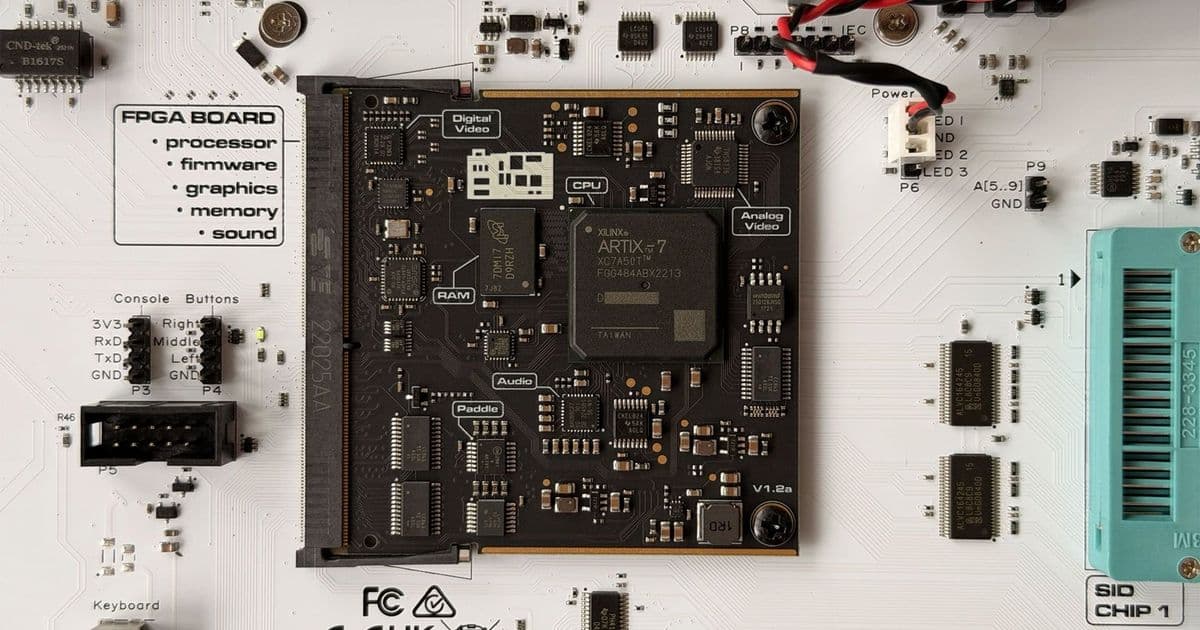
The iconic computer brand backtracks on plans to restrict third-party firmware installations for the C64 Ultimate, prioritizing user freedom while maintaining warranty limitations for damaged units.
The Commodore brand has reversed its controversial decision to implement firmware lockdown restrictions on its C64 Ultimate computer, following significant community pushback. The company announced it will no longer prevent users from loading third-party firmware onto the FPGA (Field-Programmable Gate Array) hardware, though it maintains that warranty support won't cover devices damaged by unsupported modifications.
Technical Background: FPGA in Retro Computing
The C64 Ultimate represents Commodore's modern revival of the iconic 1980s home computer, utilizing FPGA technology to recreate the original hardware's functionality with enhanced capabilities. FPGA chips allow for reprogrammable hardware logic, making them ideal for retro computing applications where authentic behavior is essential.
Unlike traditional ASIC (Application-Specific Integrated Circuit) implementations that have fixed functionality, FPGAs can be reconfigured to match specific hardware behaviors. This flexibility has made them the preferred technology for high-fidelity retro computing systems like the C64 Ultimate, which must precisely replicate the timing and behavior of original 1980s hardware while offering modern connectivity and performance improvements.
The original policy, announced in version 1.1.0 of the firmware, stated that "a future update may introduce safeguards to help make sure incompatible firmware not released by Commodore does not damage your motherboard." This technical restriction would have implemented a hardware-level verification system checking for digitally signed Commodore firmware before allowing installation.
Community Response and Corporate Reversal
The announcement sparked immediate division within the retro computing community. While some users appreciated Commodore's attempt to manage warranty claims, the majority voiced strong opposition to what they perceived as an unnecessary restriction on hardware ownership and modification rights.
Social media platforms and retro computing forums saw extensive discussion, with many pointing out that similar restrictions had previously hurt other companies' relationships with their user bases. The conversation highlighted a fundamental tension between manufacturer control and user freedom in the hardware modification space.
In response to this feedback, Commodore published a detailed blog post explaining their change in direction. "We will not prevent you from installing other firmware on your Commodore 64 Ultimate," the post explicitly states, adding that the company "values freedom of choice the most."
The New Compromise Approach
Rather than implementing technical barriers, Commodore will now rely on a disclaimer-based approach. The company will clearly communicate that "community-installed firmware, patches, or other modifications are used at the owner's own risk, and Commodore cannot provide free support, free warranty service, or free replacement for units bricked or damaged as a result."
This approach mirrors policies established by other consumer electronics companies, including Apple's stance on jailbroken devices. The key difference lies in Commodore's explicit acknowledgment that warranty limitations for user modifications represent "an 'us' problem, not a 'you' problem," indicating the company will bear some responsibility for the consequences of this policy.
Market Implications and Industry Context
This decision carries particular significance within the retro computing market, which has seen substantial growth in recent years. According to market research, the retro gaming and computing sector has grown at approximately 15% annually over the past five years, driven by nostalgia, educational interest, and the preservation of computing history.
The C64 Ultimate competes with other FPGA-based retro systems like the MiSTer project, which has established an open ecosystem with extensive community-developed cores and modifications. Commodore's reversal suggests recognition that restrictive firmware policies could disadvantage their product against more open alternatives in this increasingly competitive market.
From a supply chain perspective, the decision may impact Commodore's after-sales service operations. The company previously cited "hardware returns and replacements due to actions entirely out of our control" as a primary motivation for the original policy. While the new approach eliminates the need for technical enforcement mechanisms, it may increase warranty claims related to user modifications.
Technical Considerations for FPGA Modifications
For users considering third-party firmware installations, several technical factors should be considered:
- Voltage Compatibility: Not all FPGA modifications account for hardware voltage tolerances, potentially causing physical damage
- Clock Speed Stability: Overclocked or unstable clock configurations can lead to hardware stress
- Signal Integrity: Poorly implemented modifications may introduce electrical noise that degrades component longevity
- Thermal Management: Some modifications increase power consumption, requiring additional cooling
The retro computing community has developed extensive documentation for safe FPGA modifications, with resources available through platforms like The Ultimate C64 Wiki and specialized forums like Commodore USA's community section.
Future Outlook
Commodore's reversal sets an interesting precedent for retro computing hardware manufacturers. As FPGA technology becomes more accessible and the community development ecosystem expands, companies must balance technical support requirements with user freedom and expectations.
The company's statement that "we listened" suggests a willingness to engage with the community on technical policy decisions. This approach may prove valuable as Commodore develops future products, including rumored expansions of their FPGA-based product line beyond the C64 platform.
For consumers, the decision represents a victory for hardware ownership rights while establishing clear boundaries for manufacturer liability. The retro computing community will likely continue developing and sharing modifications, with increased awareness of the warranty implications.
As FPGA technology advances and production costs decrease, we may see further integration of user-modifiable hardware in consumer devices. Commodore's handling of this issue could influence how other companies approach similar technical and policy decisions in the evolving landscape of customizable consumer electronics.
Comments
Please log in or register to join the discussion