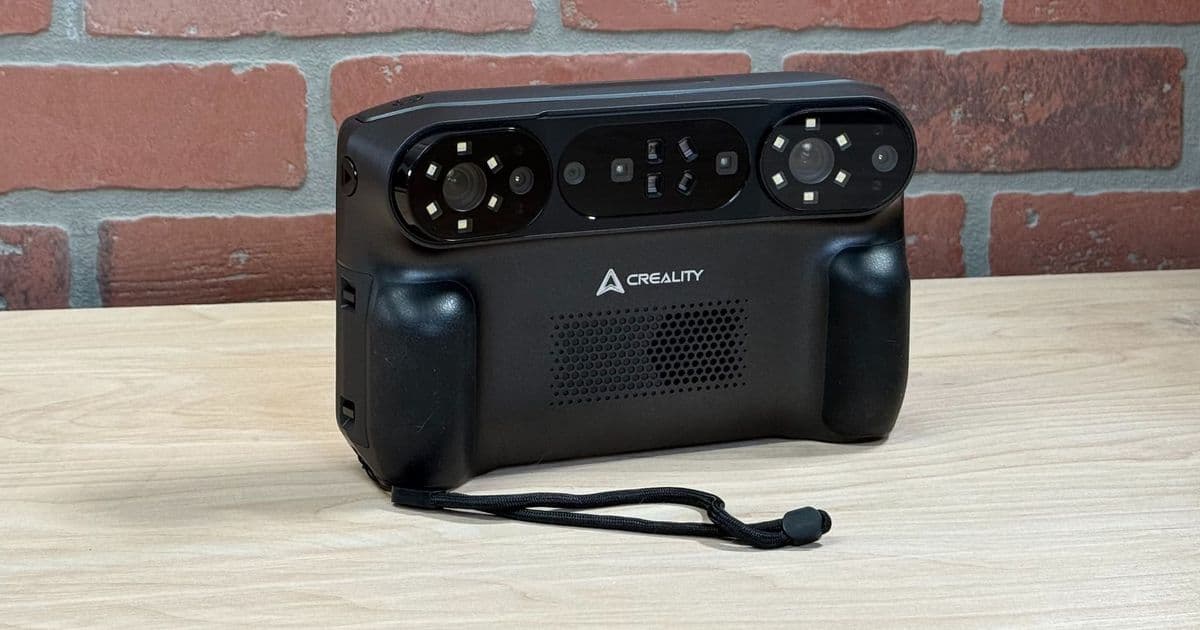
The Creality Sermoon P1 delivers exceptional geometry capture and mobile workflow capabilities, but its disappointing color texture quality and $3,129 price tag make it better suited for professional applications than hobbyist use.
The Creality Sermoon P1 represents a significant leap forward in handheld 3D scanning technology, offering professionals a portable solution that doesn't require a computer connection during operation. This standalone scanner combines blue laser and NIR (near-infrared) scanning capabilities in a single device that can comfortably fit in your hands, making it ideal for fieldwork and on-site applications.
Design and Portability
The Sermoon P1's design philosophy centers on mobility and independence from traditional computing infrastructure. At 830 grams, the device feels substantial but well-balanced in both hands, with rubber grips and an included wrist strap providing secure handling during extended scanning sessions. The standout feature is the 6-inch LCD touchscreen on the rear, which serves as both a control interface and processing display, allowing users to capture, edit, and export scans entirely on-device.
The inclusion of a second battery addresses a critical concern for mobile scanning operations. With USB-C charging capability on the battery itself, users can hot-swap power sources in the field without interrupting workflows. Creality claims 80% charge in approximately 50 minutes, and real-world testing confirmed this performance.
Scanning Capabilities
The Sermoon P1 offers three distinct blue laser scanning modes:
- 22 crossed laser lines: Optimized for rapid scanning of large objects at up to 60 FPS
- 7 parallel laser lines: Best for capturing fine details and intricate geometry
- Single laser line: Specifically designed for deep holes and recesses that other modes cannot reach
These modes can be combined during a single scanning session, allowing users to first capture broad geometry quickly before switching to more detailed modes for specific features. The NIR structured light mode provides marker-free scanning capabilities in various lighting conditions, though frame rates drop to approximately 18 FPS in standalone mode.
Performance in Real-World Applications
Automotive scanning applications demonstrate the Sermoon P1's strengths effectively. When scanning a carbon fiber window switch panel on a Mazda CX-3, the 22-line laser mode captured the bulk geometry at an impressive 53 FPS. The 7-line mode then provided fine detail around transitions, while the single-line mode successfully captured deep recesses that other modes couldn't reach.
Outdoor scanning capabilities proved equally impressive. A large brick sculpture scanned using NIR mode with geometry-based tracking produced remarkably accurate geometry, capturing even small tool marks on brick edges. However, the color texture quality suffered significantly, with visible seams and abrupt shadow transitions that couldn't be corrected without external software.
Software and Workflow
The Sermoon P1 includes two software options: onboard processing and the CrealityScan desktop application. The onboard software provides a complete workflow including alignment, meshing, mesh editing, and texture generation without requiring a computer connection. The "One-Click Process" feature automates these steps for simple objects, though complex models benefit from manual control over individual operations.
CrealityScan for Windows and macOS offers enhanced performance, particularly in NIR mode where frame rates increase to 30 FPS when tethered via USB. However, this performance gain comes at the cost of mobility, as the device must remain connected to a computer during scanning.
Color Texture Limitations
Despite impressive geometry capture, the Sermoon P1's color texture generation represents a significant weakness. The texture mapping process creates visible seams between scan areas, with no user-adjustable parameters to improve results. This limitation is particularly problematic for applications where color accuracy matters, such as cultural heritage documentation or product visualization.
The texture issues stem from the device's inability to properly blend color data between scan areas, resulting in a patchwork appearance that undermines the otherwise professional-grade geometry capture. Users requiring high-quality color textures will need to export models and manually edit UV mapping in external software.
Storage and Processing Power
With 256 GB of onboard storage and 24 GB of RAM, the Sermoon P1 can handle substantial scanning projects without external storage. Large objects can generate multi-gigabyte mesh files, but the device's processing capabilities allow for on-device editing and export without performance degradation.
Target Market and Pricing
At $3,129 for the complete bundle, the Sermoon P1 positions itself firmly in the professional market segment. The price point reflects the device's advanced capabilities but places it well beyond hobbyist budgets, especially when compared to entry-level scanners like the 3DMakerPro Mole at under $400.
The Sermoon P1 excels in professional applications where:
- Mobility is essential
- Computer access is limited or unavailable
- High-accuracy geometry capture is the primary requirement
- Color texture quality is secondary to geometric accuracy
Conclusion
The Creality Sermoon P1 delivers on its promise of professional-grade, computer-free 3D scanning with impressive geometry capture and robust mobile workflow capabilities. The device's ability to combine multiple scanning modes, process data on-device, and operate independently of external computing infrastructure makes it a compelling choice for professionals in fields like automotive, industrial design, and cultural heritage.
However, the disappointing color texture quality and premium price point limit its appeal primarily to professional users who prioritize geometric accuracy over color fidelity. For hobbyists or users requiring high-quality color textures, more affordable alternatives or traditional photogrammetry workflows may provide better value.
Bottom Line: The Sermoon P1 is a powerful, portable 3D scanner that excels at geometry capture but falls short on color texture quality, making it ideal for professional applications where mobility and geometric accuracy matter most.
Comments
Please log in or register to join the discussion