
The D7VK project has reached version 1.2, significantly improving its Direct3D 6 front-end for running classic Windows games on Linux with Vulkan acceleration, showing performance gains over WineD3D in benchmarks.
The D7VK project, which implements Direct3D 7 over the Vulkan API for legacy Windows game compatibility on Linux, has released version 1.2. This update focuses heavily on maturing the Direct3D 6 front-end that was introduced in late 2025, moving it from experimental to a more stable state that supports a wider range of classic titles.
D7VK serves a similar purpose to DXVK and VKD3D-Proton but targets the older Direct3D 7 and 6 APIs. While DXVK handles Direct3D 9-11 and VKD3D-Proton tackles Direct3D 12, D7VK fills the gap for games from the late 1990s and early 2000s that relied on Direct3D 6 or 7. This is particularly valuable for the growing community of Linux gamers interested in retro titles and for homelab builders running game servers or virtual machines with legacy software.
Direct3D 6 Front-End Improvements
The Direct3D 6 support in D7VK 1.2 is described as "a bit less experimental now," with several key improvements:
Expanded Game Compatibility: More Direct3D 6 titles now run successfully. Notable games confirmed working well include:
- Tomb Raider: Chronicles (1999)
- Battlezone II: Combat Commander (2000)
- Drakan: Order of the Flame (1999)
- Indiana Jones and the Infernal Machine (1999)
Reduced Rendering Artifacts: The D3D6 implementation now handles more of the legacy API's quirks and edge cases, reducing visual glitches and crashes that plagued earlier versions.
Better State Management: Direct3D 6's fixed-function pipeline requires careful state tracking. Version 1.2 improves how these states are cached and validated against Vulkan's requirements.
Performance Benchmarking
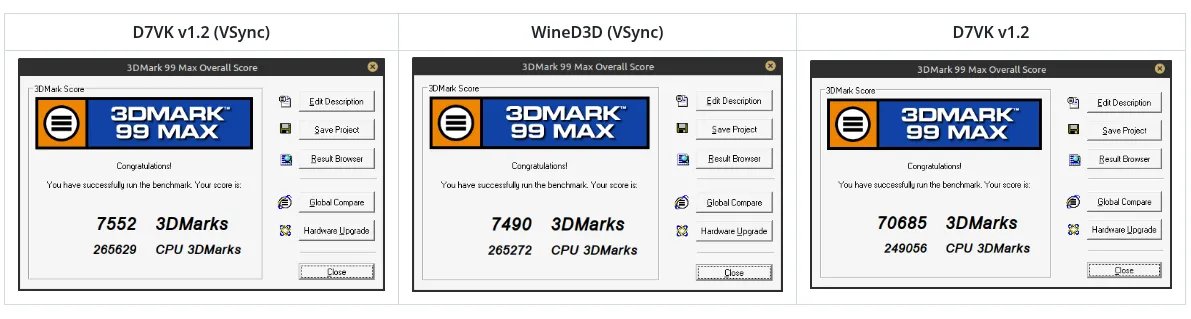
Early benchmarks show D7VK significantly outperforming WineD3D's Direct3D 6 implementation. In 3DMark 99 MAX, a classic synthetic benchmark from the era, D7VK demonstrates excellent performance gains. While specific frame rate numbers weren't provided in the announcement, the performance delta is substantial enough to be immediately noticeable in gameplay.
This performance advantage stems from D7VK's architecture:
Direct Vulkan Translation: Unlike WineD3D's more complex translation layer, D7VK maps Direct3D 6 calls more directly to Vulkan commands.
Modern GPU Utilization: Vulkan allows better utilization of modern GPU features like compute shaders for tasks that were originally CPU-bound in Direct3D 6.
Reduced Overhead: By avoiding the legacy OpenGL path that WineD3D often uses, D7VK reduces driver overhead and CPU usage.
Technical Implementation Details
D7VK's approach to Direct3D 6 differs from its Direct3D 7 implementation:
Direct3D 6 Characteristics:
- Fixed-function pipeline only (no shaders)
- Limited texture formats and blending modes
- Simpler state management but more implicit state dependencies
- Designed for hardware like 3dfx Voodoo and early NVIDIA RIVA TNT
D7VK's Translation Strategy:
- Maps fixed-function pipeline to Vulkan's graphics pipeline with hardcoded shaders
- Implements legacy texture operations via Vulkan's image operations
- Handles state changes through Vulkan descriptor sets and push constants
- Maintains compatibility with both modern and legacy GPU features
Build and Compatibility Recommendations
For users wanting to test D7VK 1.2:
System Requirements:
- Vulkan 1.1 capable GPU (most GPUs from 2016 onward)
- Mesa 21.0+ or proprietary drivers with Vulkan support
- Wine 7.0+ for integration
Installation:
- Clone the D7VK GitHub repository
- Build with Meson:
meson setup build && ninja -C build - Install to Wine prefix:
cp build/src/libd3d11.so ~/.wine/drive_c/windows/system32/ - Set
WINEDLLOVERRIDES="d3d11=n,b"environment variable
Game-Specific Tweaks:
- Some Direct3D 6 games expect specific pixel formats. D7VK 1.2 handles most, but check the project wiki for known issues.
- For games using DirectDraw (DDraw), D7VK may need companion libraries or WineD3D fallbacks.
Broader Impact on Linux Gaming Ecosystem
D7VK 1.2 strengthens the complete Direct3D-to-Vulkan translation stack:
- DXVK: Direct3D 9-11 (most modern games)
- VKD3D-Proton: Direct3D 12 (latest AAA titles)
- D7VK: Direct3D 6-7 (legacy/retro games)
This coverage means nearly all Windows games from 1996 onward can potentially run on Linux with native Vulkan acceleration, eliminating the need for CPU-intensive software rendering or compatibility layers like WineD3D's OpenGL backend.
For homelab builders and server administrators, D7VK enables running legacy Windows applications and games in Linux VMs or containers without sacrificing GPU acceleration. This is particularly useful for:
- Game servers hosting classic titles
- Development environments for retro game modding
- Preservation projects for abandonware games
- Educational systems teaching game development history
Future Development
The D7VK project continues active development. Future priorities likely include:
- Direct3D 6.1 Support: Adding features from the DirectX 6.1 update
- Multi-Sampling Anti-Aliasing (MSAA): Direct3D 6's MSAA implementation differs from modern approaches
- Better Resource Management: Improving memory usage for systems with limited VRAM
- Integration with Proton: Potential inclusion in Valve's Proton for seamless Steam integration
Users can track development and contribute via the D7VK GitHub repository. The project welcomes testing reports for Direct3D 6 and 7 games, especially those with rendering issues or performance problems.
The D7VK project continues to expand Linux gaming compatibility for classic Windows titles.
D7VK 1.2 represents a significant step forward for Linux gaming preservation, making it easier than ever to run classic Windows games with modern performance. As the project matures, the gap between Windows and Linux gaming continues to narrow, even for titles that predate the modern gaming ecosystem.
Comments
Please log in or register to join the discussion