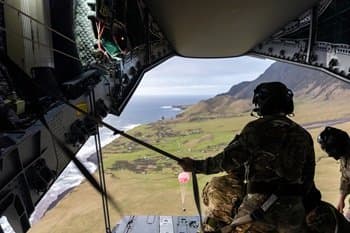
In an unprecedented operation, the RAF conducted a daring airdrop to deliver critical medical supplies to the remote Tristan da Cunha island during a hantavirus outbreak, showcasing remarkable logistics and human resilience.
The world's most remote inhabited island recently witnessed an extraordinary event as RAF aircraft performed a daring airdrop operation to deliver medical supplies to Tristan da Cunha during a hantavirus crisis. This unprecedented mission, conducted on May 9, 2026, demonstrated remarkable logistical capabilities and international cooperation in the face of extreme isolation.
The Remote Challenge
Tristan da Cunha, located 1,510 miles from the nearest airport on St Helena and 2,010 miles from the nearest British military air base at Ascension Island, presents one of the most challenging environments for emergency response. With no airstrip and notoriously unpredictable weather, the island has remained largely untouched by fixed-wing aircraft throughout its history.
The crisis began when the cruise ship MV Hondius visited Tristan in mid-April, landing visitors who subsequently spread hantavirus to the island. One islander fell ill with suspected hantavirus and was isolated in the island's small hospital. However, the facility quickly became overwhelmed, with medical oxygen and other supplies rapidly depleting, creating a potentially life-threatening situation.
Operation Planning
The Ministry of Defense faced a complex challenge: how to deliver personnel and critical medical supplies to an island without an airstrip. The solution required an intricate operation involving multiple stages of planning and execution.
The RAF selected the Airbus A400M transport plane as the primary aircraft, chosen for its range and cargo capacity. To extend its operational range, the A400M would rendezvous with a Voyager air-to-air refueling (AAR) tanker. The medical supplies, personnel, and their equipment were first assembled at RAF Brize Norton before being transported to Ascension Island for the final leg of the journey.
The Ministry of Defence coordinated closely with the Foreign, Commonwealth & Development Office (FCDO) and UK Health Security Agency (UKHSA) to ensure the operation addressed both immediate medical needs and potential future scenarios.
The Daring Airdrop
Early on Saturday, May 9th, favorable conditions allowed the operation to proceed. Administrator Philip Kendall issued a public notice to islanders, announcing the arrival time and suggesting they bring cameras to witness the unprecedented event.
The A400M (Flight RRR4989) took off from Ascension just before midday, heading directly toward Tristan. The plane conducted an in-flight refueling operation halfway through its journey, with the Voyager AAR tanker providing the necessary extension to the aircraft's range.
"The A400M's flight path presented unique challenges," explained one RAF official. "Tristan's location in the South Atlantic means any operation requires precise navigation and accounting for wind patterns that can change rapidly."
Upon arrival, the aircraft conducted several passes over the settlement, dropping paratroopers and cargo at carefully selected locations. The first group of paratroopers landed near the Back Fence, while the second group, including medical personnel, landed on the island's 9-hole golf course using tandem parachutes.
The cargo drops were particularly impressive, with the A400M flying at just 175 feet above ground level and 162 knots while releasing 3.3 tonnes of palletized medical supplies. View the operation details on the Ministry of Defence website.
Community Response
The islanders reacted with a mixture of gratitude and awe at the unprecedented sight of aircraft flying low overhead and parachutes descending onto their isolated community.
"This was an amazing combined effort from the UK armed forces, the FCDO, MoD, UKHSA and our strong Tristan community," said Administrator Philip Kendall. "Thank you everyone! A truly historic day."
For Tristanians, the operation represented more than just medical assistance—it symbolized their connection to the United Kingdom and the knowledge that they are not forgotten despite their extreme isolation. The sight of fixed-wing aircraft and parachutes was particularly remarkable, as such events had never occurred in the island's history.
The military team received the warm Tristan welcome, being accommodated in guest houses and treated to traditional island hospitality. The doctor and ICU nurse quickly integrated with the hospital staff, providing much-needed relief for the overworked medical team.
Technical Challenges and Solutions
The operation presented numerous technical challenges that required innovative solutions:
Range Limitations: The extreme distance from the nearest air base required in-flight refueling, with the Voyager tanker extending the A400M's operational range.
Wind Conditions: Tristan's notoriously unpredictable winds made parachute landings particularly challenging. Paratroopers had to account for drift, jumping from 3 miles out over the sea at 7,000 feet to compensate.
Precision Delivery: The low-altitude cargo drops required exceptional pilot skill to avoid obstacles while maintaining the precise trajectory needed for successful pallet deployment.
Timing Constraints: The operation had to be completed before darkness fell, as winter conditions in Tristan meant limited daylight hours.
Broader Implications
This operation demonstrates several important developments in emergency response for remote communities:
Enhanced Capabilities: The RAF's ability to conduct such complex operations highlights advances in military logistics and precision airdrop technologies.
International Cooperation: The seamless coordination between multiple UK government agencies sets a precedent for future humanitarian missions.
Remote Healthcare: The success of this mission may influence approaches to medical emergencies in other isolated communities worldwide.
At the time of reporting, the suspected hantavirus patient remained stable, with the medical team continuing to provide both treatment and relief for the island's healthcare staff. The military personnel will remain on Tristan until their mission is complete, departing by ship when their work is finished.
As Tristan policeman Barry Thacker poetically expressed in his poem dedicated to the operation: "No island stands alone no matter where you are." This daring airdrop not only saved a life but reinforced the bonds between Tristan da Cunha and the United Kingdom, demonstrating that even the most remote communities can count on support when needed most.
Comments
Please log in or register to join the discussion