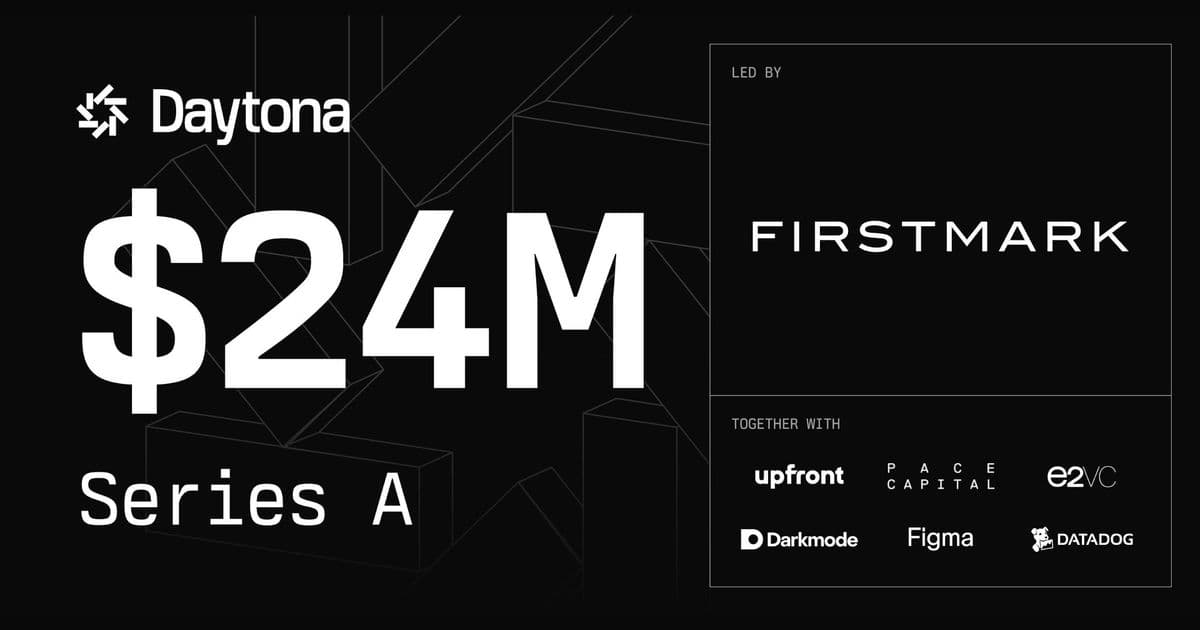
Croatian-founded Daytona has secured $24 million in Series A funding led by FirstMark to develop infrastructure specifically designed for large-scale, stateful agent workloads.
Croatian-founded Daytona has raised $24 million in Series A funding led by FirstMark to build infrastructure for large-scale agent workloads. The company is developing agent-native infrastructure designed to support large-scale, stateful agent workloads through fast, flexible computing environments optimized for long-running execution.
The funding round comes as the AI agent ecosystem continues to mature, with increasing demand for specialized infrastructure that can handle the unique requirements of autonomous software agents. Daytona's approach focuses on creating computing environments specifically tailored for agents that need to maintain state, execute complex workflows, and operate at scale.
The Agent Infrastructure Challenge
As AI agents become more sophisticated and widely deployed, traditional infrastructure often falls short in addressing their specific needs. Agents require persistent state management, reliable execution environments, and the ability to handle long-running processes that may span hours or days. Current cloud infrastructure, while powerful, wasn't designed with these agent-specific requirements in mind.
Daytona aims to fill this gap by providing infrastructure that understands and optimizes for agent workloads. This includes features like automatic state persistence, intelligent resource allocation for long-running tasks, and environments that can seamlessly handle the complex interactions and dependencies that agents typically manage.
Market Context and Competition
The timing of Daytona's funding aligns with broader trends in the AI infrastructure space. As companies like OpenAI, Anthropic, and others push the boundaries of what AI agents can accomplish, the underlying infrastructure needs to evolve accordingly. The market is seeing increased investment in specialized AI infrastructure, from chip design to cloud platforms to agent-specific tools.
However, Daytona faces competition from both established cloud providers and emerging startups. Major cloud platforms like AWS, Google Cloud, and Azure are all investing heavily in AI capabilities, while specialized infrastructure companies are emerging to address specific niches within the AI ecosystem.
Technical Approach
While specific technical details remain limited, Daytona's focus on "fast, flexible computing environments" suggests an emphasis on performance and adaptability. The company appears to be targeting the challenge of balancing the need for persistent state with the flexibility required for dynamic agent workloads.
This approach could involve innovations in container orchestration, state management systems, or novel approaches to resource allocation that better suit agent workloads than traditional virtual machines or container setups.
Implications for the AI Ecosystem
The success of Daytona's approach could have significant implications for how AI agents are deployed and managed at scale. If the company can deliver on its promise of specialized infrastructure, it could accelerate the development and deployment of more sophisticated AI agents across industries.
This investment also signals continued confidence in the AI agent market, despite broader economic uncertainties. FirstMark's leadership of the round suggests strong belief in the long-term potential of agent-specific infrastructure.
Looking Ahead
With $24 million in fresh funding, Daytona will likely focus on product development and market expansion. The company will need to demonstrate clear advantages over existing infrastructure solutions while building a sustainable business model around its specialized offering.
The broader question remains whether the market needs dedicated agent infrastructure or if existing cloud platforms will eventually incorporate sufficient agent-specific features to meet demand. Daytona's success will depend on its ability to prove that specialized infrastructure provides significant enough advantages to justify its existence as a separate category.
As AI agents continue to evolve from experimental tools to production-ready systems, the infrastructure supporting them will play a crucial role in determining their ultimate impact and adoption. Daytona's approach represents one vision for how this infrastructure should be built, and its success or failure could influence the direction of the entire agent ecosystem.
For developers and organizations working with AI agents, Daytona's emergence highlights the growing maturity of the agent infrastructure landscape and the increasing specialization occurring within the broader AI ecosystem.
Comments
Please log in or register to join the discussion