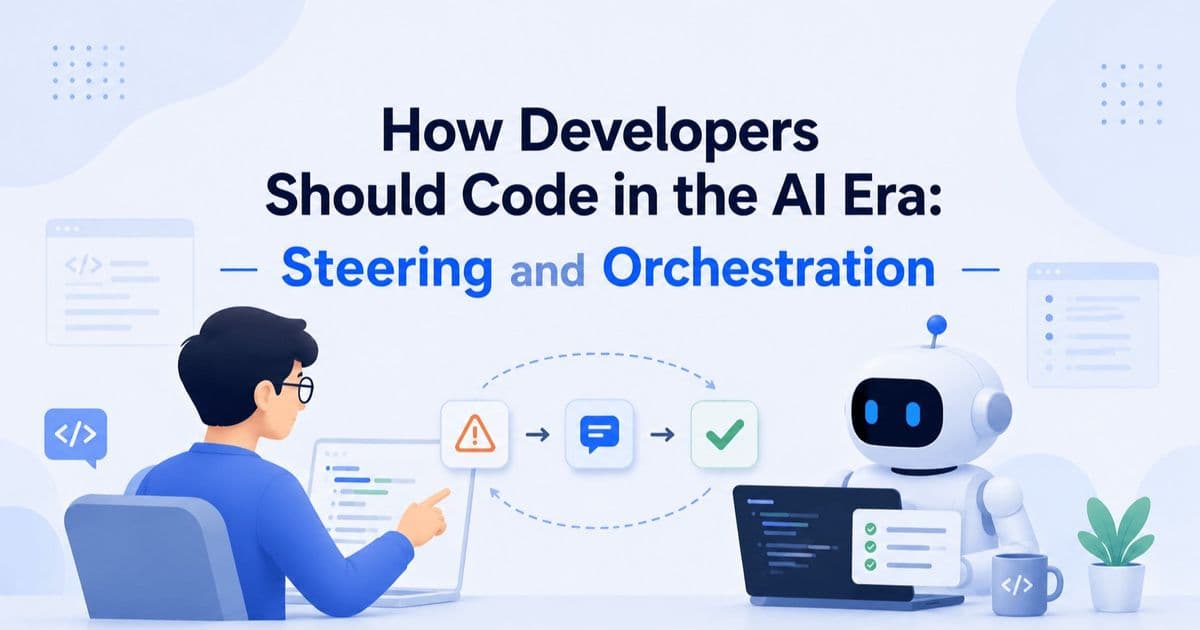
Xi Yang argues that the rise of LLM‑driven code generation will replace the traditional “write‑code” role with two new functions – steering AI output and orchestrating multi‑agent workflows – and that this shift will render classic IDEs obsolete.
Developers Are Entering the Era of Steering and Orchestration
By Xi Yang – May 25, 2026
The problem developers are facing today
The software industry is saturated with conflicting messages. Some managers demand that AI write the majority of code, while others insist developers must still type everything by hand and only use AI for unit tests. At the same time, headlines proclaim that programmers are becoming obsolete, that test‑driven development will solve all stability issues, or that AI‑generated code passes every test but crashes in production. All of these claims contain a grain of truth, but they also miss the bigger picture.
Two pieces of bad news set the stage:
- The traditional integrated development environment (IDE) business is on a steep decline. Companies like JetBrains and the makers of Cursor are losing relevance, and even GitHub Copilot is unlikely to survive in its current form.
- The current wave of AI‑assisted coding is built on large language models (LLMs), not on artificial general intelligence. An LLM predicts the next token; it does not reason about system architecture or abstract concepts.
Why LLM‑based coding hits a ceiling
Four failure modes appear when developers rely on an LLM to generate code without oversight:
- Architectural drift – Over time the model can steer the design away from the original intent, producing a structure that is hard to understand.
- Software entropy – Even a modestly complex module can become a tangled mess of duplicated logic and poorly named variables.
- Context dilemma – As the amount of code that the model must consider grows, its performance degrades. Summarizing or chunking the context helps, but each extra step consumes more compute and tokens.
- Token abuse – Every request to the model costs money. Poorly written output forces developers to spend additional tokens fixing logic, inflating the total cost of a project.
These issues are not theoretical; they show up in real‑world deployments where AI‑generated services crash after a few weeks of production use.
What developers will actually do in the AI era
The author proposes two new roles that will replace the classic “code writer” job description:
1. Steering
Steering means reviewing AI output, correcting mistakes, and feeding back guidance so the model learns the desired patterns. The developer’s day will be filled with:
- Spot‑checking generated code for architectural consistency.
- Adding or refining unit tests that surface hidden bugs.
- Enforcing coding standards, design patterns, and refactoring recommendations.
- Updating prompt libraries that encode the team’s best practices.
The goal is not to produce prettier code for its own sake, but to keep the codebase maintainable, reliable, and cheap to run.
2. Orchestration
A single LLM cannot handle the entire software lifecycle because of the context problem. Instead, a pipeline of specialized agents will take on distinct tasks:
- Solution architect agent – drafts high‑level designs based on human‑provided requirements.
- Developer agents – generate implementation fragments.
- Test‑architect agent – creates test suites and evaluates coverage.
- Tester agents – run the tests, report failures, and suggest fixes.
Human analysts remain essential for gathering and clarifying requirements. A small misunderstanding at that stage can cascade into costly architectural drift later on.
The end of the traditional IDE
If most code is produced by an LLM, features such as autocomplete, syntax highlighting, and on‑the‑fly compilation lose their purpose. Future development tools will likely be lightweight launchers that display AI‑generated snippets, allow quick edits, and provide a dashboard for monitoring token usage and test results. Open‑source projects can replicate these minimal interfaces at low cost, making a high‑margin IDE market unsustainable.
Implications for the industry
- Tool vendors need to pivot toward platforms that support multi‑agent orchestration, token budgeting, and prompt management rather than classic editor features.
- Teams should start training developers in prompt engineering, model evaluation, and cost monitoring now, before the transition becomes mandatory.
- Investors may look for startups that build “harness engineering” platforms – services that let companies assemble, tune, and run AI‑centric development pipelines.
Getting started
- Identify a pilot project where you can replace manual coding with an LLM and measure token consumption.
- Build a simple feedback loop: generate code, run automated tests, and feed failures back into the prompt.
- Track architectural drift by comparing generated designs against a baseline diagram.
- Gradually introduce additional agents (e.g., a test‑generation agent) and monitor how the overall token budget changes.
Conclusion
LLMs will not become true programmers overnight, but they will soon take over the bulk of code creation. Developers who adapt by mastering steering and orchestration will remain valuable, while those who cling to the old “type‑and‑debug” workflow risk obsolescence. The shift is already underway; the sooner teams restructure their processes, the smoother the transition will be.
Follow Xi Yang on Twitter for more insights into AI‑driven software development.
Comments
Please log in or register to join the discussion