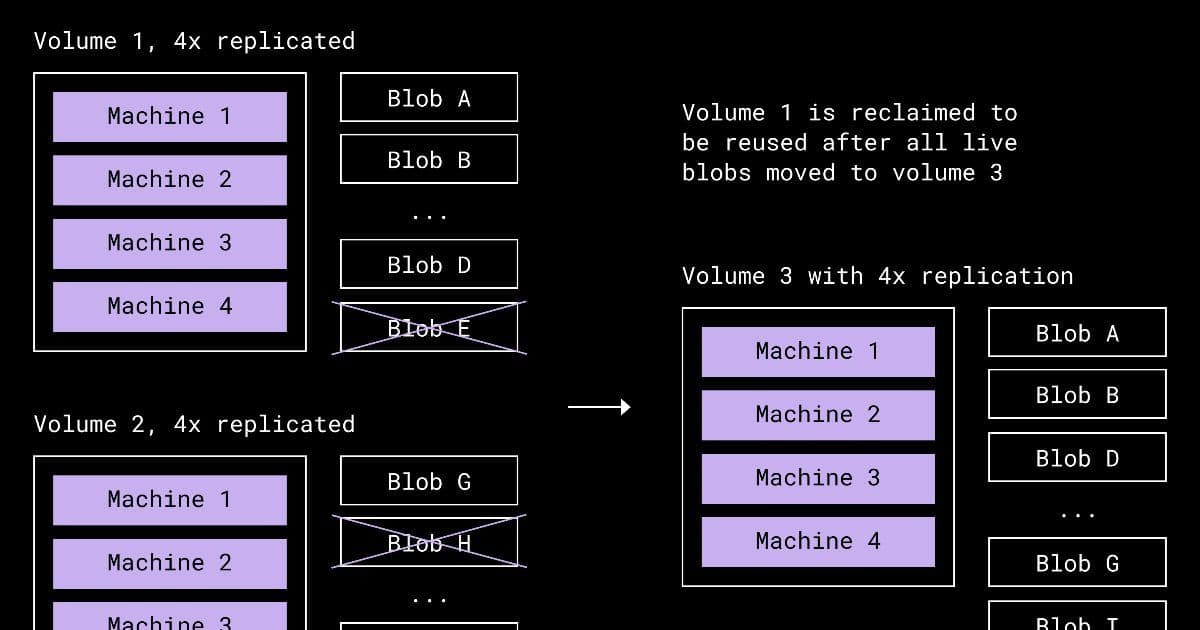
Dropbox has redesigned its compaction system for Magic Pocket, the company's internal immutable blob store, to efficiently reclaim space from underfilled storage volumes. The new L2 and L3 compaction strategies address data fragmentation issues that emerged after a recent service change, significantly improving storage efficiency at scale.
In the ever-evolving landscape of distributed storage systems, efficient space management remains a critical challenge for organizations handling massive amounts of data. Dropbox recently shared insights into how they tackled this problem by redesigning their compaction strategies for Magic Pocket, the company's proprietary exabyte-scale blob storage system. These improvements address an unexpected increase in data fragmentation that followed changes to their data distribution model, demonstrating how even well-designed systems require continuous optimization as they scale and evolve.
Understanding the Challenge: Immutable Storage and Fragmentation
Magic Pocket serves as Dropbox's internal object store, replacing Amazon S3 while maintaining 99.99% availability and extremely high durability. The system stores files as small objects across different servers, treating all data as immutable. While this design enhances reliability by preventing accidental modifications, it creates a fundamental challenge: when files are updated or deleted, the old data cannot be immediately removed from disk.
As Facundo Agriel, staff software engineer at Dropbox, explains: "Because data is immutable, deletes do not immediately free up disk space. Old data stays on-disk inside storage volumes. Once a volume is closed, it is never reopened. The tradeoff is that deletes leave unused space behind, and that waste grows over time unless we actively reclaim it."
This immutability leads to gradual fragmentation as storage volumes become partially filled with obsolete data. Without effective reclamation, live data gets spread across more disks than necessary, increasing storage overhead and potentially impacting system performance.
The Catalyst: Unintended Consequences of System Changes
Last year, Dropbox introduced a new service that changed how data is distributed across Magic Pocket. This change successfully reduced write amplification for background writes, but came with an unintended consequence: increased data fragmentation. The problem became particularly acute earlier this year when Dropbox discovered that their new "Live Coder" service was creating severely underfilled storage volumes, sometimes utilizing less than 5% of their capacity.
This inefficiency spread data across many nearly empty volumes, exacerbating fragmentation and storage overhead while exposing limitations in the existing compaction system. The original compaction strategy worked well when most storage volumes were nearly full but became inefficient when dealing with numerous severely underfilled volumes.
The Solution: Tiered Compaction Strategies
To address these challenges, Dropbox redesigned their compaction system with two new strategies: L2 and L3. These approaches complement their existing compaction method, creating a tiered system optimized for different levels of volume utilization.
L2 Compaction: Efficient Volume Consolidation
The L2 strategy focuses on reclaiming space more quickly when many storage volumes are moderately underfilled. Instead of slowly topping off already dense volumes as in the previous approach, L2 combines multiple sparse volumes into a single, nearly full one. This consolidation allows the system to reclaim space faster by reducing the number of partially filled volumes.
As Agriel describes: "Compaction performs the physical reclamation. Because volumes cannot be modified once closed, we gather the live blobs from volumes, write them into new volumes, and retire the old ones. This is how deletes eventually translate into reusable space."
L3 Compaction: Handling Extreme Sparsity
For extremely underfilled storage volumes that earlier methods couldn't reclaim efficiently, Dropbox introduced the L3 strategy. This approach streams remaining live data from these sparse volumes through the Live Coder service and gradually rewrites it into new erasure-coded volumes. Erasure coding protects data from hardware failures by splitting it into fragments with parity pieces that allow reconstruction if parts are lost.
The L3 strategy is particularly valuable for handling volumes with minimal live data, where the overhead of traditional compaction would outweigh the benefits of space reclamation.
Technical Implementation and Considerations
The redesigned compaction system represents a sophisticated approach to managing distributed storage at scale. Several technical considerations shaped the implementation:
Resource Management: The new system carefully manages cleanup work to avoid straining system resources, particularly when dealing with large volumes of underfilled storage.
Priority-Based Processing: The updated approach prioritizes the most inefficient volumes, focusing reclamation efforts where they'll have the greatest impact.
Integration with Existing Systems: The new compaction strategies integrate seamlessly with Dropbox's existing erasure coding mechanisms, ensuring data durability isn't compromised during the reclamation process.
Operational Considerations: The system accounts for the slow and uneven operation of large-scale distributed systems, where the effects of infrastructure changes can be difficult to detect immediately.
Broader Implications for Distributed Storage Systems
Dropbox's experience offers valuable insights for organizations managing large-scale distributed storage systems:
The Immutability Tradeoff: While immutable storage designs improve reliability and simplify certain operations, they create ongoing challenges for space management that require dedicated solutions.
Evolving System Requirements: As services and usage patterns change, storage systems must adapt. What works well initially may become inefficient as the system evolves.
Tiered Optimization: Different data access patterns and utilization levels may require different optimization strategies, suggesting the value of tiered approaches to compaction and space reclamation.
Operational Realism: Even in large organizations with extensive resources, infrastructure changes can have unintended consequences, highlighting the importance of monitoring and adaptation.
User Impact and Industry Perspective
While the technical improvements primarily benefit Dropbox's internal operations, they have indirect positive impacts for users through potentially reduced costs and improved system reliability. More efficient storage utilization can translate to better resource allocation and potentially more competitive service offerings.
In a Hacker News thread discussing these changes, some users questioned the product's usability ("such fantastic engineering work is buried behind a product with so many annoyances") and pricing, while others expressed surprise at the "unintended consequence" scenario in a large corporation.
User nopurpose commented: "Me thinking big corps with huge infrastructure bills meticulously model changes like that using the production data they have (...) Turned out they are like me: deploy and see what breaks."
Agriel responded in the thread, noting that large-scale systems operate slowly and unevenly, making the effects of infrastructure changes difficult to detect. This exchange highlights an important reality: even sophisticated organizations must contend with the complexity of distributed systems, and optimization is an ongoing process rather than a one-time achievement.
Looking Forward: The Future of Distributed Storage
As data volumes continue to grow and access patterns evolve, storage systems will need increasingly sophisticated approaches to efficiency and performance. Dropbox's work on Magic Pocket demonstrates the value of continuous innovation in this space, particularly in balancing competing requirements like durability, availability, and cost efficiency.
For organizations developing their own distributed storage systems, the key takeaways include:
- Plan for space reclamation from the beginning, especially when using immutable storage designs
- Design flexible systems that can adapt to changing usage patterns
- Implement monitoring that can detect inefficiencies before they become critical problems
- Consider tiered approaches that can handle different utilization scenarios
As Agriel presented at QCon Plus 2023, Magic Pocket represents a significant achievement in distributed storage design. The ongoing improvements to its compaction strategies further demonstrate Dropbox's commitment to maintaining a robust, efficient infrastructure that can handle the company's current and future needs.
For more technical details about Magic Pocket and Dropbox's storage architecture, you can explore the original blog post and watch Agriel's QCon Plus 2023 presentation. These resources provide deeper insights into the engineering challenges and solutions that power one of the world's largest storage systems.
This article highlights how even mature, sophisticated storage systems require continuous optimization to maintain efficiency as they scale and evolve. Dropbox's experience with Magic Pocket offers valuable lessons for any organization managing large-scale distributed data, demonstrating the importance of balancing technical excellence with practical operational realities.
Comments
Please log in or register to join the discussion