EmuDevz transforms the complex art of emulator development into an interactive, gamified learning experience, guiding users through implementing a 6502-based NES emulator with a full suite of debugging tools and a retro-synthwave aesthetic.
The process of building an emulator—translating hardware behavior into software—is a rite of passage for many low-level programmers, but it's notoriously difficult to learn. Traditional tutorials are static, often leaving learners to wrestle with abstract concepts in isolation. EmuDevz, a project available on GitHub and Steam, reimagines this journey as a structured, interactive game. It provides a guided, hands-on environment where the learner implements a Nintendo Entertainment System (NES) emulator piece by piece, turning a daunting theoretical challenge into a series of achievable, testable tasks.
The core of EmuDevz is its "NEEES" (Nintendo Entertainment System Emulator) emulation guide, which breaks down the monumental task of building a complete system into modular components. The game doesn't force a specific order, allowing learners to tackle the CPU, PPU (Picture Processing Unit), or APU (Audio Processing Unit) independently. This flexibility is pedagogically sound, as it lets users focus on one complex subsystem at a time. For instance, the 6502 Assembly tutorial provides the foundational knowledge needed to understand the CPU's instruction set, which is the first step in accurately simulating its behavior. The project is built with Node.js and Electron, making it accessible across Windows, macOS, and Linux, though the Steam release notes document several platform-specific quirks, such as overlay compatibility issues and sandboxing challenges on Linux.
What distinguishes EmuDevz from a simple tutorial is its integrated development environment (IDE) and powerful debugging suite. The game provides a Unix-style shell and a code editor, creating a self-contained workspace. More importantly, it offers a debugger with granular visibility into the emulator's state. Users can inspect the memory viewer, trace the instruction log, visualize name tables and sprites, and even monitor individual APU channels. This immediate feedback loop is crucial for learning; when an implemented CPU instruction fails, the debugger makes the problem visible, allowing for iterative correction. The inclusion of unit tests, video tests, and audio tests further reinforces this cycle of implementation and validation, ensuring that each component works correctly before moving on.
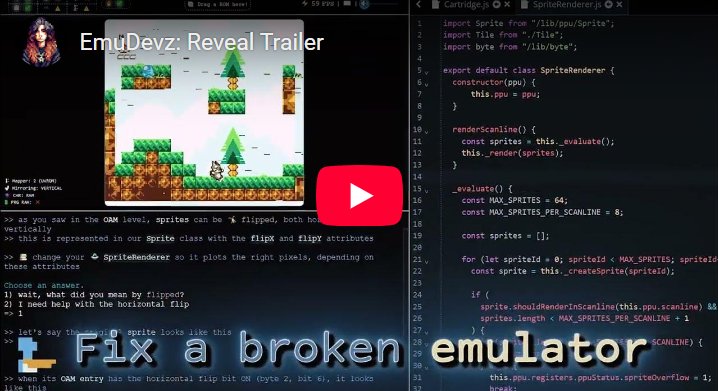
Beyond the technical implementation, EmuDevz is designed as a complete game experience. Players unlock ROMs by playing homebrew games, which serves as both a reward and a practical test of their emulator's functionality. The project features an original retro-synthwave soundtrack, a fully localized interface (English and Spanish), and an in-game dictionary to demystify technical jargon. This holistic approach lowers the barrier to entry, making a niche subject feel approachable and engaging. The "Free Mode" is a particularly clever feature, allowing users to leverage the built-in IDE to develop emulators for systems beyond the NES, effectively turning the learning tool into a general-purpose development environment once the core concepts are mastered.
The project's architecture reflects a thoughtful approach to persistence and portability. Save files are stored as .devz files, which can be imported and exported, and the game uses platform-appropriate storage locations (e.g., IndexedDB for the web version, AppData on Windows). For developers, the repository includes scripts for packaging, building, and deploying to GitHub Pages, alongside a license generation script. This transparency not only allows others to learn from the codebase but also invites community contributions to resolve the documented known issues, such as the Electron version constraints on Arch Linux or the fullscreen mode workaround on Windows 11.
In essence, EmuDevz bridges the gap between theoretical knowledge and practical application. It acknowledges that emulator development is as much about debugging and understanding system interplay as it is about writing code. By providing a sandboxed, guided, and visually engaging environment, it transforms a solitary, often frustrating endeavor into a collaborative and rewarding game. For anyone curious about how consoles work at the hardware level, or for developers seeking to deepen their understanding of low-level systems, EmuDevz offers a unique and substantive path forward.
Comments
Please log in or register to join the discussion