A Basemark In Vitro benchmark leak reveals Samsung's Exynos 2600 GPU outperforming Qualcomm's Adreno 840 by approximately 10%, though historical testing biases suggest real-world differences may be smaller.
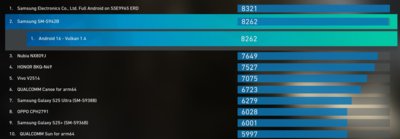
New benchmark results for Samsung's upcoming Exynos 2600 processor indicate its Xclipse 960 GPU holds a modest performance advantage over Qualcomm's competing Snapdragon 8 Elite Gen 5. The data comes from Basemark's In Vitro ray tracing benchmark, where a Galaxy S26 unit (model SM-S942B) scored 8,262 points. This production device slightly trails an Exynos 2600 engineering sample but outperforms all other listed devices, including Qualcomm's flagship chipset.
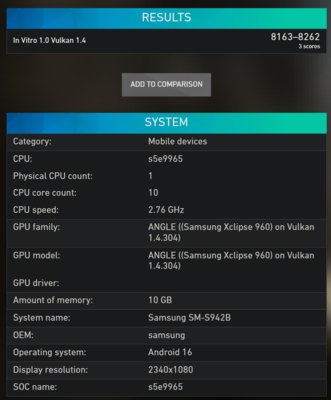
The benchmark listing confirms the Galaxy S26 utilizes Samsung's S5E9965 development board paired with the Xclipse 960 GPU architecture. While specifications weren't disclosed in this leak, previous Geekbench submissions indicate the GPU configuration includes 4 Work Group Processors (WGPs) with 8 Compute Units. This places it in direct competition with Qualcomm's Adreno 840 GPU found in the Snapdragon 8 Elite Gen 5.
Performance analysis shows the Exynos solution achieving approximately 10% higher scores in this specific benchmark. However, this margin requires context: Basemark's testing suite has consistently shown favorable results for Samsung's GPU architectures compared to other benchmarking tools. Real-world gaming performance differences between the two platforms will likely be narrower than this synthetic test suggests.
Architectural details about the Xclipse 960 remain uncertain, with conflicting reports about its origins. Some sources claim Samsung developed the GPU entirely in-house, while others suggest it incorporates AMD's unreleased RDNA 4 intellectual property. This ambiguity makes performance projections challenging until third-party testing becomes available.
The GPU performance becomes particularly significant given earlier CPU benchmarks showing near-parity between the Exynos 2600 and Snapdragon 8 Elite Gen 5. If Samsung maintains this GPU advantage in actual usage scenarios, it would mark a notable improvement over recent Exynos generations that consistently trailed Qualcomm and MediaTek equivalents in graphics performance.
For potential Galaxy S26 buyers, these results suggest regional variations in performance might be less pronounced than in previous years. Samsung typically uses Exynos chipsets in international models while reserving Snapdragon variants for North America and China. The narrowing performance gap could reduce the perceived disadvantage of Exynos-powered devices, though thermal management and sustained performance under load remain critical unanswered questions.
Technical analysts will monitor whether Samsung's claimed ray tracing advantages materialize in actual games, as Basemark In Vitro specifically tests this emerging capability. Both manufacturers are pushing mobile ray tracing technology, but developer adoption and optimization will ultimately determine its practical impact. As the Galaxy S26 launch approaches, more benchmarks should clarify whether this early performance lead holds across diverse workloads.
Comments
Please log in or register to join the discussion