Ian Erik Varatalu makes a compelling case for F#'s practical advantages in scripting and automation, highlighting its type safety, pipeline syntax, type providers, and performance characteristics that often surpass more popular scripting languages.
F# as a Scripting Powerhouse: Beyond the Hype
In the ever-evolving landscape of programming languages, F# has maintained a quiet but dedicated following, particularly for scripting and automation tasks. Ian Erik Varatalu's recent post offers a thoughtful exploration of why this functional-first language deserves more attention for practical, everyday programming needs. Far from being a trendy academic curiosity, F# provides concrete benefits that address real-world challenges faced by developers working on automation, data processing, and system maintenance.
The Type System as Safety Net
Most scripting languages trade type safety for flexibility, but Varatalu argues this trade-off often comes at the cost of runtime surprises. The core insight here is that scripting bugs rarely stem from the code itself but from the changing environment—data formats evolve, protocols shift, dependencies update. With F#'s strong type system, a script written years ago can be revisited with confidence: either it works immediately, or within minutes you'll know exactly which component needs updating.
This type safety provides immediate feedback through editor red squiggles rather than silent failures or corrupted data output—a particularly valuable feature in the era of LLM-assisted coding, where these errors serve as important reality checks for AI-generated code. The type system acts as an automated contract between your code and the external world, catching mismatches before they cause operational issues.
Pipeline Syntax: Predictable Data Flow
The pipeline operator (|>) represents one of F#'s most distinctive features and a significant cognitive advantage in scripting. Unlike languages where data flow can appear chaotic—moving left, right, top, bottom, or even through nested functions in unpredictable ways—F# pipelines enforce a simple, left-to-right, top-to-bottom data flow. Each |> operator essentially asks: "What do I have now? What do I want next?"
Varatalu contrasts this with a complex Python example where data flow becomes a puzzle to decipher. In F#, by the time you reach the next pipeline operator, you can completely forget the previous line of code. This predictability dramatically reduces cognitive load, making scripts easier to write, read, and debug. The pipeline style has influenced many languages since F# popularized it in the early 2000s, including OCaml, Elixir, Julia, R, and Elm, demonstrating its fundamental appeal.
Type Providers: Seamless Data Integration
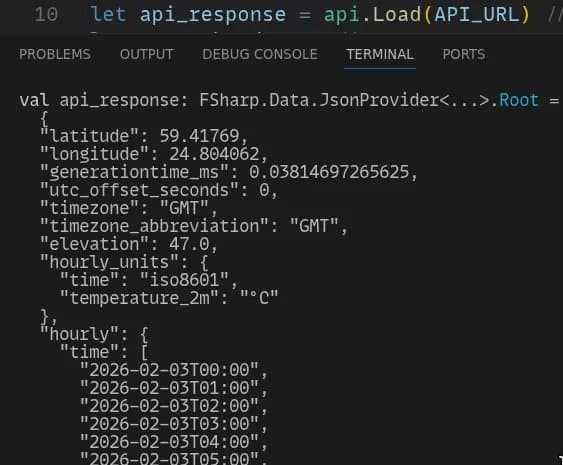
One of F#'s killer features for scripting is the type provider system. As demonstrated in the weather forecast example, type providers generate types automatically from various data sources—JSON APIs, CSV files, XML documents, Excel spreadsheets, and even database connections. The JsonProvider in the example queries the API once in the background and generates types that match the response structure, providing autocompletion and type safety without requiring manual annotation.
This creates a self-contained scripting experience where all dependencies and versions are embedded in the script itself. The script can be saved anywhere on any platform and run with dotnet fsi weather.fsx, producing consistent output across different environments. When the underlying data structure changes—say, when an API renames a temperature field—the editor immediately alerts you to the breaking change, preventing silent failures.
Performance Considerations
Contrary to common assumptions, F# is not an interpreted language. When running individual lines in F# Interactive (fsi), each line is compiled to machine code on the fly using the same optimizing JIT compiler as C#. Varatalu benchmarks F# at approximately 50% of native performance while requiring only 10% of the code— a compelling ratio for scripting tasks.
For CPU-bound tasks, F# significantly outperforms Python while maintaining readability and ease of use. While not matching raw C performance, F# provides a sweet spot between development velocity and execution speed. The main performance considerations typically involve string handling (UTF16 vs UTF8) and memory allocation patterns, which can be optimized when needed using Span and buffer reuse techniques common in high-performance .NET code.
Startup Time Solutions
One legitimate concern with .NET-based scripting is startup time. Cold starts can take a second or more, which is problematic for quick utility scripts. Fortunately, modern .NET offers several solutions:
- ReadyToRun compilation: Precompiles most framework and libraries ahead of time, reducing JIT overhead at runtime.
- NativeAOT: Compiles directly to native code, eliminating the JIT entirely. This approach has some limitations (reflection, dynamic code generation aren't supported) but provides startup times close to native binaries.
- fflat/fsnative: Compiles F# directly to native code without the .NET runtime. Varatalu, as the author of fflat, demonstrates how this can transform a script into a standalone binary with no .NET dependencies, though some libraries that rely reflection may produce compilation warnings.
The weather script example, when compiled with fflat, produces a 9MB native binary that works identically to the original script but with much faster startup and lower memory usage. With further optimization to avoid reflection, binary sizes can be reduced significantly.
Tooling and Ecosystem Maturity
Despite being a niche language, F# benefits from mature tooling that bridges the gap with mainstream languages. The F# ecosystem has focused on providing an experience comparable to C# and Java rather than the more academic tooling found in languages like Haskell or OCaml.
The combination of VS Code with Ionide provides excellent autocompletion, inline errors, and refactoring tools. The same language server (FsAutoComplete) works across multiple editors, including Vim, Emacs, and Helix. For heavier IDE needs, Rider offers comprehensive F# support. The command-line experience through dotnet fsi is seamless and included with the .NET SDK.
Ecosystem size is less of a concern for scripting tasks than one might expect. F# can leverage the vast .NET library ecosystem directly, accessing functionality for HTTP servers, authentication, image processing, database access, and more. For specialized needs not covered by existing libraries, the problem becomes a .NET ecosystem issue rather than an F# limitation.
Counter-perspectives and Limitations
No language is perfect, and Varatalu acknowledges several limitations of F# for scripting. The language remains niche, meaning community resources and examples are scarcer than for mainstream languages. While the .NET ecosystem is extensive, domains like machine learning still favor Python or Julia with their specialized libraries.
Startup time, despite solutions, remains higher than for traditional scripting languages like Python or Bash. NativeAOT compilation excludes certain .NET features that rely on reflection or dynamic code generation. The learning curve for functional concepts may present an initial hurdle for developers accustomed to imperative languages.
Conclusion: A Pragmatic Choice
Varatalu's analysis presents F# not as a revolutionary paradigm shift but as a practical tool that addresses specific pain points in scripting and automation. The combination of type safety, predictable syntax, seamless data integration, good performance, and mature tooling creates an environment where scripts are easier to write, more reliable, and more maintainable over time.
For developers who have grown frustrated with the runtime surprises of dynamic languages but aren't willing to sacrifice the rapid development cycle that scripting provides, F# offers a compelling middle ground. As the F# community Discord message quoted in the article suggests, "if you haven't tried F# yet, give it a shot for your next scripting task. You might be surprised how much you like it."
The future looks promising with projects like fflat pushing the boundaries of what's possible for F# scripting, potentially eliminating the startup time concerns while maintaining the language's expressive power and safety guarantees. For automation tasks where reliability and maintainability matter as much as quick development, F# deserves serious consideration regardless of its current niche status.
For more information about F# and type providers, visit the F# Software Foundation and FSharp.Data documentation. The fflat compiler mentioned in the article provides an interesting approach to native F# compilation.
Comments
Please log in or register to join the discussion