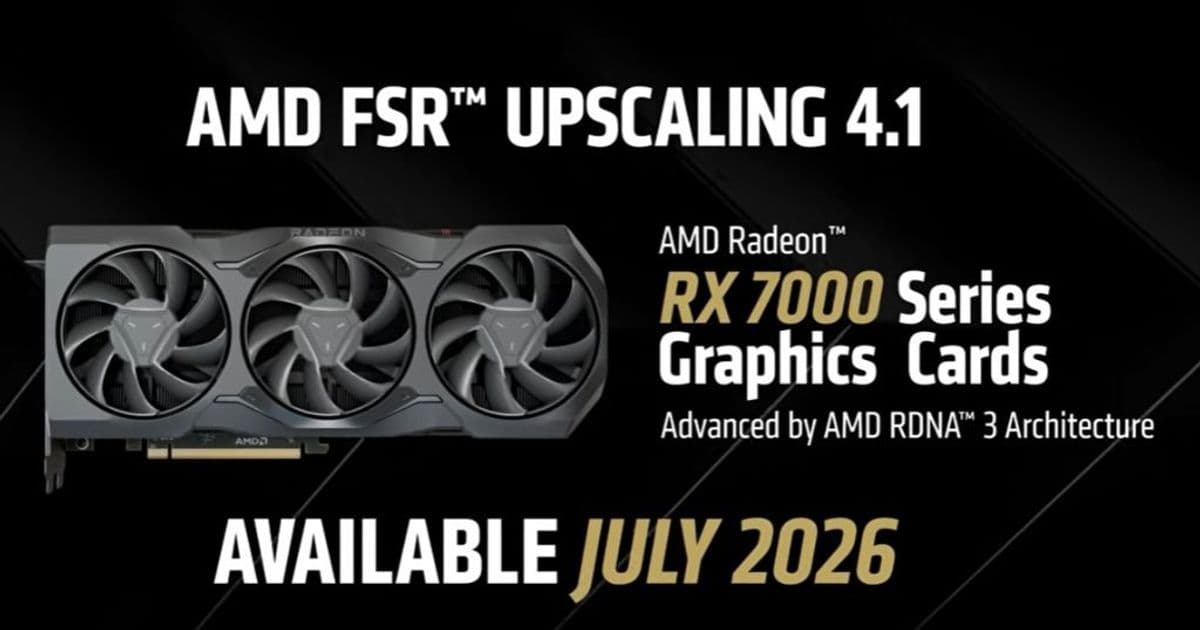
Following community backlash over limited support, AMD announces FSR 4.1 will be available for RDNA 3 (RX 7000 series) starting July 2026 and RDNA 2 (RX 6000 series) in early 2027, bringing the advanced upscaling technology to millions of existing AMD GPU owners.
AMD has reversed course and announced that its FSR 4.1 upscaling technology will be coming to RDNA 3 and RDNA 2 GPUs, following significant community backlash when the feature was initially limited to the latest RDNA 4 architecture. The decision extends access to AMD's latest upscaling solution to the millions of gamers who own RX 7000 and RX 6000 series graphics cards, addressing concerns about long-term support that emerged after a GitHub repository leak revealed the PS5 Pro was using FSR 4.1 INT8 with its RDNA 3-based hardware.
The community reaction was swift and intense when AMD initially limited FSR 4.1 to RDNA 4 GPUs. Many AMD GPU owners purchased their cards with the expectation of long-term software support, and the discovery that the PS5 Pro was using a version of FSR 4.1 with RDNA 3 while PC users were left in the dark created significant frustration. This sentiment was particularly strong among RX 7000 series owners, whose cards remain competitive in the market with better price points than both AMD's newer offerings and competing products.
AMD's Senior Vice President and General Manager of Computing and Graphics, Jack Huynh, directly addressed these concerns on X, announcing that FSR 4.1 would be coming to both RDNA 3 and RDNA 2 GPUs. "My team and I have been working hard to evolve AMD FSR 4 and bring it to more cards," Huynh stated. "This July, RDNA 3 players will experience FSR 4.1 upscaling, delivering sharper visuals and smoother gameplay than ever before. We tested across hundreds of PC configurations and in hundreds of games to ensure visuals are sharp and everything works out of the box."
For RDNA 2 users, Huynh added, "And for our RDNA 2 players, we have something exciting coming in early 2027. FSR 4.1 upscaling will be coming to your cards as well."
FSR 4.1 represents a significant advancement in upscaling technology, offering improved image quality and performance compared to previous versions. When it launched earlier this year, it was exclusive to RX 9000-series RDNA 4 GPUs, leaving many AMD Radeon users to seek alternatives. Those determined to use FSR 4.1 resorted to workarounds like OptiScaler, which unofficially injected the technology into games, though these solutions were often unreliable and inconsistent.
The official implementation of FSR 4.1 for older RDNA cards is expected to provide better performance and stability than third-party workarounds. AMD has emphasized extensive testing across hundreds of PC configurations and games to ensure a smooth experience out of the box.
For RX 7000 series owners, the wait will be relatively short, with FSR 4.1 support expected in July 2026. The company has indicated that RDNA 2 users will need to wait until early 2027 for their implementation. At launch on RDNA 3 GPUs, FSR 4.1 is expected to support over 300 games, demonstrating AMD's commitment to broad compatibility.
This expansion of FSR 4.1 support represents a significant win for AMD customers who were concerned about the company's commitment to long-term support. By bringing its latest upscaling technology to multiple generations of GPUs, AMD is addressing the concerns of its user base while maintaining its position in the competitive graphics market.
The announcement also highlights the importance of community feedback in shaping product roadmaps. The swift reversal of AMD's initial decision demonstrates how consumer pressure can influence corporate strategies, particularly in the competitive gaming hardware market where brand loyalty plays a significant role in purchasing decisions.
For gamers, this means access to AMD's latest upscaling technology without needing to upgrade to the latest hardware, preserving the value of existing investments while still benefiting from technological advancements.
Comments
Please log in or register to join the discussion