AMD has released ROCm 7.13, the latest tech preview version of its ROCm Core SDK, adding support for the Instinct MI350P accelerator card, expanded Ryzen AI APU support, and enhanced GPU virtualization capabilities.
AMD has announced the release of ROCm 7.13, the newest iteration in its ROCm Core SDK Preview series that's building toward what is expected to be ROCm 8.0 later in 2026. This release continues the tech preview cycle that began with ROCm 7.9 in October 2025, which introduced TheRock build system and marked a shift from the previous stable releases (ROCm 7.0-7.2).
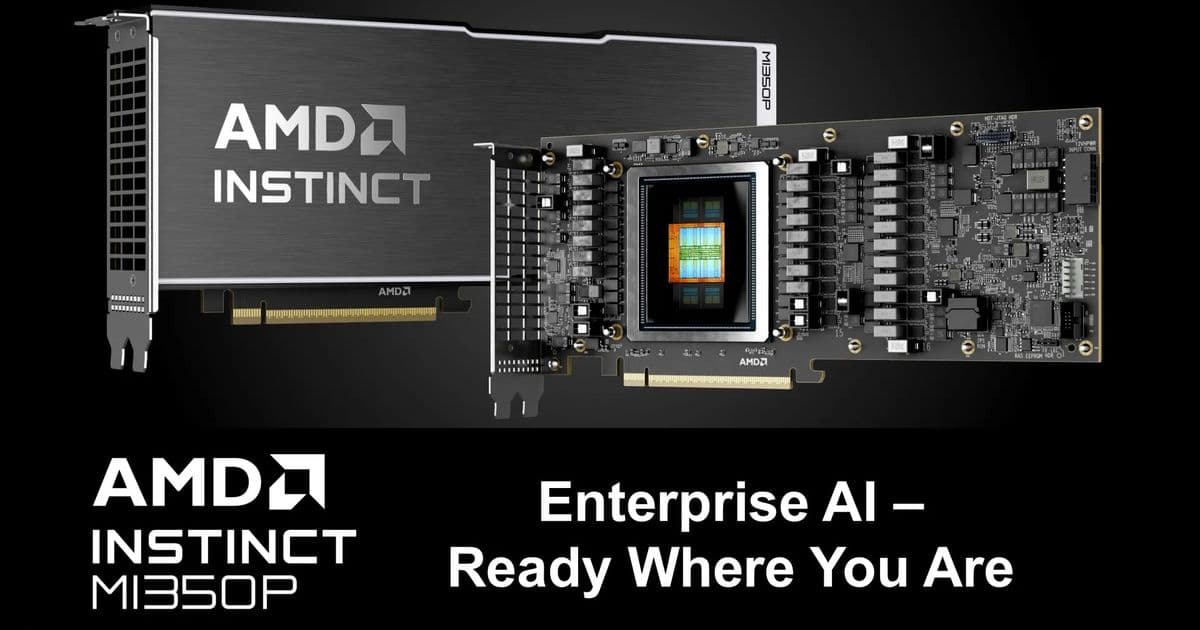
The most significant addition in ROCm 7.13 is official support for the recently announced Instinct MI350P PCIe add-in accelerator card, part of MI350 series. This represents AMD's latest high-performance computing accelerator, designed to compete in the data center and AI training markets where NVIDIA's CUDA ecosystem has traditionally dominated.
Beyond the flagship MI350P support, ROCm 7.13 expands hardware compatibility to include several Radeon PRO graphics cards:
- AMD Radeon PRO W6800 (gfx1030)
- AMD Radeon PRO V620 (gfx1030)
The release also significantly broadens support for AMD's Ryzen AI 300 series APUs, adding official ROCm support for:
- AMD Ryzen AI 7 PRO 360 (gfx1152)
- AMD Ryzen AI 7 PRO 350 (gfx1152)
- AMD Ryzen AI 5 PRO 340 (gfx1152)
- AMD Ryzen AI 7 350 (gfx1152)
- AMD Ryzen AI 7 345 (gfx1152)
- AMD Ryzen AI 5 340 (gfx1152)
- AMD Ryzen AI 5 330 (gfx1152)
This expanded APU support is particularly noteworthy as it enables more accessible AI development on consumer and prosumer hardware, potentially accelerating adoption of ROCm in developer communities.
On the software side, ROCm 7.13 adds support for Ubuntu 26.04 LTS while maintaining validated support for Ubuntu 24.04.4 LTS. This ensures compatibility with the latest long-term support Ubuntu release, addressing enterprise needs for stable, supported platforms.
The release also introduces several important technical improvements:
- Enhanced GPU virtualization support on Instinct GPUs, enabling more efficient multi-tenant environments
- Improved GPU partitioning capabilities, allowing for more flexible resource allocation
- New optimizations specifically for Ryzen AI Max 300 "Strix Halo" processors
- Open-sourcing of the ROCprof Trace Decoder, which should improve tooling and debugging capabilities for developers
For developers building from source, ROCm 7.13 Tech Preview is available via TheRock on GitHub, providing a pathway for those who want to stay on the cutting edge of AMD's GPU computing platform.
The timing of this release is significant as AMD continues to build momentum for its ROCm platform against NVIDIA's CUDA ecosystem. By expanding hardware support and improving virtualization capabilities, AMD is addressing key enterprise requirements while also making its platform more accessible to developers through expanded APU support.
The continued tech preview releases suggest AMD is iterating more rapidly on ROCm, likely in response to increased competition and the growing importance of GPU computing in AI, machine learning, and high-performance workloads.
This release, along with the recent Instinct MI350P launch, positions AMD as a serious contender in the data center accelerator market, with ROCm 7.13 providing the software foundation to leverage the latest hardware capabilities.
Comments
Please log in or register to join the discussion