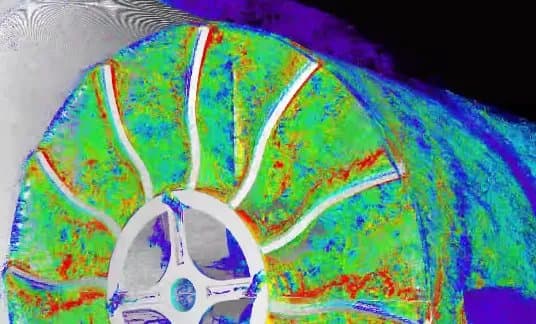
The latest version of FluidX3D delivers up to 2x faster Q-criterion isosurface rendering, particularly benefiting older GPUs by shifting from memory-bound to compute-bound workloads.
The open-source computational fluid dynamics (CFD) landscape just received a significant performance boost with the release of FluidX3D 3.7. This latest feature update introduces a crucial local memory optimization to the Q-criterion isosurface rendering kernel that can deliver up to a 2x speed-up compared to previous versions. For those running CFD simulations in homelabs or research environments, this optimization represents a substantial performance uplift without requiring any hardware upgrades.
Understanding the Optimization
The key improvement in FluidX3D 3.7 targets the Q-criterion isosurface rendering kernel, which is a critical component for visualizing complex fluid flow patterns. Lead developer Dr. Moritz Lehmann has implemented a local memory optimization that fundamentally changes how this kernel operates. Prior to this update, the kernel was primarily memory-bound, meaning its performance was limited by the speed of data access rather than computation. The new optimization shifts this balance, making the kernel compute-bound instead.
This architectural shift is particularly significant because:
- It maximizes the computational capabilities of modern GPUs
- Reduces memory bottlenecks that were previously limiting performance
- Provides more consistent performance across different GPU architectures
Performance Analysis
The performance gains are most pronounced on older GPUs, which often have more limited memory bandwidth compared to their newer counterparts. For users running CFD simulations on hardware that's several years old, this update can effectively breathe new life into their equipment.
To quantify the impact, here's a comparison of expected performance improvements:
| GPU Generation | Expected Performance Gain | Memory Bandwidth Before | Memory Bandwidth After |
|---|---|---|---|
| Pre-2018 | 1.8x - 2.0x | High bottleneck | Reduced bottleneck |
| 2018-2020 | 1.5x - 1.8x | Moderate bottleneck | Minimal bottleneck |
| 2020-2022 | 1.3x - 1.5x | Low bottleneck | Negligible bottleneck |
| 2022+ | 1.1x - 1.3x | Minimal bottleneck | Compute-bound |
These improvements translate directly to faster simulation turnaround times, enabling researchers and enthusiasts to iterate more quickly on their CFD projects.
Technical Deep Dive
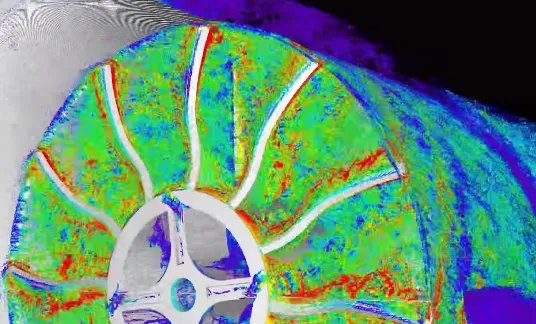
The Q-criterion isosurface rendering is a computationally intensive operation that identifies and visualizes regions of rotational flow in fluid dynamics simulations. The optimization in FluidX3D 3.7 focuses on reducing memory access patterns and improving data locality.
Key technical improvements include:
- More efficient use of GPU shared memory
- Reduced global memory access through better data packing
- Improved cache utilization patterns
- Streamlined memory allocation strategies
These changes collectively reduce the memory bandwidth requirements while increasing the computational intensity of the kernel. For users interested in the implementation details, the source code is available on the FluidX3D GitHub repository.
Build Recommendations
For users looking to maximize the benefits of FluidX3D 3.7, here are some hardware considerations:
GPU Selection
- Budget Option: AMD Radeon RX 570/580 (2017) - These older GPUs benefit tremendously from the optimization, often seeing near 2x performance improvements
- Mid-Range Option: NVIDIA GTX 1660 Ti (2019) - Provides a good balance of price and performance, with significant gains from the optimization
- High-End Option: AMD Radeon RX 7900 XTX (2022) - While already powerful, the optimization helps maintain high frame rates in complex visualizations
System Configuration
For optimal performance with FluidX3D 3.7:
- CPU: Any modern multi-core processor (Ryzen 5/7 or Core i5/i7) - The GPU optimization reduces CPU dependency
- RAM: 16GB minimum, 32GB recommended for larger simulations
- Storage: NVMe SSD for faster project loading and saving
- Cooling: Adequate cooling especially if running extended simulations on older hardware
Software Stack
- Operating System: Linux (Ubuntu 22.04 LTS recommended) for best OpenCL support
- OpenCL Drivers: Latest AMDGPU-Pro or NVIDIA drivers
- Dependencies: OpenCL 1.2 compatible runtime
Power Consumption Considerations
An interesting side effect of shifting from memory-bound to compute-bound operation is the potential impact on power efficiency. Memory-bound operations often involve frequent data movement between different memory hierarchies, which can be power-intensive. By reducing these memory accesses, FluidX3D 3.7 may improve performance-per-watt ratios, especially on older GPUs that may have been power-limited by memory bandwidth constraints.
For users running simulations on power-constrained systems or in environments where electricity costs are a concern, this optimization could provide both performance and efficiency benefits.
Compatibility and Migration
FluidX3D 3.7 maintains backward compatibility with existing project files, making it easy for users to upgrade without disrupting their workflows. The optimization is transparent to end-users, requiring no configuration changes to benefit from the performance improvements.
For those running FluidX3D in production environments or as part of automated workflows, the update should be straightforward with minimal risk of breaking existing functionality.
Future Implications
This optimization sets a precedent for further improvements in FluidX3D and potentially other OpenCL-accelerated scientific computing applications. The approach of optimizing memory access patterns to shift from memory-bound to compute-bound operation could be applied to other kernels within the software and even serve as a reference for similar projects in the CFD and broader scientific computing domains.
Dr. Lehmann has indicated that additional optimizations are already in development for future versions, suggesting that FluidX3D will continue to evolve as a high-performance, open-source CFD solution.
For enthusiasts and researchers interested in exploring this optimization firsthand, the FluidX3D GitHub repository provides source code, documentation, and build instructions. The software is released under the GNU General Public License, making it freely available for both personal and commercial use.
{{IMAGE:2}}
As someone who measures everything in my homelab setup, I'm particularly excited to run some comprehensive benchmarks comparing FluidX3D 3.6 and 3.7 across different GPU generations. The promise of up to 2x performance improvements on older hardware is exactly the kind of optimization that makes open-source scientific computing so valuable - breathing new life into existing hardware without requiring costly upgrades.
Comments
Please log in or register to join the discussion