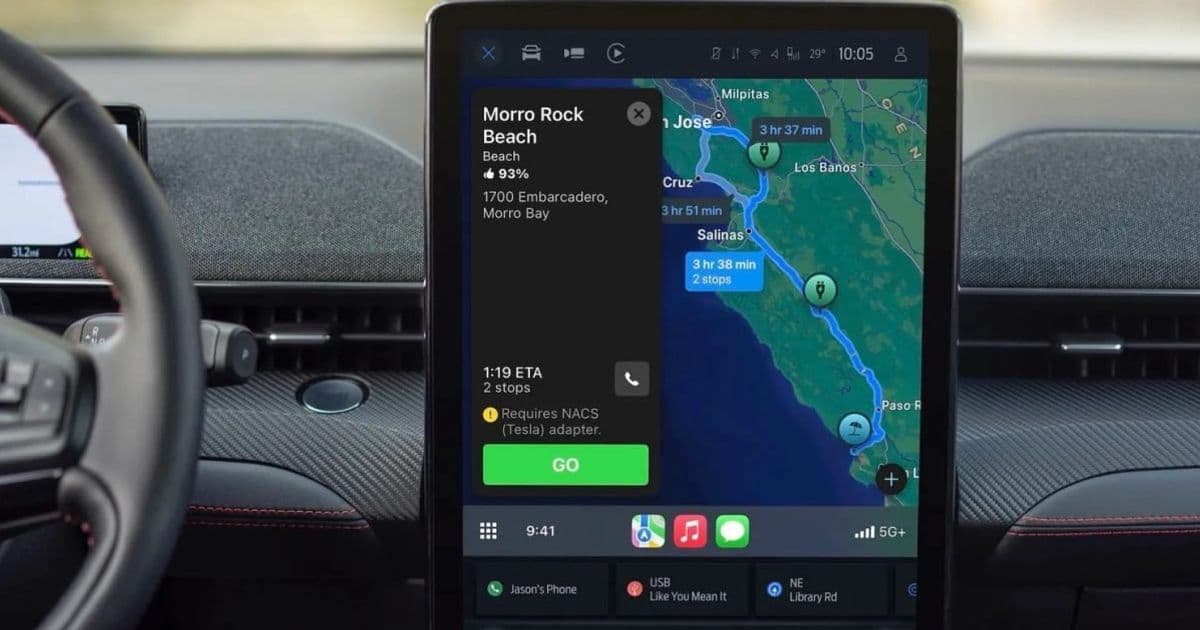
Ford's 2026 Mustang Mach-E now supports battery preconditioning when using Apple Maps EV Routing in CarPlay, improving charging speeds during road trips.
Ford has expanded the capabilities of Apple Maps EV Routing in CarPlay by adding battery preconditioning support for the 2026 model year Mustang Mach-E. This enhancement addresses a long-standing limitation of the feature, which previously couldn't optimize battery temperature for faster charging stops during electric vehicle road trips.
The Mustang Mach-E is one of the few vehicles that supports Apple Maps EV Routing in CarPlay, allowing drivers to plan EV trips with automatically inserted charging stops. However, until now, the system couldn't precondition the battery to ensure optimal charging performance when arriving at DC fast chargers.
According to Ford's official documentation, the 2026 Mustang Mach-E now includes "En-Route Preconditioning" that works with Apple Maps EV Routing. The system uses CarPlay's navigation data to detect when you're heading to a DC fast charger and automatically adjusts the battery temperature accordingly. This means the vehicle will cool or warm the battery as needed to maximize charging efficiency upon arrival.
Ford explains that en-route preconditioning activates when planning routes that include DC fast charging stops through:
- Connected Navigation
- Google Maps EV Routing for Android Auto
- Apple Maps EV Routing in CarPlay
The feature works similarly with Ford's Connected Navigation and Google Maps EV Routing, where you can also select a DC fast charger from nearby options and trigger preconditioning. However, this manual selection capability isn't available when using Apple Maps EV Routing.
Battery preconditioning is particularly valuable for EV drivers, especially during longer trips and in colder weather conditions. A properly preconditioned battery can significantly reduce charging times at fast-charging stations, making road trips more efficient and convenient. Without preconditioning, batteries that are too cold may charge at reduced speeds until they reach optimal temperature.
For Mustang Mach-E owners like myself who frequently use Apple Maps EV Routing for road trips, this enhancement is welcome news. The lack of battery preconditioning has been a noticeable limitation, particularly during winter months when charging speeds can be impacted by cold battery temperatures. Being able to arrive at charging stations with batteries already at optimal temperature will make long-distance EV travel more practical and time-efficient.
Unfortunately, this new feature is limited to 2026 model year vehicles, meaning owners of 2022 and 2023 models won't benefit from the enhancement. Ford hasn't indicated whether this capability will be extended to older model years through software updates or if it requires hardware changes specific to the 2026 vehicles.
There's also no information about whether Ford plans to bring this Apple Maps EV Routing preconditioning feature to other electric vehicles in its lineup, such as the F-150 Lightning, which also supports Apple Maps EV Routing in CarPlay. Given that the F-150 Lightning shares many of the same electric vehicle technologies as the Mustang Mach-E, it seems likely that similar functionality could be implemented, though Ford hasn't confirmed any plans.
The addition of battery preconditioning to Apple Maps EV Routing represents a meaningful improvement in the EV driving experience, particularly for Ford Mustang Mach-E owners planning road trips. As electric vehicles become more prevalent for long-distance travel, features that optimize charging efficiency and reduce wait times will become increasingly important for mainstream adoption.
For those interested in learning more about electric vehicle technology and charging solutions, resources like EnergySage provide information on solar charging options and EV infrastructure.
Comments
Please log in or register to join the discussion