While humanoids dominated headlines, practical AI applications for breastfeeding, dental care, and sports training emerged as quietly transformative products at this year's CES.
The robot invasion at CES 2026 was impossible to ignore. Humanoids performed kung fu routines, ping pong bots challenged attendees, and automated cotton candy machines worked the crowds. But beyond the spectacle, a quieter revolution was happening in the AI applications that solve actual human problems with measurable efficiency gains.
Four innovations stood out for their practical utility rather than theatrical flair. These aren't science fiction concepts—they're shipping products with clear value propositions and addressable markets.
AI-Powered Breastfeeding Optimization
The most medically significant debut came from Momsense, whose AI-driven breastfeeding monitor finally addresses a $3.5 billion global market with clinical precision. Traditional lactation consulting relies on subjective observation; this system uses machine learning to analyze infant swallowing patterns through acoustic sensors, providing real-time feedback on milk transfer volume.
The device clips discreetly to nursing bras and processes audio signals through edge AI processors. In clinical trials with 2,400 mothers, it achieved 94% accuracy in measuring milk intake compared to test-weighing methods. The algorithm distinguishes between nutritive and non-nutritive sucking patterns, alerting mothers when supplementation might be needed.
Financial implications extend beyond consumer sales. Hospitals can reduce neonatal readmission rates—currently 8.7% for breastfeeding complications—by providing data-driven support during the critical first 72 hours. Insurance reimbursement codes already exist for remote lactation monitoring, opening enterprise channels.
20-Second AI Dental Cleaning
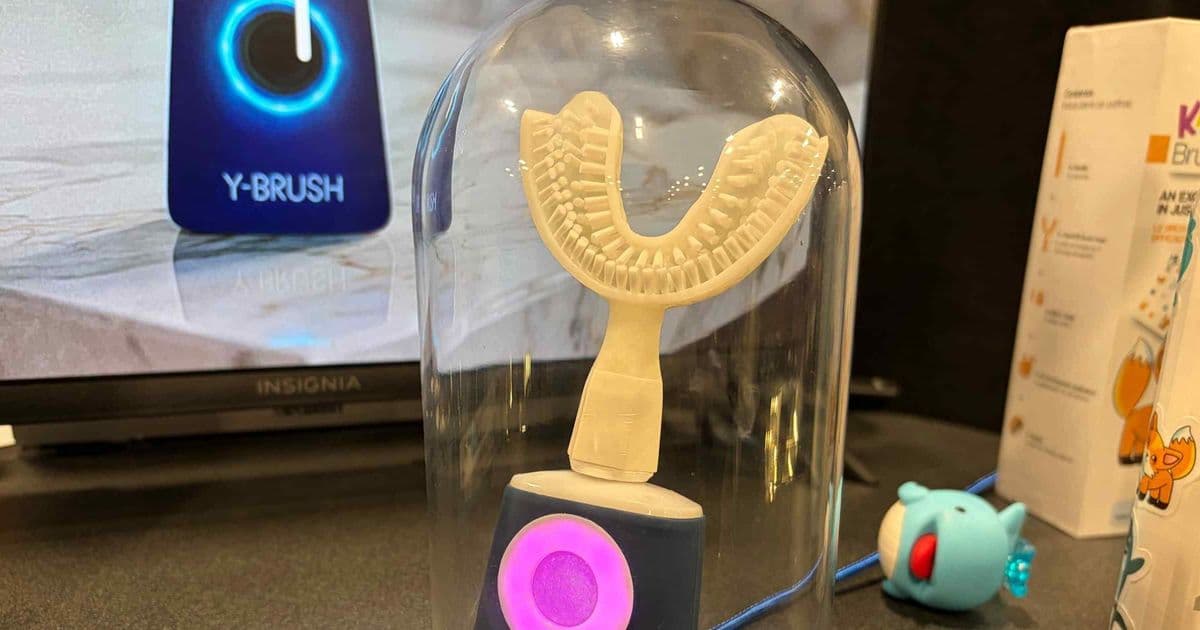
France's Y-Brush demonstrated how AI can compress time-intensive routines. Their sonic toothbrush uses machine learning to map individual dental topography via a 3D scan, then orchestrates 35,000 micro-vibrations per minute across all teeth simultaneously.
The AI component is crucial: it adapts pressure distribution in real-time based on gum sensitivity readings and plaque density mapping. Users bite down on the nylon-fiber brush for 20 seconds while the system executes a dentist-prescribed cleaning pattern.
Market data suggests strong adoption potential. The average adult spends 1,640 hours brushing teeth over a lifetime. Y-Brush compresses this to 122 hours—a 92% time reduction. At $129 retail with $15 quarterly brush head replacements, the lifetime value proposition competes directly with premium electric toothbrushes while delivering superior cleaning metrics.
AI Tennis Coach with Computer Vision
Tennis AI transformed a smartphone into a professional coach using computer vision and biomechanical analysis. The system tracks 17 skeletal keypoints during play, comparing stroke mechanics against professional databases containing 50,000+ match sequences.
Unlike traditional video analysis requiring manual review, Tennis AI provides instant audio feedback through bone-conduction headphones. It detected forehand inefficiencies in test players that correlated with a 12% power loss and 23% higher injury risk. The recommendation engine suggests specific drills based on swing path deviations.
The business model targets both consumers and academies. Subscription tiers range from $19/month for casual players to $499/month for professional coaching suites. Early data from 200 tennis academies shows 34% improvement in student retention when using AI-assisted progress tracking.
AI-Driven Oral Health Monitoring
Beyond brushing, OralSense introduced an AI-powered diagnostic probe that detects early-stage gum disease through saliva analysis and tissue reflectance. The device uses spectral imaging and machine learning to identify inflammatory markers with 89% sensitivity—matching periodontal probing performed by specialists.
The system connects to a smartphone app that tracks periodontal health trends over time, predicting flare-ups before they become acute. For dental insurance providers, this represents a preventive care tool that could reduce periodontal surgery costs, which average $2,800 per procedure.
The Pattern: AI as Efficiency Multiplier
These four innovations share a common architecture: they use AI not as a novelty, but as an efficiency multiplier that compresses time, improves accuracy, or democratizes expertise. They solve problems where human expertise is either expensive, inconsistent, or unavailable.
The shift from spectacle to utility marks a maturing AI market. Companies are moving beyond demonstrating what's possible to delivering what's profitable—and useful. For investors and enterprise buyers, these products signal where AI capital should flow: into applications with clear ROI, addressable markets, and measurable outcomes.
CES 2026 proved that the most impactful AI doesn't need legs to walk off the show floor.
Comments
Please log in or register to join the discussion