
Framework has implemented its first-ever price increase for its Desktop line, with the top-tier 128 GB configuration seeing a $460 hike. The company attributes the adjustment to rising memory component costs, specifically citing shortages affecting the 128-Gbit chips required for high-capacity configurations.
Framework has officially adjusted pricing across its Desktop lineup for the first time, citing a global shortage of memory chips that has driven up production costs. The increases, which range from a modest $40 on lower-end models to a substantial $460 on the top configuration, mark a shift in strategy for a company that has so far held off on desktop price adjustments despite multiple laptop price hikes in recent weeks.

The primary driver behind the price hike is the specific memory architecture of the Framework Desktop. Unlike its laptop counterparts, which feature user-upgradeable RAM slots, the desktop relies on onboard LPDDR5x memory soldered directly to the motherboard. This design choice means the company cannot simply ship base models and let users upgrade later; every unit must be configured with its final memory capacity at the factory. According to Framework's official blog post, the cost of 128-Gbit memory chips—critical for high-capacity 128 GB configurations—has risen sharply, making it impossible to absorb the increased component costs indefinitely.
The New Pricing Structure
The price increases are tiered based on the memory density and the number of chips required. The lower-end configurations, which use fewer chips or lower-density modules, have seen the smallest impact.
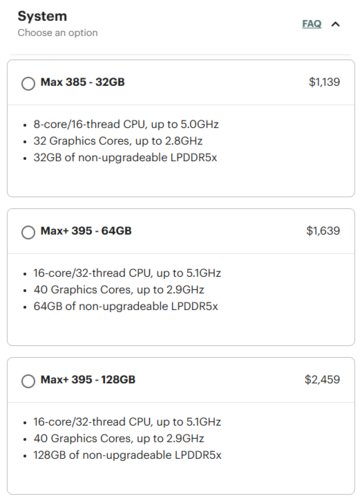
32 GB Configuration (Ryzen AI Max 385)
- Old Price: $1,099
- New Price: $1,139
- Increase: $40
64 GB Configuration (Ryzen AI Max+ 395)
- Old Price: $1,599
- New Price: $1,639
- Increase: $40
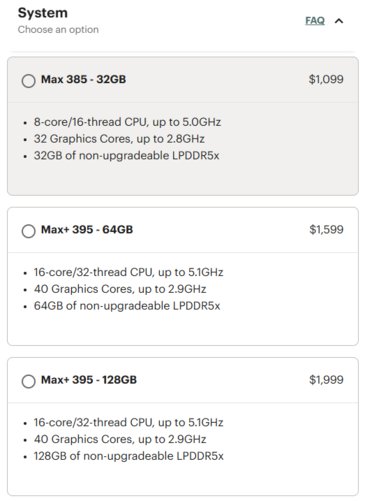
128 GB Configuration (Ryzen AI Max+ 395)
- Old Price: $1,999
- New Price: $2,459
- Increase: $460
The dramatic $460 jump on the 128 GB model reflects its reliance on eight individual 128-Gbit chips. When component prices for these specific chips rise, the cumulative cost increase is significant. Framework emphasized that these adjustments are purely to offset rising production costs and are not a reflection of changed market positioning or profit margin expansion.
Competitive Landscape: Is the Framework Desktop Still a Good Deal?
Despite the higher prices, the Framework Desktop remains a competitive option in the high-performance mini-PC market, particularly for users who value the company's repairability and modularity ethos. However, the new pricing does narrow the gap with competitors.
For AI developers considering the 128 GB model, the $2,459 price tag makes it less accessible than before. The GMKtec Evo-X2, which features the same Ryzen AI Max+ 395 processor and 128 GB of RAM, is currently available on Amazon for approximately $2,300. While the GMKtec lacks Framework's modular expansion card system and repairability focus, it presents a compelling value proposition for users purely focused on maximizing performance per dollar.
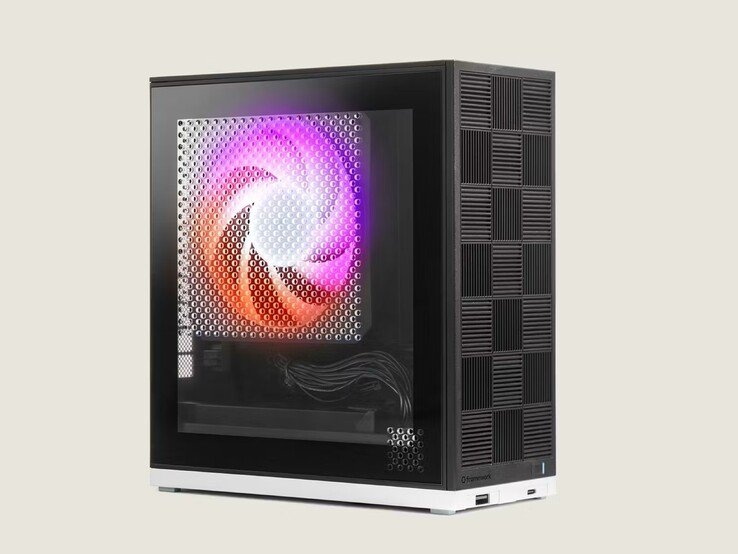
For gaming enthusiasts, the calculus is different. Framework claims the base model offers better value than a custom-built desktop PC with similar performance. This claim hinges on the integrated nature of the system and the difficulty of sourcing the specific Ryzen AI Max processors and LPDDR5x memory configurations at retail. However, savvy builders looking for raw gaming performance might still find better value by sourcing discrete graphics cards at current market prices. For example, an Nvidia GeForce RTX 5060, which significantly outperforms the integrated AMD Radeon 8050S graphics in the Framework Desktop, can be purchased for around $300. A custom build centered around this card could offer superior gaming performance for a similar total cost, though it would sacrifice the compact form factor and integrated design of the Framework system.
What This Means for Buyers
The price increase underscores the fragility of the current hardware supply chain. For Framework, the inability to offer user-upgradeable RAM on the desktop platform creates a vulnerability to component price fluctuations that more traditional desktop designs can avoid. Users looking to purchase a Framework Desktop now will need to weigh the premium for its unique design and repairability against the rising costs of memory components.
For those not in immediate need, monitoring the memory market for stabilization could be prudent. The current shortage appears to be specific to high-density chips, so users considering the 128 GB configuration may want to evaluate whether the premium is justified for their specific AI or high-memory workload needs. Conversely, the 32 GB and 64 GB models, with only a $40 increase, remain relatively insulated and may still represent the best value within the Framework Desktop ecosystem.
Ultimately, this price adjustment serves as a reminder that even companies committed to fair pricing are not immune to global supply chain pressures. The Framework Desktop remains a unique product in the market, but its value proposition now depends more heavily on the specific needs of the buyer and their tolerance for the premium associated with its design philosophy.
Comments
Please log in or register to join the discussion