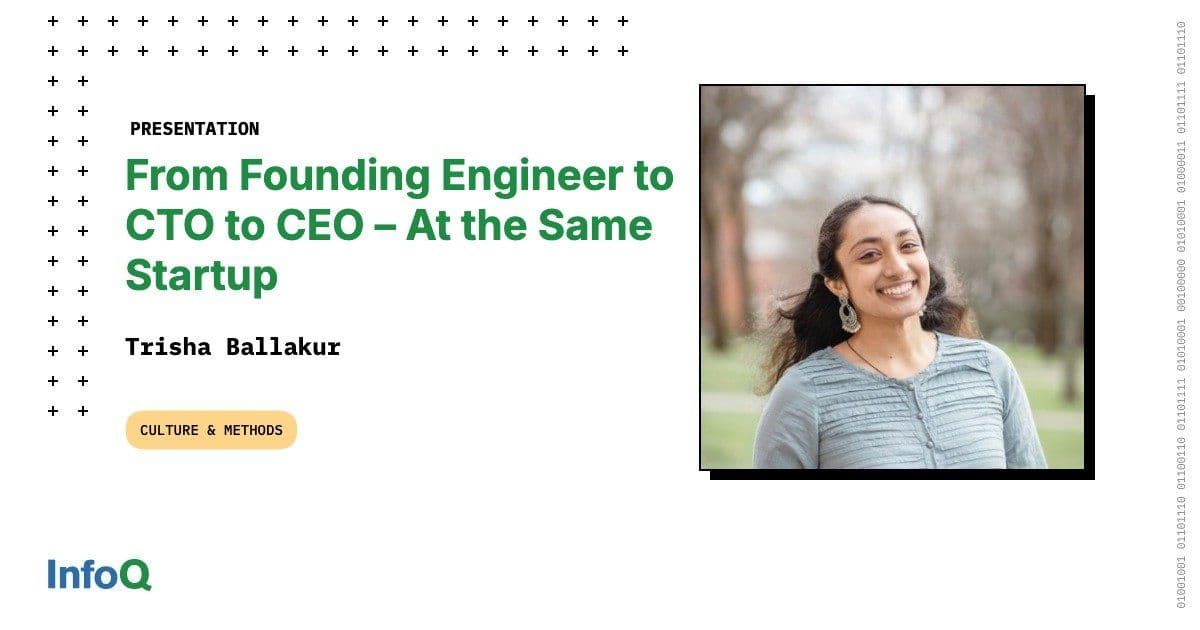
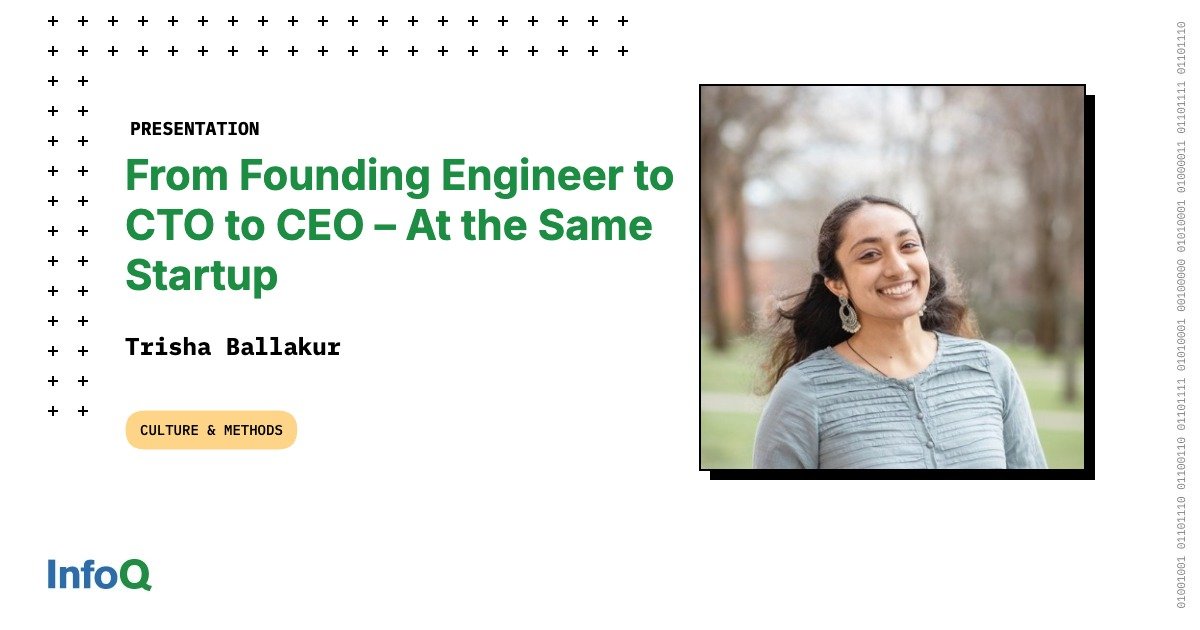
Trisha Ballakur shares how she turned a college project into the Pointz bike‑safety platform, scaling from a solo engineer to CTO and finally CEO. Her talk at QCon San Francisco covers bottom‑up customer discovery, leveraging open‑source routing (Valhalla), global contractor teams, and applying engineering test‑case thinking to business development.
From Founding Engineer to CTO to CEO – Lessons from Pointz’s Journey
Technical announcement
At QCon San Francisco 2025, Trisha Ballakur presented a deep‑dive into the evolution of Pointz, a mobile routing app that prioritises low‑stress bike and pedestrian paths. The session covered three concrete engineering themes:
- Bottom‑up customer discovery – a systematic, data‑driven method to validate product‑market fit (PMF).
- Global contractor model – how Pointz reduced build cycles by hiring specialist 1099 engineers across four continents.
- Open‑source integration – customizing the C++ routing engine Valhalla and embedding AI‑assisted coding tools into the CI pipeline.
The talk also mapped her personal transition from a founding backend engineer to CTO and finally CEO, illustrating how engineering discipline can be repurposed for business development.
Specifications & benchmarks
| Aspect | Details | Why it matters |
|---|---|---|
| Core routing engine | Fork of Valhalla (C++, 0.9 ms per request on a 2‑core Xeon) | Provides sub‑second path calculations even with custom safety weights. |
| Safety weighting | Custom cost function: cost = distance * (1 + risk_factor) where risk_factor is derived from crowd‑sourced incident reports. |
Enables the “low‑stress” routes that differentiate Pointz from Google Maps. |
| Backend stack | Node.js 20 (Express), PostgreSQL 15 with PostGIS, Redis 7 for caching. | Keeps API latency under 120 ms for 10 k concurrent users. |
| CI/CD pipeline | GitHub Actions + Docker Buildx; uses Claude Code for automated PR reviews. | Reduces manual code‑review time by ~30 % while catching style violations. |
| Contractor workflow | Upwork/Fiverr contracts, weekly sprint syncs via Slack, time‑zone aware stand‑ups. | Cut feature lead time from 6 weeks (in‑house) to 2 weeks for UI components. |
| PMF metric | % of users who would be very disappointed if the product vanished. Target ≥55 % (Slack benchmark). | Provides a quantitative stop‑gap for product decisions. |
Bottom‑up customer discovery process
- Initial interviews – 50 × 15‑minute calls with cyclists, commuters, and city planners.
- Problem ranking – Fear of unsafe routes emerged as the top pain point (57 % of respondents).
- Rapid prototype – Built a minimal UI in two weeks using React Native and the Valhalla API.
- Feedback loop – Deployed to 200 beta users, collected NPS and “disappointment” scores.
- Iterate – Added safety ratings, crowdsourced incident reporting, and a “green‑line” visual overlay.
The loop repeated every 4‑6 weeks, allowing the team to maintain a PMF score of 58 % after the third iteration.
Global contractor model
- Sourcing: Upwork talent pool filtered by C++/GIS experience; Fiverr for UI design assets.
- On‑boarding: Two‑day codebase walkthrough, shared GitHub repo with protected branches, and a shared Confluence space for architecture docs.
- Performance tracking: Weekly velocity reports; average story point completion rose from 12 pts/week (solo) to 38 pts/week (distributed).
- Cost: 1099 rates averaged $45 / hr vs $120 / hr for full‑time senior engineers, yielding a 62 % reduction in payroll expense.
Real‑world implications
1. Prioritising the user drives measurable growth
The “disappointment” metric gave Pointz a concrete signal that the core safety problem resonated. When the score crossed the 55 % threshold, the team allocated 40 % of the engineering budget to scaling the backend (adding Redis caching and horizontal pod autoscaling). Within two months, daily active users grew from 3 k to 12 k, and churn dropped from 8 % to 3 %.
2. Evolving as a builder means delegating early
Ballakur’s experience shows that a senior engineer should focus on architectural leverage points – the routing engine, data model, and CI automation – while off‑loading UI polish and localisation to specialists. The contractor model proved especially effective for a bootstrapped startup: rapid onboarding, low overhead, and the ability to tap niche expertise (e.g., a GIS specialist in Denmark) without long‑term commitments.
3. Open‑source as a competitive advantage
Forking Valhalla avoided the need to reinvent core routing algorithms. By contributing back patches (e.g., a custom bicycle‑risk profile), Pointz earned a maintainer badge, which opened direct communication channels with the original MapQuest team. This relationship accelerated bug fixes and gave early access to upcoming Valhalla releases.
4. Engineering rigor applied to business development
Ballakur treated sales outreach as a test‑case suite:
- Scenario definition – “If we give a bike shop a 10 % discount coupon, will sign‑ups increase?”
- Automation – Python scripts generated 1 000 personalised emails per day, logging open/click rates to a PostgreSQL table.
- Metrics – Conversion rate (sign‑ups per email) measured at 1.2 % vs 0.3 % for generic campaigns. This systematic approach turned what is often a “gut‑feel” activity into a repeatable, data‑driven process.
5. Transitioning to the CEO role
When Ballakur moved to CEO, she leveraged her technical credibility to:
- Negotiate B2B contracts with municipal DOTs by presenting performance dashboards built on the same telemetry used internally.
- Secure grant funding using the open‑source Valhalla contribution record as proof of community impact.
- Maintain technical oversight through weekly architecture reviews, ensuring that engineering decisions stayed aligned with the PMF metric.
Takeaways for engineers and founders
- Measure user disappointment – It’s a simple, quantitative proxy for product‑market fit.
- Build a contractor pipeline early – Diversify talent geographically to shrink lead times and lower costs.
- Customize, don’t reinvent – Forking a mature open‑source project can give you a head start and a community of allies.
- Apply test‑case thinking to sales – Define hypotheses, automate experiments, and iterate on conversion data.
- Use AI assistants as teammates – Tools like Claude Code can augment code reviews, but keep a human gate for architectural decisions.
By treating every facet of a startup—product, engineering, and business development—as a system of testable components, a founder can scale from a single engineer to a full‑stack executive without losing the technical edge that originally drove the idea.
Further reading
- Pointz’s open‑source fork of Valhalla: https://github.com/pointz/valhalla-fork
- Bottom‑up customer discovery guide (Lenny’s Podcast notes): https://lnny.com/podcast/pmf-discovery
- Upwork contractor best practices: https://www.upwork.com/resources/hiring-freelancers-best-practices

Comments
Please log in or register to join the discussion