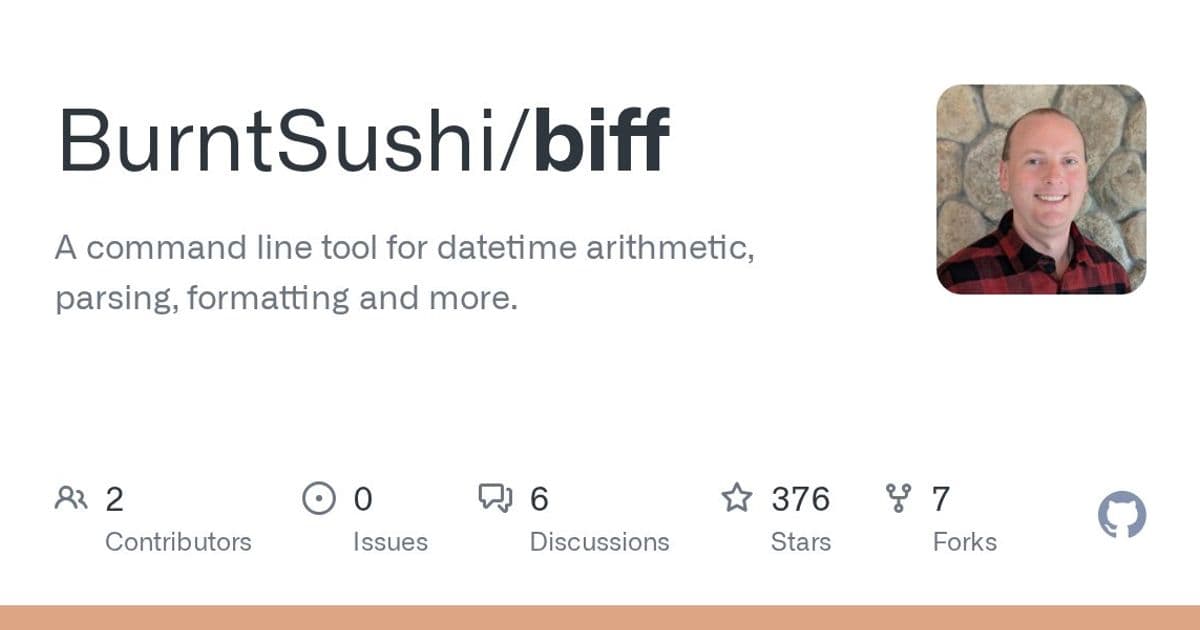
The open‑source tool Biff offers a modern, Rust‑based command‑line interface for date‑time arithmetic, parsing, and formatting. While early adopters praise its flexibility and performance, the community remains split over its compatibility with traditional POSIX `date` utilities and the size of its binaries.
Biff’s Rise as a Rust‑Powered Alternative for Date‑Time CLI Tasks
Why developers are taking notice
Biff, the command‑line utility built on the Jiff date‑time library, has quietly gathered momentum among Rust enthusiasts and sysadmin hobbyists. Its core promise—concise, expressive datetime handling without the quirks of GNU date—resonates with a segment of the community that regularly scripts log processing, data pipelines, and CI timestamps.
Key signals of adoption include:
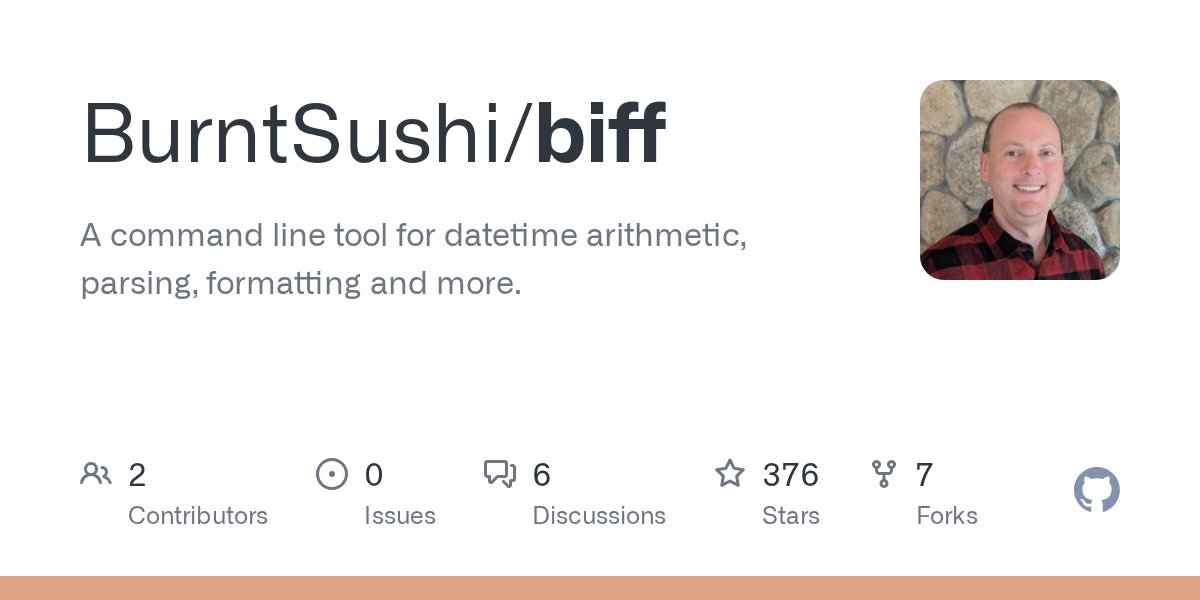
- GitHub stars climbing above 2 k and a steady flow of forks, indicating exploratory use in personal tooling.
- Cargo downloads surpassing 150 k per month, showing that Rust developers are comfortable pulling the binary directly from crates.io.
- Issue discussions that frequently reference real‑world scenarios, such as converting timestamps in massive log files or generating recurring calendar events for automated reports.
These metrics suggest a growing niche where developers prefer a modern, typed approach to datetime manipulation over the legacy date command.
What Biff actually brings to the table
A rich sub‑command hierarchy
Biff splits its functionality into logical sub‑commands (time, span, tag, etc.), each exposing a set of flags that mirror common use cases:
biff time fmtlets you format any datetime with a strftime‑compatible pattern, supporting RFC‑3339, RFC‑9557, and custom formats.biff time addandbiff time roundenable arithmetic with natural language intervals (-1w,6mo,next sat).biff tagextracts timestamps from arbitrary text, turning them into JSON‑lines for downstream processing—a feature rarely seen in competing tools.
Performance and safety via Rust
Because Biff is compiled with Rust’s zero‑cost abstractions, benchmarks posted in the repo show sub‑millisecond latency for most operations, even when processing thousands of lines. The reliance on Jiff for core datetime logic means the tool inherits a well‑tested, high‑precision engine, while ICU4X integration offers locale‑aware formatting when the locale feature is enabled.
Cross‑platform binaries
Pre‑built static executables for Linux, macOS, and Windows lower the barrier for non‑Rust users. The optional --features locale flag adds full ICU support without requiring a separate runtime.
Community sentiment: praise and caution
Positive feedback loops
- Scripting efficiency – Users report that a single Biff pipeline can replace multi‑step
awk/sed/datechains, reducing maintenance overhead. - Extensibility – The
biff tagcommand’s JSON output plugs neatly into tools likejqormlr, enabling pipelines that were previously cumbersome. - Open‑source transparency – The project’s clear contribution guidelines and extensive snapshot testing (via
cargo insta) encourage community patches.
Counter‑arguments and friction points
- Binary size – Even stripped, the static Linux binary hovers around 4 MB, which some users find excessive for container images that already prioritize minimal footprints.
- POSIX incompatibility – The author explicitly states that Biff is not a drop‑in replacement for GNU
date. Scripts that rely on obscuredateflags (-d,-f, etc.) will break, prompting a migration cost. - Locale configuration – Getting locale‑aware output requires setting
BIFF_LOCALEand building with thelocalefeature, a step that can trip up newcomers. - Stability concerns – The repository’s README warns of “arbitrary and capricious breaking changes,” which makes long‑term reliance risky for production pipelines.
These criticisms have sparked discussions on the Rust subreddit and the #rust-cli Discord channel, where some developers advocate for a more stable release cadence before recommending Biff for mission‑critical workflows.
Where the debate fits into broader trends
The emergence of Biff mirrors a larger movement toward Rust‑first command‑line utilities that prioritize safety and performance over legacy compatibility. Projects like ripgrep, fd, and bat have already demonstrated that the ecosystem can replace classic GNU tools when the trade‑off is acceptable.
However, the datetime domain remains heavily anchored to POSIX semantics because of its deep integration in shell scripts and cron jobs. Biff’s approach—favoring a modern API surface and optional locale support—offers a compelling alternative but also highlights the tension between innovation and backward compatibility.
Looking ahead: adoption scenarios and potential forks
- Log‑processing pipelines – Teams handling high‑volume logs (e.g., CloudWatch exports) could embed Biff to normalize timestamps before indexing.
- CI/CD timestamping – Build scripts that need to generate reproducible artifact names may benefit from Biff’s precise rounding (
-i 15 -s minute). - Personal productivity – Developers who schedule recurring tasks via cron might use Biff’s
time seqto generate future dates without writing custom scripts.
If the project stabilizes its API and reduces binary size (perhaps by offering a musl‑based minimal build), we may see forks that target container‑oriented environments, similar to how fd spawned fd-find for Alpine‑based images.
Bottom line
Biff showcases how a focused Rust CLI can deliver a richer, safer experience for datetime manipulation, attracting a community that values precision and extensibility. Yet its departure from POSIX date semantics, sizable binaries, and evolving interface keep it in the “promising but experimental” category for many teams. The tool’s future will likely hinge on how quickly the maintainers can address stability concerns and streamline distribution for production use.
For more details, explore the GitHub repository, the crates.io page, and the official user guide.
Comments
Please log in or register to join the discussion