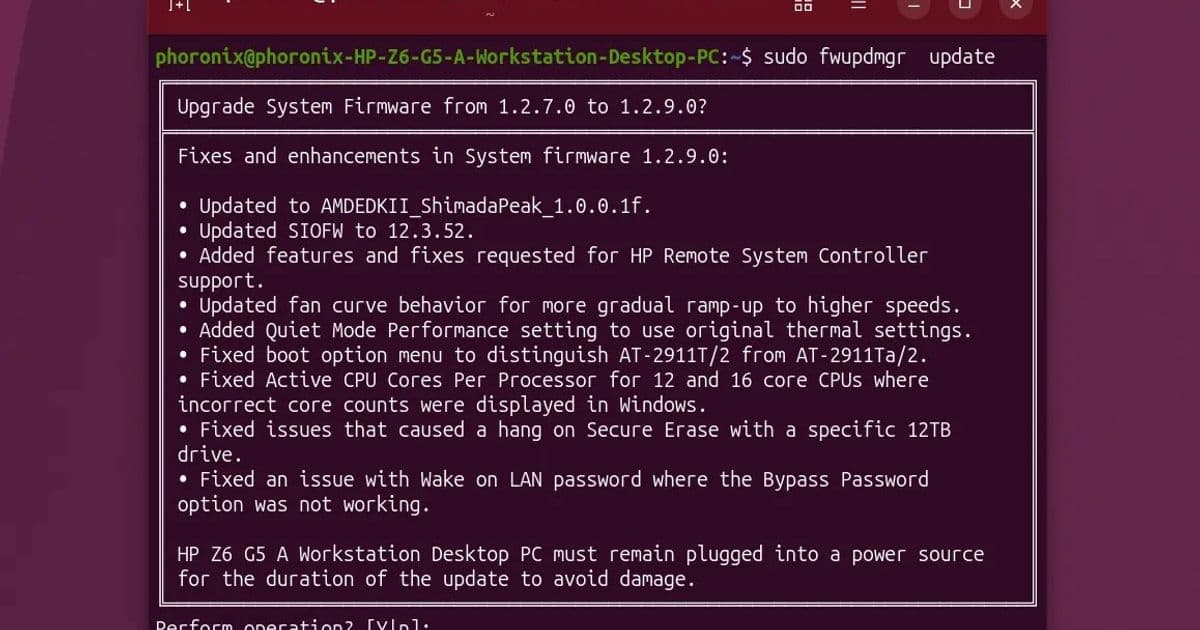
The latest Fwupd release brings expanded firmware update capabilities for Linux users, adding support for numerous devices including Chromebooks, USB-C docks, and various peripherals.
Firmware updates are the unsung heroes of system stability and security, and with Fwupd 2.1.2, Linux users gain even more capabilities to keep their hardware up to date. This latest release from Richard Hughes of Red Hat, the lead developer of both the LVFS (Linux Vendor Firmware Service) and Fwupd, continues to expand the ecosystem of devices that can be properly updated under Linux.
Fwupd serves as the critical bridge between Linux systems and device firmware, providing a standardized way to update everything from system firmware to peripheral firmware. The LVFS acts as the backend service that aggregates firmware from various vendors, making it accessible to Linux systems through the Fwupd client. This infrastructure has become increasingly important as more devices rely on firmware for functionality, security, and performance.
The 2.1.2 release brings several notable improvements beyond just new hardware support. The daemon now has better support for modems that export ttyUSB devices, which will be particularly valuable for users relying on cellular or satellite internet connections. Various device quirks have been refined to improve reliability, and numerous bug fixes address issues that could have prevented successful updates on certain hardware configurations.
Perhaps most exciting is the expanded hardware support in this release. The addition of Google Moonstone support is particularly noteworthy, as this appears to be codename for an upcoming Chromebook model. The inclusion of Elan touchpad controller support (type 0x19) suggests this Chromebook will feature an Elan touchpad, and users will be able to update its firmware through Fwupd.
The peripheral support has seen significant expansion as well:
- HP 400 and 405 Mouse: These new additions expand the range of supported HP peripherals, potentially improving battery life and functionality for Linux users.
- Lenovo USB-4 dock: USB-4 represents the latest in connectivity standards, and proper firmware support is crucial for maintaining performance and compatibility.
- LX Semicon SW42101 touch controller: This addition benefits users of devices featuring this touch controller, potentially improving responsiveness and accuracy.
- Parade USB hubs with GPIO control: For users with complex multi-monitor setups or those requiring extensive USB connectivity, this support ensures their hubs function optimally.
- Pixart PLP239 devices: Pixart sensors are common in many mice and trackpads, so this broadens support for a wide range of pointing devices.
- Raydium TP devices: Touchscreen users with Raydium controllers will benefit from this addition.
- Sunplus cameras: Users with Sunplus-based cameras, particularly in embedded or specialized applications, gain update capabilities.
The continued expansion of USB-C dock and hub support reflects the reality that these devices have become ubiquitous in modern computing setups. As more users adopt docking solutions for their workstations, having reliable firmware update capabilities becomes increasingly important for maintaining functionality, especially after operating system updates.
For homelab builders and system administrators, Fwupd 2.1.2 represents another step toward making Linux a first-class citizen in terms of hardware support. The ability to update firmware through a standardized, secure channel reduces the risk of bricking devices and ensures that security vulnerabilities in firmware can be promptly addressed.
The full changelog for Fwupd 2.1.2 can be examined on the GitHub repository, where developers and curious users can see the complete list of changes, bug fixes, and additions. This transparency is one of the strengths of open-source projects like Fwupd, allowing the community to understand exactly what has changed and potentially contribute to future improvements.
As Linux continues to gain popularity on the desktop and in server environments, tools like Fwupd become increasingly critical for maintaining hardware compatibility and security. The steady pace of development and expansion of supported devices demonstrates the commitment of the development team to making Linux a viable platform for all types of hardware configurations.
For users running Ubuntu or other distributions that include Fwupd by default, this update should arrive through the standard package repositories. For those running distributions without Fwupd or those who want the latest version, compiling from source using the GitHub repository is an option for technically inclined users.
The evolution of Fwupd and the LVFS represents an important piece of Linux's hardware support infrastructure. As more manufacturers recognize the importance of Linux support and contribute their firmware to the LVFS, tools like Fwupd will only become more valuable to the Linux community.
Comments
Please log in or register to join the discussion