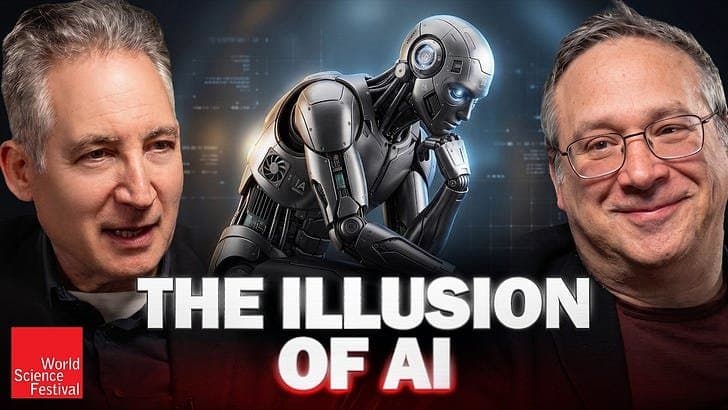
AI researcher Gary Marcus challenges the prevailing narrative around generative AI and massive model scaling, arguing for more robust approaches combining neural networks with symbolic reasoning and world models.
In a series of recent interviews and presentations, AI researcher Gary Marcus has continued his critique of the current dominant approaches in artificial intelligence, characterizing the hype around generative AI as an "illusion" and questioning the wisdom of pouring resources into ever-larger models without addressing fundamental limitations.
Marcus, a prominent figure in AI research who has previously served as director of the NYU Center for Language and Music and as CEO of Geometric Intelligence (acquired by Uber), has been increasingly vocal about what he sees as misplaced priorities in the field. His recent commentary comes at a time when companies continue to invest billions in scaling up existing transformer architectures, often without corresponding improvements in reliability or reasoning capabilities.
The "Illusion" of Generative AI
In his conversation with physicist Brian Greene at the World Science Festival, Marcus elaborated on his long-standing concerns about current large language models (LLMs). While acknowledging their impressive text-generation capabilities, he emphasized that these models remain fundamentally unreliable and lack true understanding.
"We've built systems that can generate fluent text that often appears coherent, but they don't actually know what they're talking about," Marcus explained. "They're pattern matchers on a massive scale, not reasoners. This creates an illusion of understanding that's both seductive and dangerous."
Marcus points to persistent issues with hallucination, factual inaccuracy, and lack of causal reasoning as evidence that current approaches are hitting diminishing returns. He notes that while model sizes have increased exponentially—from GPT-3's 175 billion parameters to proposed models with trillions—fundamental capabilities have not improved proportionally.
"Insanity" of Hyperscaling Bets
In a separate interview with Zachary Karabell, Marcus described the current trend of massive investment in scaling existing AI models as "insanity," particularly when considering the environmental and economic costs.
"We're seeing companies make enormous bets on models that are essentially scaled-up versions of architectures from 2017," Marcus stated. "The computational resources required to train these models are staggering, with energy consumption sometimes equivalent to that of small cities. And for what? Marginal improvements in text generation that still don't address core reliability issues."
He specifically criticized the approach of simply adding more parameters without corresponding architectural innovations. Research has shown that beyond a certain point, increases in model size yield diminishing returns in performance metrics like perplexity, while costs continue to rise exponentially.
The Case for Neurosymbolic AI
Marcus advocates instead for what he terms "neurosymbolic AI"—approaches that combine the pattern recognition capabilities of neural networks with the structured reasoning of symbolic systems. This hybrid approach, he argues, could provide the robustness and reliability that pure connectionist methods lack.
In his keynote address at Web Summit, Marcus outlined several promising research directions in this space:
- Knowledge-infused neural networks: Systems that incorporate structured knowledge bases to constrain and guide neural network behavior
- Differentiable reasoning: Neural architectures that can perform logical operations in a differentiable manner, allowing for end-to-end learning while maintaining reasoning constraints
- Causal modeling: Systems that build explicit representations of causal relationships rather than relying solely on statistical correlations
Marcus points to research from groups like those at MIT, Stanford, and IBM as evidence that these approaches can yield systems with improved reliability and explainability. For example, projects like MIT's CSAIL have demonstrated neurosymbolic systems that can solve complex reasoning problems with significantly fewer errors than comparable neural-only approaches.
The Importance of World Models
A key component of Marcus's proposed alternative is the development of "world models"—internal representations of how the world works that allow AI systems to make predictions and understand consequences.
"Current LLMs don't have a model of the world; they have a model of text," Marcus explained. "They don't understand that if you drop a glass, it might break, or that objects can't teleport through space. These are not just limitations—they're fundamental flaws in how these systems represent reality."
Research in cognitive science suggests that humans develop world models early in life, allowing us to understand physics, social dynamics, and causal relationships. Marcus argues that AI systems need similar capabilities to move beyond pattern matching to genuine understanding.
Software Verification in the LLM Era
In a fireside chat at Bug Bash 2026, hosted by Will Wilson of Antithesis, Marcus emphasized the critical importance of software verification as AI systems become more prevalent in high-stakes applications.
"We're deploying these systems in healthcare, finance, and critical infrastructure without adequate testing or verification," Marcus warned. "The probabilistic nature of current AI makes traditional verification approaches challenging, but we need to develop new methods to ensure reliability."
He highlighted initiatives like Antithesis that are working on formal verification methods for AI systems, as well as research on adversarial testing and formal specification languages for neural networks.
Practical Applications and Alternatives
Marcus's critique isn't purely theoretical. He points to several practical applications where neurosymbolic approaches have shown promise:
- Medical diagnosis: Systems that combine neural pattern recognition with medical knowledge bases have demonstrated improved diagnostic accuracy compared to neural-only approaches
- Robotics: Hybrid systems that combine perception with symbolic planning have shown better adaptability in dynamic environments
- Scientific discovery: AI systems that incorporate domain knowledge have made notable advances in areas like protein folding and materials science
For those interested in exploring these alternatives, Marcus recommends several resources:
- The Neuro-Symbolic AI reading list maintained by researcher K. Sankar
- MIT's Center for Brains, Minds, and Machines which focuses on integrated cognitive and neural approaches
- The Journal of Machine Learning Research special issues on neurosymbolic methods
As Marcus concludes in his presentations, the path forward in AI may not be bigger models, but smarter architectures that combine the best of neural and symbolic approaches. This shift, he argues, could lead to AI systems that are not only more capable but also more reliable, interpretable, and aligned with human values.
For those interested in Marcus's perspective, his interviews and presentations provide valuable insights into the current state of AI and potential alternative paths forward. The growing interest in neurosymbolic approaches suggests that the field may be beginning to heed his call for a more balanced and principled approach to artificial intelligence.
Comments
Please log in or register to join the discussion