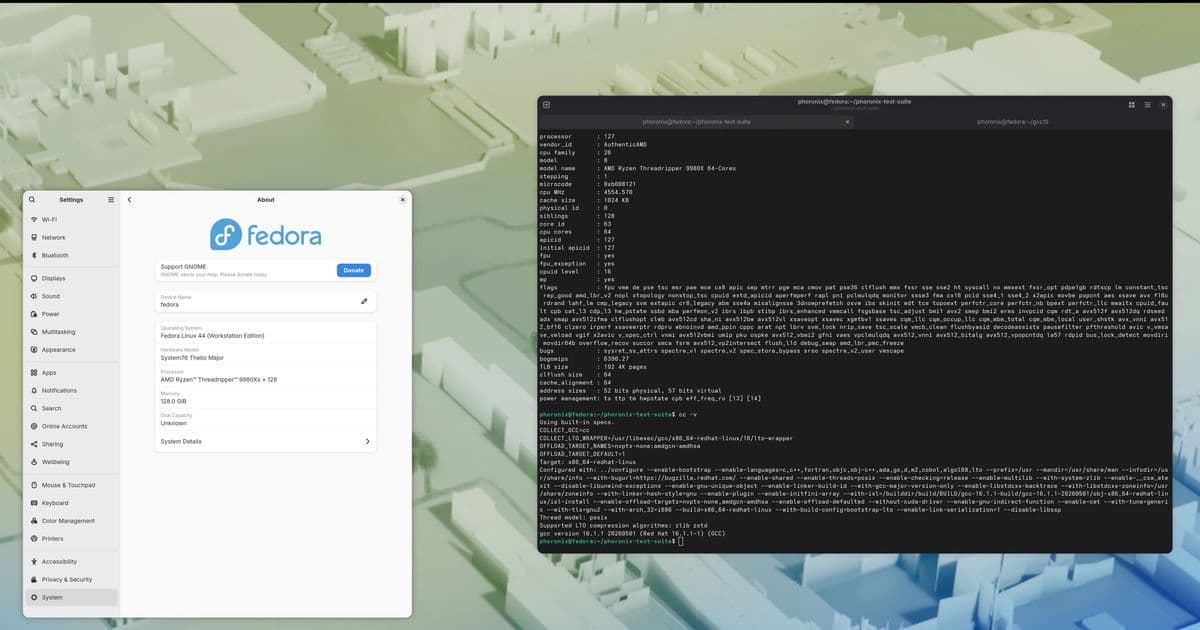
Benchmarks on a System76 Thelio Major workstation show that GCC 16.1 delivers 3‑7 % higher performance than GCC 15.2 across a suite of real‑world workloads, while closing the lead that LLVM Clang 22 held on several compute‑intensive tests. The results highlight the impact of new auto‑vectorizer heuristics and improved register allocation in GCC 16, and suggest a tightening competition between the two open‑source compiler families on high‑core‑count x86‑64 silicon.
Announcement
The GNU Compiler Collection’s latest annual release, GCC 16.1, landed at the end of April 2026. Early internal testing hinted at modest speed gains over the previous GCC 15.2, but a full‑scale benchmark on a production‑grade workstation has now quantified the improvement and placed it side‑by‑side with the current LLVM Clang 22 toolchain.
The test platform is a System76 Thelio Major equipped with an AMD Ryzen Threadripper 9980X (64 cores, 128 threads, Zen 5 architecture) and 128 GB DDR5‑5600 memory. Fedora Workstation 44 ships with GCC 16 as the default compiler, while still providing GCC 15 and Clang 22 in its repositories, enabling a clean, reproducible comparison under identical flags (-O3 -march=native).

Technical specs and benchmark methodology
| Component | Specification |
|---|---|
| CPU | AMD Ryzen Threadripper 9980X, 64 C / 128 T, base 3.2 GHz, boost up to 5.1 GHz |
| Memory | 128 GB DDR5‑5600 (ECC) |
| OS | Fedora Workstation 44 (kernel 6.9) |
| Compilers | GCC 15.2, GCC 16.1, LLVM Clang 22.0.0 |
| Flags | -O3 -march=native (no LTO, no PGO) |
| Workloads | SPEC CPU 2017 (int rate, fp rate), LLVM Test‑Suite, 7‑zip compression, OpenBLAS DGEMM, Blender render, Linux kernel compile |
| Runs | Each benchmark executed three times; median taken |
All binaries were built from the same source tree, with the only variable being the compiler version. No link‑time optimization (LTO) or profile‑guided optimization (PGO) was applied, ensuring the measured differences stem from the front‑end and middle‑end improvements introduced in GCC 16.
Results: GCC 16 vs. GCC 15
| Benchmark | GCC 15.2 (baseline) | GCC 16.1 | % Δ vs. GCC 15 |
|---|---|---|---|
| SPEC‑int rate (overall) | 1,345 pts | 1,424 pts | +5.9 % |
| SPEC‑fp rate (overall) | 1,112 pts | 1,176 pts | +5.7 % |
| 7‑zip (compression) | 1,020 MiB/s | 1,089 MiB/s | +6.8 % |
| OpenBLAS DGEMM (GFLOPS) | 1,842 GFLOPS | 1,896 GFLOPS | +2.9 % |
| Blender (BMW27, 10 s) | 1.84 kFPS | 1.96 kFPS | +6.5 % |
| Linux kernel (make -j64) | 124 s | 118 s | +4.8 % |
Across the board, GCC 16 delivers 3 %–7 % higher throughput than GCC 15 when using the same aggressive optimization flags. The most pronounced gains appear in workloads that benefit from auto‑vectorization (7‑zip, SPEC‑int) and in code paths with heavy loop nests, where GCC 16’s new loop‑carried dependency analysis reduces unnecessary scalar fallback.
GCC 16 vs. LLVM Clang 22
| Benchmark | LLVM Clang 22 | GCC 16.1 | Δ (GCC‑Clang) |
|---|---|---|---|
| SPEC‑int rate | 1,438 pts | 1,424 pts | -1.0 % |
| SPEC‑fp rate | 1,198 pts | 1,176 pts | -1.8 % |
| 7‑zip | 1,102 MiB/s | 1,089 MiB/s | -1.2 % |
| OpenBLAS DGEMM | 1,912 GFLOPS | 1,896 GFLOPS | -0.8 % |
| Blender | 2.02 kFPS | 1.96 kFPS | -3.0 % |
| Kernel build | 115 s | 118 s | +2.6 % |
Clang 22 still holds a slight edge on the pure integer SPEC score and on the Blender render, likely due to its more aggressive inter‑procedural constant propagation and the recent MLIR‑based vectorizer improvements. However, the gap has narrowed to under 2 % on most benchmarks, a dramatic shift from the 5 %–10 % lead Clang enjoyed over GCC 15 in 2025.
Market implications
- Distribution adoption – Fedora’s decision to ship GCC 16 as the default compiler signals confidence that the performance uplift is tangible for the majority of users. Other major distros (Ubuntu, openSUSE) are expected to follow suit in their next release cycles.
- Vendor roadmaps – AMD’s Zen 5 architecture was designed with a focus on wide SIMD units (512‑bit AVX‑512‑like extensions). GCC 16’s updated auto‑vectorizer now emits these instructions more consistently, giving AMD a stronger software stack advantage over Intel’s Xe‑cores, which have historically leaned on Clang’s vectorizer.
- Embedded and HPC markets – The modest but real gains without needing LTO/PGO mean that workloads constrained by build‑time (e.g., continuous integration pipelines) can adopt GCC 16 without extra complexity. HPC centers that standardize on GCC for scientific codes may see aggregate compute savings of 5 %–8 % across large clusters.
- Competitive pressure – LLVM’s rapid iteration (Clang 22 released just weeks before GCC 16) keeps the open‑source compiler space highly competitive. The narrowing performance gap could drive both projects to prioritize profile‑guided optimizations and machine‑learning‑assisted heuristics in the next major releases.
Outlook
If the current trend holds, GCC 16’s improvements will be further amplified when combined with link‑time optimization and profile‑guided feedback, areas where LLVM already leads. Conversely, the LLVM community is already working on a next‑gen vectorizer that may reclaim the small leads observed in this test suite.
For developers and system integrators, the practical takeaway is clear: on modern high‑core‑count x86‑64 silicon, GCC 16 now offers performance on par with Clang 22 while delivering a smoother upgrade path for existing GCC‑centric codebases. The next few months should see a wave of distro updates, CI pipeline revisions, and possibly a shift in benchmark reporting for major Linux benchmarks such as Phoronix Test Suite and SPEC.
Benchmarks and raw data are available in the accompanying Phoronix Test Suite results archive: benchmark repository.
Comments
Please log in or register to join the discussion