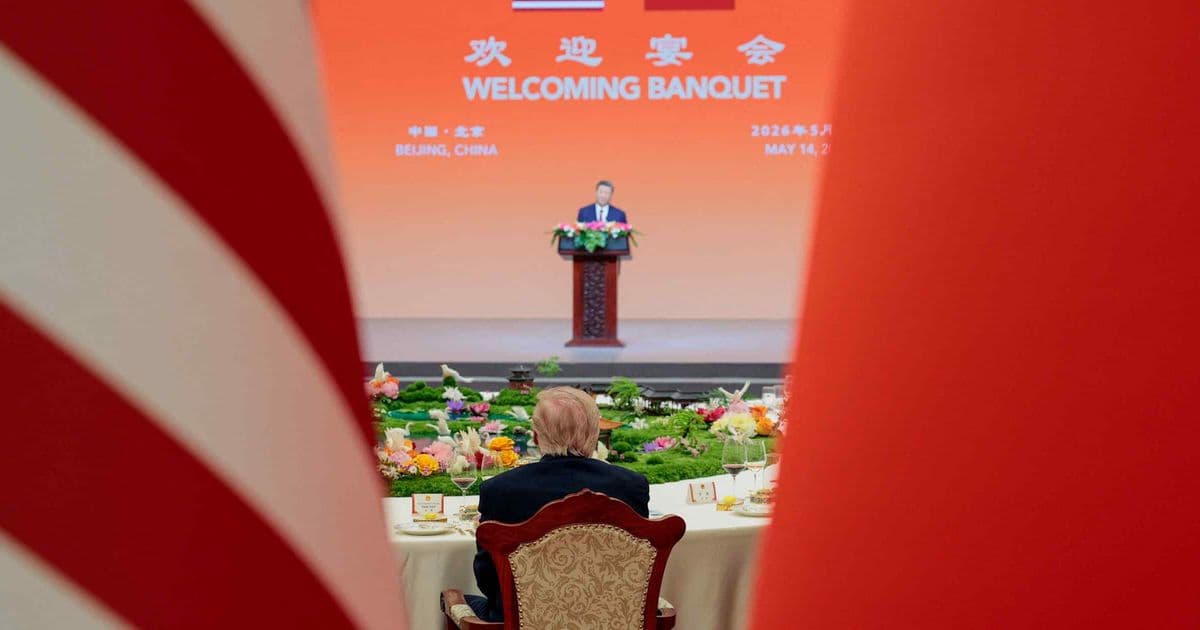
President Donald Trump’s three‑day visit to China, the first by a U.S. president since 2017, produced limited concrete agreements but highlighted key pressure points: Taiwan, AI chip export controls, and a potential $37 billion Boeing deal. The summit also set the stage for a White House invitation on Sept. 24, signaling a tentative reset in U.S.–China relations amid broader geopolitical turbulence.
Business news
U.S. President Donald Trump arrived in Beijing on May 13, 2026, for a three‑day state visit that included a bilateral meeting with President Xi Jinping, a state banquet, and a tour of the Temple of Heaven. The delegation featured top‑tier corporate leaders – Elon Musk (Tesla), Tim Cook (Apple), Jensen Huang (Nvidia) and Kelly Ortberg (Boeing). The most headline‑grabbing moment was Trump’s invitation to Xi and his wife to the White House on Sept. 24, a diplomatic overture that could pave the way for a second summit later this year.
Market context
Trade and aerospace
- China has signaled interest in purchasing up to 600 Boeing jetliners, roughly double the 300 aircraft bought during Trump’s 2017 visit, a deal that would be worth $74 billion at catalog prices. The transaction would come at a time when Chinese airlines have already placed $37.2 billion in orders for Airbus aircraft, intensifying competition between the two manufacturers.
- The yuan was trading at 6.79 CNY per USD, its strongest level in over three years, reflecting Beijing’s managed appreciation strategy aimed at internationalising the renminbi and reducing reliance on the dollar.
Technology and AI chips
- Nvidia’s CEO attended the business round‑table, stoking speculation that Washington may ease export curbs on high‑end AI chips. China’s customs data show chip exports up 83.7 % YoY in value and 10.6 % in volume for the first four months of 2026, underscoring the country’s growing role as both a buyer and supplier in the global AI supply chain.
Taiwan and security
- Xi warned that mishandling the Taiwan question could lead to a “clash.” The U.S. has not publicly altered its “one‑China” stance, but the summit’s silence on the issue suggests a tactical avoidance rather than a policy shift. The Taiwan Affairs Office reiterated that “our resolve to oppose Taiwan independence is as firm as a rock.”
What it means
- A tentative diplomatic thaw – The invitation to the White House signals a willingness on both sides to engage at a high level, but the lack of immediate breakthroughs on trade tariffs or Taiwan indicates that core strategic disagreements remain.
- Aerospace market opportunity – If the Boeing deal materialises, it would inject $74 billion of U.S. manufacturing revenue and could shift the balance of aircraft market share in China. However, Airbus’s recent wins and the domestic high‑speed rail network’s price advantage mean Boeing will need competitive pricing and delivery schedules.
- AI export policy under review – The presence of Jensen Huang suggests that the U.S. may consider a calibrated relaxation of export restrictions on AI accelerators, potentially unlocking a $15‑$20 billion market for American chip firms in China. Any policy change will have to balance national‑security concerns with the economic benefits of expanded sales.
- Currency dynamics – The yuan’s appreciation, supported by policy tolerance, could make Chinese imports cheaper for U.S. buyers, enhancing the attractiveness of a “open‑up” pledge from Trump. Conversely, a stronger yuan may pressure Chinese exporters to manage profit margins, especially in sectors hit by the Middle‑East conflict‑driven fuel price spikes.
- Geopolitical risk premium – Ongoing tensions in the Iran‑Gulf region and the unresolved Taiwan flashpoint keep the risk premium high for investors. The CSI 300 Index fell about 1 % on summit day, while the S&P 500 rose 0.6 %, reflecting divergent market sentiment.
Outlook
The September White House meeting will be the first test of whether the diplomatic gestures in Beijing translate into concrete policy shifts. Analysts will watch for:
- Any amendment to the U.S. export control list for AI chips.
- Confirmation of the Boeing aircraft order and its financing terms.
- Signals from the U.S. side on arms sales to Taiwan, which could trigger a diplomatic backlash from Beijing.
If progress is made on these fronts, the summit could mark the beginning of a more stable, albeit competitive, U.S.–China relationship. If not, the visit may be remembered as a high‑profile photo‑op that failed to move the needle on the underlying strategic frictions.
Further reading
Comments
Please log in or register to join the discussion