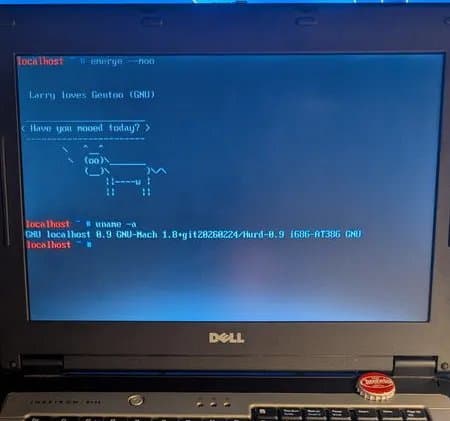
Gentoo Linux has released experimental GNU/Hurd images following an April Fools' joke about switching kernels, offering enthusiasts a chance to test this rare combination in virtual machines.
Following an April Fools' Day tease that had the Linux community buzzing, Gentoo Linux has officially released experimental GNU/Hurd images for those adventurous enough to explore this unconventional operating system combination. The announcement came after Gentoo initially claimed they would switch to GNU Hurd as their primary kernel, only to later reveal it as an elaborate joke while simultaneously unveiling the experimental images.
The April Fools' Revelation
The initial announcement on April 1st sent shockwaves through the Linux community, with many taking the bait before Gentoo clarified their position. The tongue-in-cheek announcement stated that Gentoo would be abandoning the Linux kernel in favor of GNU Hurd, the microkernel-based system that has been in development since the 1990s but never achieved widespread adoption.
However, the joke came with a twist. Gentoo acknowledged the prank while simultaneously announcing that experimental Gentoo GNU/Hurd images were indeed available for testing. This meta-approach to April Fools' Day demonstrates Gentoo's playful relationship with their user base while also contributing to the preservation and testing of alternative operating systems.
Current State of Gentoo GNU/Hurd
The experimental images are currently available for i686 architecture, with x86_64 feature parity listed as a future goal. This limitation reflects the current state of GNU Hurd development, which has historically lagged behind mainstream kernel development in terms of hardware support and feature completeness.
Gentoo describes the GNU/Hurd implementation as "heavily experimental," which is an accurate characterization given the challenges inherent in running Hurd on modern hardware. The microkernel architecture of Hurd, while theoretically elegant, presents significant compatibility challenges with contemporary hardware and software ecosystems.
Testing Recommendations
Gentoo strongly recommends testing the GNU/Hurd images within virtual machines rather than attempting to run them on physical hardware. This recommendation stems from several factors:
- Limited hardware driver support in Hurd
- Potential stability issues with newer hardware components
- The experimental nature of the port
- Better isolation for testing purposes
The official announcement does show Gentoo GNU/Hurd running on "real hardware" - specifically an ancient Dell laptop with a notably large display bezel. This visual cue serves as a reminder that Hurd's hardware support is limited to older, more compatible systems.
Comparison to Debian GNU/Hurd
Gentoo's effort is described as being "akin to the Debian GNU/Hurd effort," suggesting a similar approach to packaging and system integration. Debian has maintained GNU/Hurd support for many years, providing a reference point for Gentoo's experimental implementation.
The key differences likely lie in Gentoo's package management philosophy and the Portage system, which would need to be adapted to work with Hurd's unique characteristics. Gentoo's source-based distribution model may present both opportunities and challenges when working with Hurd's microkernel architecture.
Future Development Plans
According to the announcement, several features are planned for future development:
- Release media like stages for easier installation
- Automated image builds for regular updates
- x86_64 architecture support
- Improved hardware compatibility
These planned features suggest that Gentoo views this as more than just a temporary experiment, though the heavily experimental designation indicates that production use is not recommended at this stage.
Technical Challenges
Running Gentoo on GNU/Hurd presents numerous technical challenges:
- Package Compatibility: Many packages designed for Linux may require modification to work properly with Hurd's system call interface and filesystem structure
- Hardware Support: Modern hardware often lacks drivers for Hurd, limiting practical deployment scenarios
- Performance Considerations: The microkernel architecture can introduce overhead compared to monolithic kernels
- Development Resources: Hurd development has historically been limited compared to Linux kernel development
Community Response
The Linux community's response has been mixed, with some viewing it as an interesting preservation effort while others question the practical value of investing resources in such an experimental platform. The April Fools' context adds an element of humor to what is actually a serious technical undertaking.
For enthusiasts interested in alternative operating systems, historical preservation, or simply exploring different computing paradigms, the Gentoo GNU/Hurd images offer a unique opportunity to experience a different approach to system architecture.
Getting Started
Those interested in experimenting with Gentoo GNU/Hurd can find the official announcement and download links at Gentoo.org. The project recommends using virtualization platforms like QEMU, VirtualBox, or VMware for initial testing.
Given the experimental nature of the release, users should expect:
- Potential instability
- Limited hardware support
- Incomplete package availability
- The need for manual configuration and troubleshooting
Historical Context
GNU Hurd represents one of the longest-running operating system projects in computing history. Originally intended to be the kernel for the GNU operating system, Hurd has been in development since the mid-1980s but has never achieved the widespread adoption of Linux or BSD kernels.
The project's microkernel architecture was designed to provide superior security and stability through process isolation, but the complexity of implementing such a system has proven challenging. While academic interest in microkernels remains, practical deployment has been limited.
Gentoo's decision to support GNU/Hurd, even experimentally, represents a commitment to computing diversity and the preservation of alternative system architectures. Whether this effort will lead to broader adoption or remain a niche curiosity remains to be seen, but it certainly provides an interesting case study in operating system design and community engagement.
Comments
Please log in or register to join the discussion