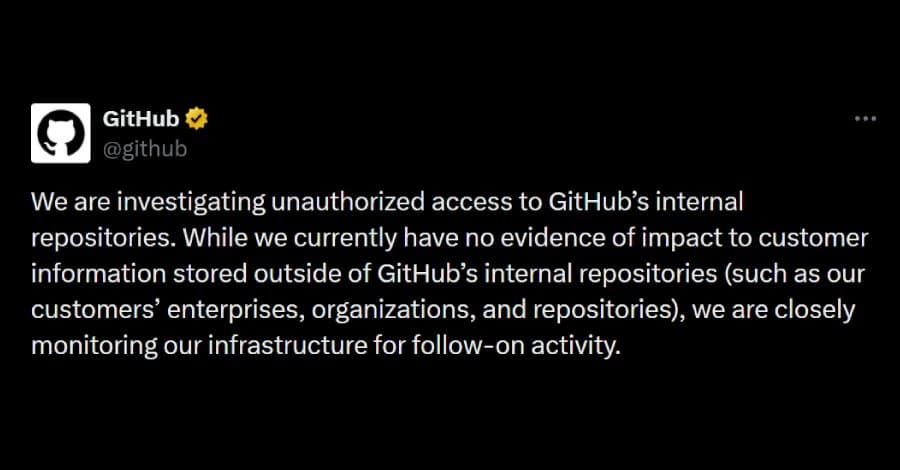
GitHub disclosed a breach that stemmed from a compromised Visual Studio Code extension on an employee’s workstation. Threat actor TeamPCP stole thousands of internal repositories and put the code up for sale. The article explains the attack chain, the broader supply‑chain implications, and concrete steps for developers, DevOps engineers, and security teams to protect their environments.
 )
)
The breach in a nutshell
On May 20 2026 GitHub announced that an attacker had accessed an employee’s device through a malicious Visual Studio Code (VS Code) extension. The intrusion allowed the threat group known as TeamPCP to copy more than 3,800 internal repositories and list the data for sale on a cyber‑crime forum. While GitHub says no customer‑facing data has been confirmed compromised, the incident highlights how a single compromised developer tool can cascade into a massive supply‑chain exposure.
How the attackers got in
- Poisoned VS Code extension – The malicious extension was installed on a GitHub employee’s workstation. Once loaded, it harvested stored credentials (personal access tokens, SSH keys, and SSO cookies) from the VS Code credential store.
- Credential abuse – With those tokens the attackers authenticated to GitHub’s internal API, enumerated repositories, and downloaded source code.
- Data dump for sale – TeamPCP posted the stolen code on a dark‑web marketplace, demanding a minimum price of $50,000. The group explicitly stated the leak was not a ransom; if no buyer appeared they would release the data publicly.
- Supply‑chain ripple – The same threat actor has been linked to the Mini Shai‑Hulud worm that compromised the
durabletaskPyPI package, showing a pattern of moving from developer‑tool compromise to broader package poisoning.
"A single compromised extension is enough to turn a trusted developer machine into a credential‑harvesting platform. Organizations must treat every third‑party tool as a potential attack surface," – Dr. Maya Patel, Principal Security Engineer at Wiz.
Why this matters beyond GitHub
- Internal code is a goldmine – Proprietary build scripts, CI/CD pipelines, and internal libraries often contain secrets (API keys, cloud credentials, internal IP ranges). Their exposure can accelerate downstream attacks on customer environments.
- Supply‑chain amplification – Once attackers obtain a token with repository‑read permissions, they can publish malicious versions of open‑source packages, as seen with the
durabletaskincident. Those packages then infect thousands of downstream projects. - Developer tooling trust model – VS Code extensions are signed, but the signing process can be bypassed if an attacker distributes a malicious version through a compromised developer account or a compromised extension marketplace.
Practical steps for organizations
1. Harden developer workstations
- Enforce extension whitelisting – Use VS Code’s
extensions.autoCheckUpdatesandextensions.ignoreRecommendationspolicies to allow only vetted extensions. Microsoft provides a policy‑JSON template for enterprise deployment. - Isolate credentials – Store personal access tokens (PATs) in a dedicated secret manager (e.g., Azure Key Vault, HashiCorp Vault) rather than the local VS Code credential store. Enable multi‑factor authentication on all GitHub accounts.
- Endpoint detection – Deploy EDR solutions that flag anomalous processes spawning from VS Code (e.g., unexpected network connections from
Code.exe).
2. Rotate and protect secrets immediately after a breach
GitHub’s response included rotating “critical secrets.” Follow a similar playbook:
- Identify high‑impact credentials – PATs with
repo,admin:org, orwrite:packagesscopes should be revoked first. - Automate rotation – Use GitHub’s Secret Scanning API to locate leaked tokens and trigger automated revocation via GitHub Actions.
- Audit audit logs – Review the organization’s audit log for unusual token creation or repository access patterns in the past 30 days.
3. Strengthen supply‑chain defenses
- Enable provenance for published packages – The new GitHub Package Provenance feature signs packages with a cryptographic attestation, making it harder for attackers to inject malicious code.
- Adopt SBOM verification – Integrate Software Bill of Materials (SBOM) checks into CI pipelines to ensure only approved dependencies are used.
- Monitor PyPI and other registries – Set up alerts for new versions of critical packages (e.g.,
durabletask) using tools like OSS Index or Snyk.
4. Incident‑response checklist for a compromised developer tool
| Step | Action |
|---|---|
| Contain | Disconnect the affected workstation from the corporate network. Disable the compromised user’s PATs and SSH keys. |
| Investigate | Capture a forensic image of the workstation. Look for suspicious VS Code extensions in %USERPROFILE%\.vscode\extensions (Windows) or ~/.vscode/extensions (Linux/macOS). |
| Eradicate | Remove the malicious extension, run a full anti‑malware scan, and reinstall VS Code from a trusted source. |
| Recover | Re‑issue clean credentials, re‑enable the user’s access after verification, and monitor for re‑infection. |
| Post‑mortem | Document the attack chain, update extension‑allowlist policies, and conduct a tabletop exercise with the DevSecOps team. |
"Treat every developer‑installed binary as a potential entry point. A disciplined extension‑allowlist combined with automated secret rotation can cut the dwell time from weeks to hours," – James Liu, Senior Threat Analyst at Aikido Security.
What to watch for next
- Further data dumps – TeamPCP has already hinted at leaking the GitHub code for free if no buyer appears. Security teams should monitor dark‑web forums and GitHub’s public commit stream for any accidental exposure of internal identifiers.
- Cross‑platform propagation – The Mini Shai‑Hulud worm can spread through AWS SSM,
kubectl exec, and even trigger destructive payloads on systems with Israeli or Iranian locale settings. Organizations running workloads in those regions should audit their SSM permissions and restrictkubectl execto privileged accounts only. - Emerging “FIRESCALE” C2 technique – The worm embeds backup C2 addresses in public commit messages using a
FIRESCALE <base64>pattern. Scanning commit histories for that pattern can provide early warning of compromised repositories.
Bottom line
The GitHub breach underscores a simple truth: the security of your supply chain starts at the developer’s desk. By tightening extension controls, automating secret rotation, and continuously monitoring package registries, teams can dramatically reduce the risk of a single compromised tool leading to a massive data exfiltration.
For further reading, see the official GitHub incident statement, the Wiz analysis of the durabletask compromise, and the Aikido Security blog on the Mini Shai‑Hulud worm.
Comments
Please log in or register to join the discussion