A developer from Uzbekistan built GitHub Store, a cross-platform app distribution platform that uses GitHub releases as its backend, growing it to 12,500+ stars in just six months without external funding or coding assistance.
In the world of app distribution, the barriers to entry can be surprisingly high, especially for small projects and independent developers. This reality led a 16-year-old developer in Uzbekistan to create GitHub Store—a cross-platform alternative to traditional app stores that has garnered 12,500+ stars and served 250,000+ updates in just six months.
The Problem with Traditional App Stores
The developer, who goes by @rainxchzed on GitHub, initially set out to publish a small Android app as part of Philipp Lackner's Mobile Dev Campus challenge. The Play Store's requirements quickly became a roadblock:
- $25 developer fee
- Government ID verification
- Address verification
- 20 closed testers
- 2-week minimum closed testing period
- Potential approval wait times of up to a month
For a side project, this level of friction didn't make practical sense. "The math wasn't there," the developer explained. "GitHub already lets developers publish APKs in releases. So I figured: build a store on top of that. That gap was the project."
Technical Implementation: Kotlin Multiplatform
The developer chose Kotlin Multiplatform (KMP) for the project, bringing two years of Android development experience to desktop applications without needing to learn new languages or frameworks.
"Kotlin was my language. Compose was my UI toolkit. Flutter would've meant Dart + new build system + new debugger. React Native would've meant JavaScript I didn't know. Tauri would've meant Rust I didn't know. KMP let me bring two years of Android straight into Desktop without changing language, IDE, or mental model. I picked it because I could ship faster."
The first version was completed in a single week of intense focus, with the developer skipping school and studies, working late into some nights. Notably, this was accomplished without the assistance of modern coding agents like Cursor, Copilot, or Claude Code—relying instead on IntelliJ, the Compose Multiplatform docs, and the Ktor docs.
The initial MVP included:
- GitHub Releases search via the public API
- Asset filtering for APKs and Desktop installers
- Tap-to-install functionality on Android
- A single UI codebase supporting Android, Windows, macOS, and Linux
Growth Trajectory
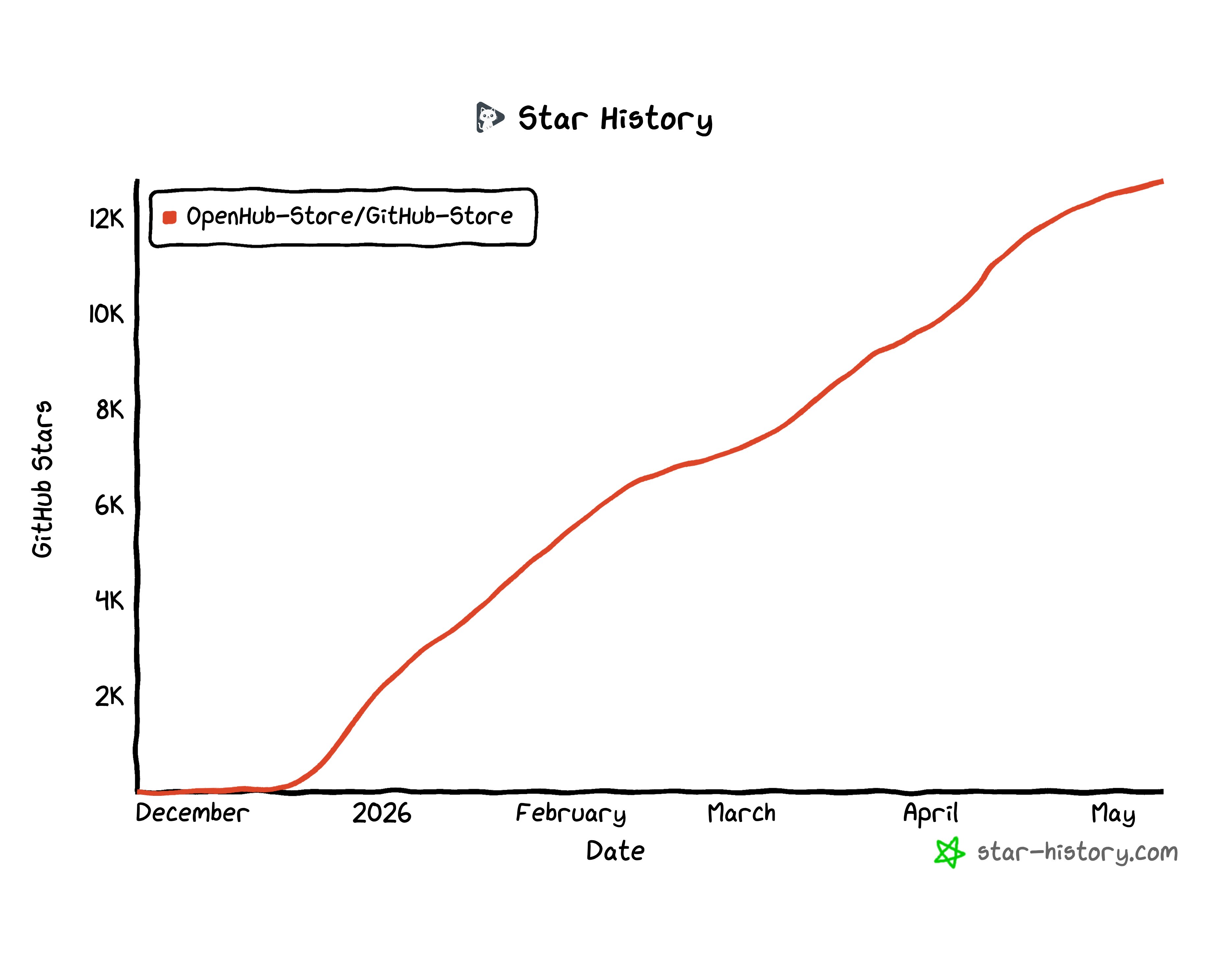
The project's growth followed an interesting pattern:
- November 21, 2025: Private development begins
- Late November: Repository made public
- November 30: First star
- December 15: 100 stars
- January 3: 2,500 stars
The developer shared milestones on LinkedIn, which generated significant engagement. A major turning point came when HowToMen featured GitHub Store in his "Top 12 App Stores Better than Play Store" video, exposing the project to an audience of privacy-conscious Android users who were already distrustful of the Play Store.
The Valley of Doubt
Around the 2,000-3,000 star mark, the developer experienced a period of significant self-doubt:
"Around 2-3,000 stars I went strange. Heads-down for months. Product getting attention. People writing nice things. Issues piling up. And I started losing the plot. I'd open the repo and just stare. Why am I doing this. Is anyone going to use this long-term. Is the star count just vanity. Am I spending my life on something that doesn't matter."
This "valley" period is a common experience for developers of successful open-source projects. Despite external indicators of success, the developer questioned the project's value and their own motivation. What helped pull them through was direct user feedback—messages from developers whose workflows had changed, bug reports from engaged users, and maintainers claiming their repo pages.
Differentiation from Alternatives
GitHub Store inevitably draws comparisons to existing alternatives like Obtainium and F-Droid. The developer acknowledges this but sees different use cases:
"Obtainium is the lightweight power-user updater for repos you already know about. GitHub Store is the discovery-first store for people who don't know what to install yet — and it's cross-platform. Use Obtainium. Use GitHub Store. Use both."
To facilitate this, the project includes Obtainium import/export functionality, allowing users to move between the two platforms with a single tap.
Current Status and Future Plans
Today, GitHub Store supports 13 languages and runs on Android, Windows, macOS, and Linux. The developer emphasizes that distribution is a feature, not just marketing, having integrated with multiple channels including F-Droid, Obtainium config, Scoop, Winget, and IzzyOnDroid.
Looking ahead, the project has several planned improvements:
- A new design that's substantially nicer than the current interface
- Better Desktop support with auto-update capabilities
- A 100x better user experience
- A potential paid tier for features that incur costs to run
The developer maintains a clear principle regarding monetization: "GitHub Store charges only for features that cost us money to run. Storage, bandwidth, compute, monitoring. Anything that runs on your device stays free, forever. Backend is open source and self-hostable."
Lessons for Young Developers
The developer shares several valuable insights for other young developers considering their own projects:
Ship first, know your audience second: "I didn't research the audience before I shipped. The audience showed up — FOSS users who love tinkering, hate ads, hate tracking, want privacy. Knowing that landed me on every product decision afterward."
KMP works, even on Desktop: The cross-platform approach wasn't just marketing—it enabled reaching a broader audience.
Talk to your users directly: "Release notes don't cut it. Most people don't read them." The developer built in-app feedback mechanisms, including a what's-new sheet, announcements feed, and a Discord server.
Localize early: "People will use your app worldwide if it's good and they can read it. The limiters are language and network." GitHub Store's backend proxy helps users in regions with restricted internet access.
The valley is real: "Nobody warned me about the valley. What's next A lot more coming."
GitHub Store represents an interesting case study in indie development, demonstrating how a focused solution to a personal problem can grow into a widely-used platform. The project's success stems from its practical approach to app distribution, respect for user privacy, and the developer's commitment to listening to their community.
For developers interested in exploring GitHub Store, the project is available on GitHub. The developer can be followed on Twitter at @rainxchzed.
Comments
Please log in or register to join the discussion