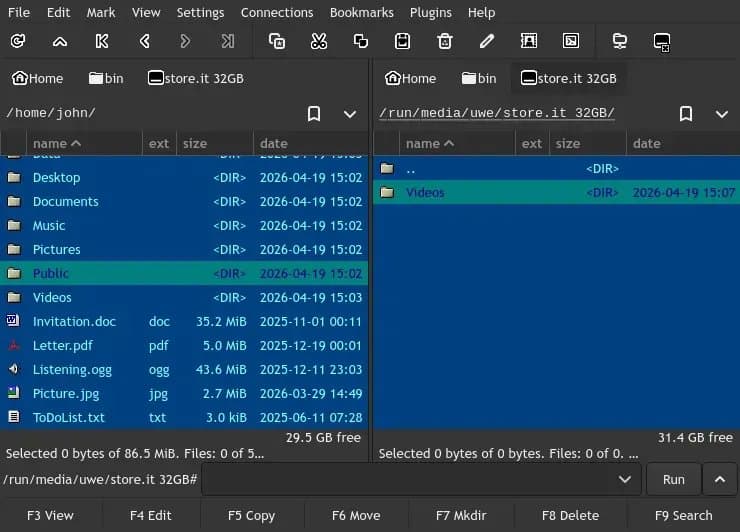
The classic Norton Commander-inspired file manager has undergone a complete transformation, moving from C++ to Rust with GTK4, adding an embedded terminal, and enhancing accessibility features.
GNOME Commander, the beloved orthodox file manager that pays homage to the classic Norton Commander interface, has reached version 2.0 following a complete rewrite in Rust and transition to the GTK4 toolkit. This represents a significant architectural shift for the application, which was previously written in C++ and used GTK3.
The rewrite in Rust brings several advantages to the table. Rust's memory safety guarantees and robust error handling should make GNOME Commander more stable and less prone to crashes compared to its C++ predecessor. For users running this file manager on critical systems or in production environments, this increased reliability is a welcome improvement.
The migration to GTK4 aligns GNOME Commander with the latest GNOME ecosystem, bringing better performance, improved accessibility support, and enhanced Wayland compatibility. Wayland support has been particularly strengthened in this release, which is crucial as Linux desktop environments continue to transition away from X11.
Key New Features in GNOME Commander 2.0
One of the most notable additions is the embedded terminal functionality. This allows users to run commands directly within the GNOME Commander interface without needing to switch to a separate terminal emulator. The terminal output is displayed in a dedicated pane, making it convenient for file operations that require command-line interaction.
The quick search functionality has been redesigned to provide a more intuitive and efficient experience. For users who frequently navigate through large directory structures, improved search capabilities can significantly enhance productivity.
Other enhancements include:
- Improved search dialog with better filtering options
- Enhanced internal viewer for previewing files
- Better accessibility support, making the application more usable for people with disabilities
- An improved keyboard shortcuts dialog, making it easier to discover and customize key bindings
Technical Implications of the Rewrite
The move from C++ to Rust isn't just about language preference—it represents a fundamental shift in development philosophy. Rust's ownership model and borrow checker eliminate entire classes of memory-related bugs that are common in C++ codebases. For a file manager that handles system resources and user data, this increased safety is particularly valuable.
GTK4 brings several improvements over GTK3, including better rendering performance, improved accessibility support through ATK, and more efficient handling of Wayland protocols. These improvements should translate to a smoother user experience, especially on systems with limited resources.
For developers interested in the technical details, the source code is available on GitHub. The repository contains documentation, build instructions, and issue tracking for those who want to contribute or examine the implementation.
Build Recommendations
For users looking to install GNOME Commander 2.0, the application should be available in the repositories of most major Linux distributions. For Ubuntu and Debian-based systems, you can expect to find it in the main repository or as a flatpak from Flathub. Arch Linux users will likely find it in the AUR.
For those building from source, the requirements include:
- Rust toolchain
- GTK4 development libraries
- Appropriate build dependencies
The project maintainers have indicated that the application is now feature-complete for the 2.0 release, but ongoing development will focus on bug fixes, performance optimizations, and additional Wayland improvements.
Conclusion
GNOME Commander 2.0 represents a significant evolution of a classic application. The rewrite in Rust and migration to GTK4 positions it as a modern file manager ready for the current Linux desktop landscape. The addition of an embedded terminal and improved search functionality enhances its utility for both casual users and power users.
For enthusiasts who appreciate the dual-pane interface of orthodox file managers but want modern features and reliability, GNOME Commander 2.0 is an excellent choice that bridges the gap between classic functionality and contemporary design.
More details on other GNOME app updates can be found via This Week in GNOME, which provides regular updates on developments across the GNOME ecosystem.
Comments
Please log in or register to join the discussion