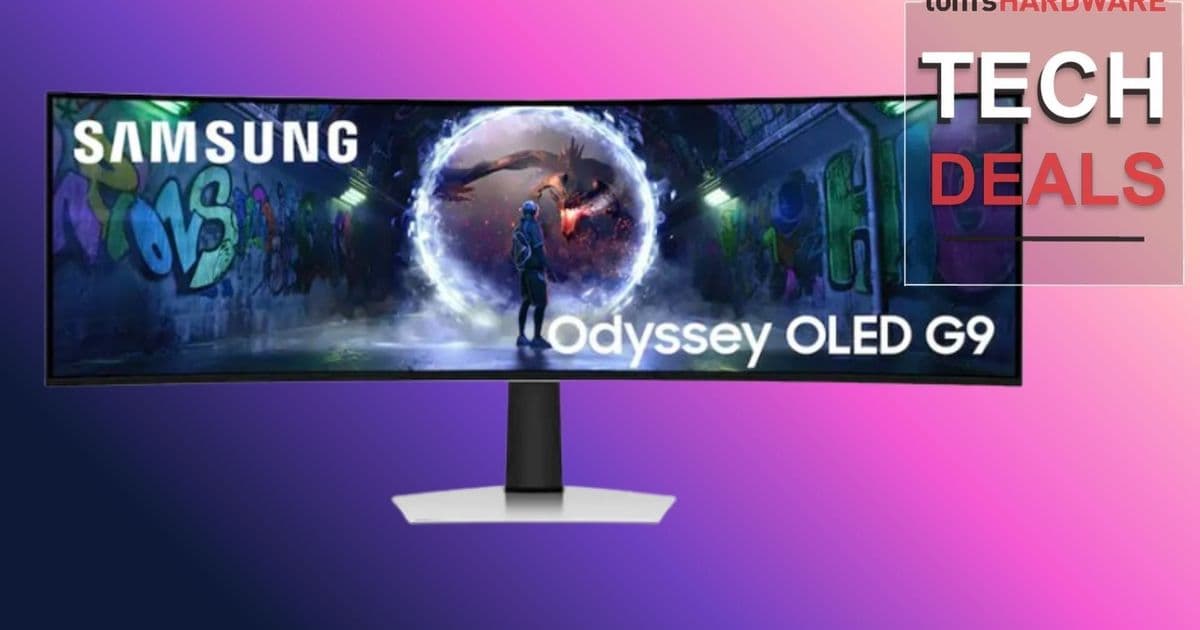
Best Buy's $700 discount on Samsung's 49-inch Odyssey OLED G9 (G93SD) monitor reflects broader trends in display panel economics and QD-OLED adoption, bringing a previously niche enthusiast product closer to mainstream accessibility while highlighting technical trade-offs in ultrawide gaming displays.
The recent price reduction of Samsung's Odyssey OLED G9 G93SD to $999 at Best Buy represents more than a seasonal promotion—it reveals evolving cost structures in high-end display manufacturing and shifting consumer expectations for ultrawide gaming monitors. This 49-inch QD-OLED panel, previously commanding a $1,700 premium, now enters a price bracket where its technical specifications warrant closer examination against both OLED and LCD alternatives in the 240Hz+ segment.
At the core of this monitor's value proposition lies Samsung's QD-OLED technology, which combines quantum dot enhancement with OLED's self-emissive properties. Unlike traditional WOLED panels that use white subpixels with color filters, QD-OLED employs blue OLED emitters paired with red and green quantum dots to produce color. This approach theoretically achieves higher peak brightness (up to 1,000 nits in HDR) and wider color gamut coverage than conventional OLED while maintaining the per-pixel lighting advantages that enable true blacks and near-instantaneous 0.03ms gray-to-gray response times. The 5120x1440 resolution (Dual QHD) delivers 110 pixels per inch—a density that balances sharpness with the monitor's aggressive 1800R curvature, which Samsung claims optimizes field of view for the ultrawide format.
The 240Hz refresh rate specification requires contextualization within current interface capabilities. Achieving this rate at 5120x1440 necessitates Display Stream Compression (DSC) over DisplayPort 1.4, as the uncompressed bandwidth exceeds the interface's 32.4 Gbps limit. HDMI 2.1 ports on the G93SD are similarly constrained to 120Hz at native resolution without compression, making DisplayPort the primary path for maximum refresh rates—a nuance often overlooked in promotional material. Real-world testing shows sustained 240Hz operation depends heavily on GPU output stability and game optimization, with titles lacking proper ultrawide support frequently defaulting to lower effective refresh rates through aspect ratio conversion.
From a market perspective, this price point positions the G93SD against emerging competitors in the ultrawide OLED space. LG's upcoming 45-inch WOLED panels (like the 45GR95QE) target similar productivity/gaming hybrids at lower resolutions but potentially better subpixel layouts for text clarity. Meanwhile, mini-LED LCD alternatives such as the Mini-LED equipped Odyssey Neo G9 offer higher sustained brightness (2,000 nits peak) but cannot match OLED's contrast ratios or response times. The $999 tag now places Samsung's offering within striking distance of high-end 32-inch 4K 144Hz monitors, forcing buyers to consider whether ultrawide immersion justifies the pixel density trade-off versus traditional dual-monitor setups.
Supply chain factors likely contribute to this pricing shift. Samsung Display's QD-OLED production lines, initially focused on smartphone panels, have scaled to monitor-sized Gen 8.5 substrates, improving yield rates and reducing per-unit costs. Concurrently, inventory management ahead of potential Q3 2024 panel refreshes (possibly featuring improved efficiency or updated HDMI 2.1 bandwidth) may be accelerating clearance of current-generation stock. The monitor's inclusion of a USB hub with 90W power delivery and Picture-by-Picture functionality further enhances its value as a single-display workstation replacement—a use case increasingly relevant as hybrid work persists.
For consumers, the decision hinges on specific use cases. Competitive gamers prioritizing motion clarity in esports titles will benefit most from the combination of low persistence and high refresh rate, though they must verify game compatibility with 32:9 aspect ratios. Content creators gain substantial horizontal timeline space in video editing applications, though the subpixel layout may require font smoothing adjustments for crisp text at 110 PPI. The monitor's HDR performance remains its strongest suit for media consumption, with the QD-OLED panel delivering exceptional highlight detail in HDR10+ content when properly calibrated.
This price adjustment underscores a broader maturation in the premium display market where panel technology advantages once exclusive to flagship televisions are trickling down to computer monitors at accelerating rates. While the G93SD still represents a significant investment, its current valuation reflects a more realistic assessment of the ultrawide OLED segment's total addressable market—one where technical excellence must now compete on value rather than solely on specification supremacy.
Comments
Please log in or register to join the discussion