
After a three-year development cycle, GNU Guix 1.5.0 arrives with a new consensus-based decision-making process, a migration to Codeberg, significant security improvements including a rootless daemon, and the completion of full-source bootstraps for Zig and Mono compilers, marking a pivotal evolution in the project's governance and technical capabilities.
The release of GNU Guix 1.5.0 is more than a version bump; it represents the culmination of a three-year period of profound internal transformation. For a project that operates as a rolling release, where users continuously receive updates via guix pull, a formal release is a significant milestone. This gap since the last major version underscores not stagnation, but rather a deliberate focus on addressing foundational processes that had become strained by the project's growth. With over 71,000 commits from 744 contributors during this period, the challenge was not a lack of activity, but the need to channel that activity into a sustainable, collaborative structure.
The most significant change lies in the project's social architecture. Recognizing that a growing contributor base complicates decision-making, the community unanimously adopted a new consensus-based process. This framework introduces Guix Consensus Documents (GCDs), a formal mechanism for proposing and ratifying significant changes. This move from ad-hoc discussion to structured deliberation is a critical evolution for any open-source project seeking longevity. It was this very process that enabled the project's migration to Codeberg, a move that consolidated repositories and bug trackers under one roof and shifted contribution workflows from patch series to pull requests. Complementing this, a new annual release cycle was established, providing a predictable rhythm for major milestones. The new Planet Guix aggregator further strengthens the community by centralizing the diverse voices of Guix hackers and contributors.
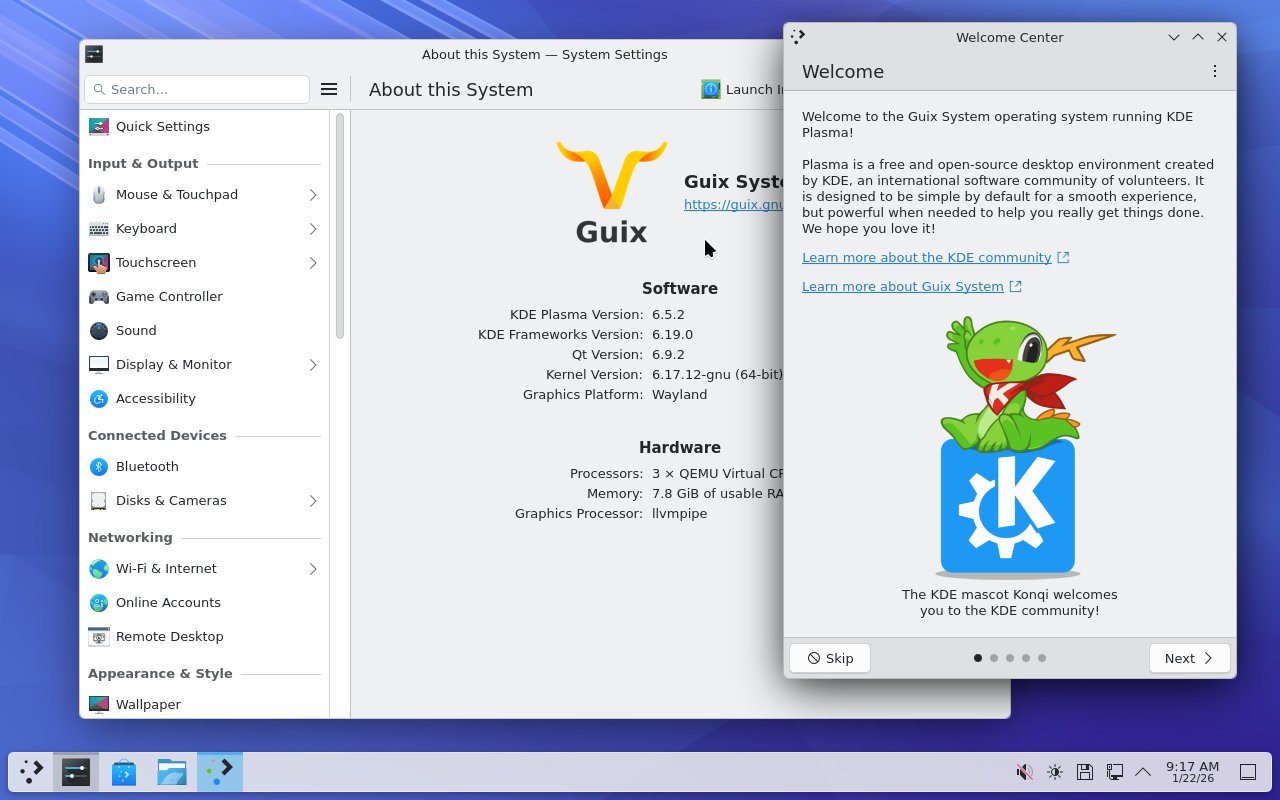
On the technical front, the distribution itself has matured substantially. The three-year interval allowed for the integration of 12,525 new packages and nearly 30,000 updates, keeping Guix among the top ten distributions by package count. Desktop environments saw major leaps: KDE Plasma 6.5 is now available with a dedicated plasma-desktop-service-type, and GNOME has been updated from version 42 to 46, now defaulting to Wayland. The gnome-desktop-service-type itself has been made more modular, allowing for finer-grained customization of the default application set.
Under the hood, Guix System has upgraded to GNU Shepherd 1.0, a service manager that now supports timed services, kexec reboots, and new services for system logs and log rotation, replacing legacy tools like Rottlog and syslogd. The introduction of approximately 40 new system services—including Forgejo Runner, RabbitMQ, iwd, and dhcpcd—expands the system's capabilities. Notably, the concept of setuid-programs has been replaced with privileged-programs in operating-system definitions, enabling more granular control over Linux capabilities. The inclusion of the nss-certs package in the base system ensures that SSL/TLS verification works out-of-the-box, a crucial detail for a functional system.
A key philosophical and technical achievement is the progress on full-source bootstraps. This addresses the "trusting trust" problem, where compilers are typically built by pre-existing binaries, creating a chain of trust that is difficult to verify. Guix has now achieved full-source bootstraps for the Zig and Mono compilers, meaning they can be built entirely from source code, all the way down to the first binary. This is a monumental effort in ensuring software freedom and reproducibility, as documented in the project's detailed posts on the Full-Source Bootstrap and Zig reproduction.
Security has been a major focus, with the introduction of a "rootless" mode for the Guix daemon. By leveraging user namespaces, the daemon can now operate without root privileges, significantly reducing the attack surface for privilege escalation vulnerabilities. This mode is the default when installing Guix on foreign distributions and can be enabled on Guix System. To support this, AppArmor profiles are now included by default. Furthermore, the daemon received critical security fixes for several CVEs (CVE-2024-27297, CVE-2024-52867, CVE-2025-46415, CVE-2025-46416, and CVE-2025-59378).
The project's commitment to hardware freedom is evident in its widened architecture support. Release tarballs are now available for RISC-V 64-bit (riscv64-linux), a growing architecture in the open hardware ecosystem. Experimental support for the GNU Hurd kernel on x86_64 (x86_64-gnu) has also advanced, with improvements that make it an option in the installer and allow it to run on a Thinkpad X60. This represents a significant step in the Hurd's practical adoption.
The collaborative effort is reflected in the structured work of 50 specialized teams. The HPC team's annual report highlights advancements in high-performance computing, while the electronics team maintains a suite of free software EDA tools like KiCad and LibrePCB, collaborating with the Free Silicon Foundation. The science team has added numerous astronomy packages, and the Python team has managed the transition to pyproject.toml and the NumPy 2 update. Perhaps most impressively, the Rust team developed a new packaging model that migrated the entire Rust collection—over 150 packages and 3,600 libraries—in under two weeks.
This release is also an invitation to support the project's infrastructure. The Guix Foundation is running a fundraising campaign to cover the costs of build farms, web servers, and QA tools essential for producing a distribution of this scale and quality. The work of 744 contributors, acknowledged in the release notes, is made possible by this underlying infrastructure, which requires sustained financial support.
In essence, Guix 1.5.0 is not merely a collection of new packages and features. It is the product of a community that has strengthened its governance, hardened its security, and deepened its commitment to software freedom through verifiable, source-based bootstrapping. It demonstrates how a technical project can mature its social processes to match its technical ambitions, ensuring that the principles of freedom and reproducibility are built into both the code and the community that sustains it.
Comments
Please log in or register to join the discussion