
Uniontech's latest Deepin Linux release introduces a Windows 11-style desktop, integrated LLM capabilities, and a partially-immutable OS layout using OSTree technology, signaling China's growing independence in desktop operating systems.
Uniontech has released Deepin 25.0.10, the latest point release of its community-focused Linux distribution, showcasing a modern desktop environment with integrated artificial intelligence features and a partially-immutable system architecture. The release demonstrates China's continued development of domestic operating systems that operate independently of Western technology stacks.

Desktop Environment and Visual Design
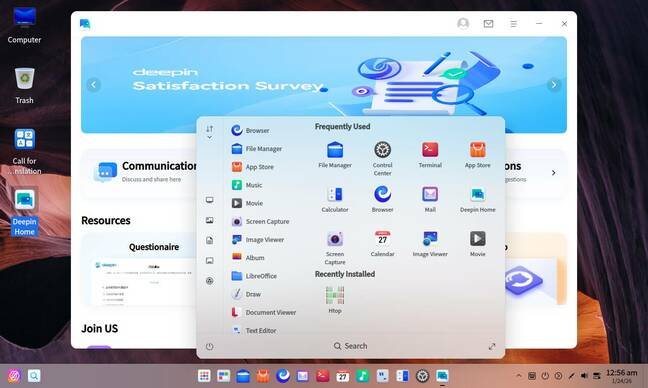
Deepin 25 maintains the Deepin Desktop Environment (DDE 7) that debuted in the previous major release. The interface follows a Windows 11-inspired layout with centered application launchers, though the leftmost position is reserved for Uniontech's AI assistant. The Settings application has been reorganized and the file manager has been revamped, though the changes are evolutionary rather than revolutionary. The overall aesthetic remains clean and modern, with a focus on visual appeal and user experience.
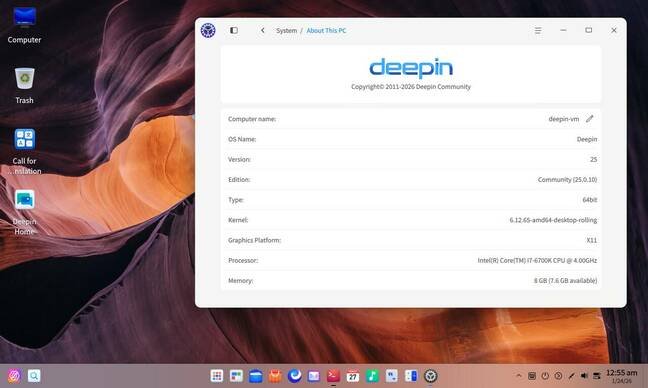
The distribution continues to use X11 for its display server, despite development work on a new Wayland compositor called Treeland. This Qt-based compositor is currently in technical preview status and not yet ready for production use. The development team has chosen to maintain stability in the current release rather than rushing to adopt Wayland before it's fully mature.
Integrated AI Capabilities
Deepin 25 includes "UOS AI," Uniontech's large language model assistant, integrated directly into the desktop. Upon first boot, users are presented with a welcome video demonstrating LLM-powered features primarily for Chinese language users, including automatic document translation, text snippet explanations, summarization, and local file search capabilities.
The AI assistant requires users to confirm they are over 18 and acknowledge that the English-language experience may not be perfect. When tested with the query "what Linux distribution is Deepin 25 based on?" the model responded with extensive text explaining that its training data was from 2023 and it cannot access the web. It correctly noted that previous Deepin versions were based on Debian but could not speculate about unannounced versions.
While the AI integration is present and fairly well-integrated into the system, the technology appears to be more of a marketing feature than a fundamental advancement. The model's limitations are evident, particularly its outdated training data and inability to access current information. However, for users who want these capabilities, they are built-in and accessible without additional configuration.
Immutable System Architecture
Deepin 25 introduces a partially-immutable operating system layout called "Solid," which is based on OSTree tooling. This approach protects critical system directories including /bin, /lib, /lib64, /sbin, and /usr, making them read-only even for the root user. This architecture provides system stability and security by preventing accidental or malicious modifications to core system components.
Unlike Red Hat's whole-OS immutable approach, Deepin's implementation is more selective. It doesn't create whole-system snapshots, and there are commands available to disable and re-enable immutability when needed. This pragmatic approach offers protection while maintaining flexibility for system administration. The implementation resembles techniques previously seen in openSUSE, though with Uniontech's specific modifications.
Packaging and Software Ecosystem
Deepin continues to use Uniontech's cross-platform packaging system called Linglong. The ll-cli list command shows approximately 20 installed Linyaps packages, including applications like email clients and calculators. This proprietary packaging format allows Uniontech to control the software ecosystem while maintaining compatibility across different hardware platforms.
The distribution avoids engaging in the Flatpak versus Snap debate, instead maintaining its own packaging solution. This approach gives Uniontech greater control over the software distribution chain and security model, though it may limit compatibility with the broader Linux software ecosystem.
Internationalization and Localization
English language support in Deepin 25 appears somewhat reduced compared to previous releases. The initial boot screen displays primarily in Chinese, with only the word "English" appearing in English text. While various US English keyboard settings are available, UK English is not offered—only a general "region" setting that prevents date format confusion.
The distribution supports international search engines and various character sets, but the user experience is clearly optimized for Chinese users. This Sinocentric approach reflects the distribution's primary target market while maintaining basic international accessibility.
Hardware Requirements and Compatibility
Deepin 25 has modest system requirements for x86-64 architecture: 8 GB of RAM, a display with 1920×1080 resolution or higher recommended, and at least 64 GB of disk space. The distribution requires approximately 6.7 GB of disk space and 1 GB of RAM for basic operation.
Hardware compatibility presents some challenges. Testing revealed issues with VMware Workstation and on a Thinkpad T420, though the live medium ran smoothly on a newer Dell XPS 13. This suggests the distribution may have better support for modern hardware than older systems.
Platform Support
Downloads are available for multiple architectures including AMD64, ARM64, and Loong64, with a preview version for RISC-V. This broad platform support demonstrates Uniontech's commitment to running on various hardware platforms, including China's domestic processor architectures.
Strategic Context
Deepin represents China's broader strategy of technological independence. By taking open-source software developed in the West and adapting it with domestic desktop environments, tools, and applications, China creates operating systems that can run on its own processors. This approach doesn't necessarily require world-beating innovation—merely "good enough" technology that enables China to rely on its own software stack for critical operations.
The distribution's pragmatic approach—using Debian and Red Hat technologies while avoiding total lock-in to Western immutable distro models—reflects a balanced strategy. It's neither purely open-source purist nor completely proprietary, but rather a hybrid that serves specific national interests while maintaining some compatibility with the broader Linux ecosystem.
Technical Architecture Notes
Deepin's use of OSTree for immutability represents a different philosophical approach compared to other immutable distributions. Rather than treating the entire system as immutable, Deepin protects only core directories, allowing for more flexibility in system administration. This approach may appeal to users who want system stability without sacrificing all administrative control.
The Treeland compositor development, while not yet ready for production, shows Uniontech's long-term planning. By building a Qt-based Wayland compositor, the company is preparing for the future display server transition while maintaining current stability with X11.
Conclusion
Deepin 25.0.10 represents a mature, visually appealing Linux distribution with integrated AI features and a pragmatic approach to system immutability. While the AI capabilities may not be revolutionary, they are integrated and functional. The partially-immutable architecture offers a middle ground between traditional mutable systems and fully immutable distributions. For users interested in Chinese-developed Linux distributions with modern features and hardware support across multiple architectures, Deepin 25 provides a compelling option.
The distribution's development reflects China's broader technological strategy of creating independent software ecosystems while leveraging existing open-source technologies. As such, Deepin serves not just as a desktop operating system but as a demonstration of China's growing capabilities in software development and system integration.
For those interested in exploring Deepin 25, the distribution is available for download from Uniontech's official website, with editions for AMD64, ARM64, Loong64, and a preview for RISC-V architectures.
Comments
Please log in or register to join the discussion