
Google's 2025 security report reveals massive scale of app store protection efforts, blocking 1.75M submissions and 255K apps from accessing sensitive data, while leveraging AI to detect evolving threats.
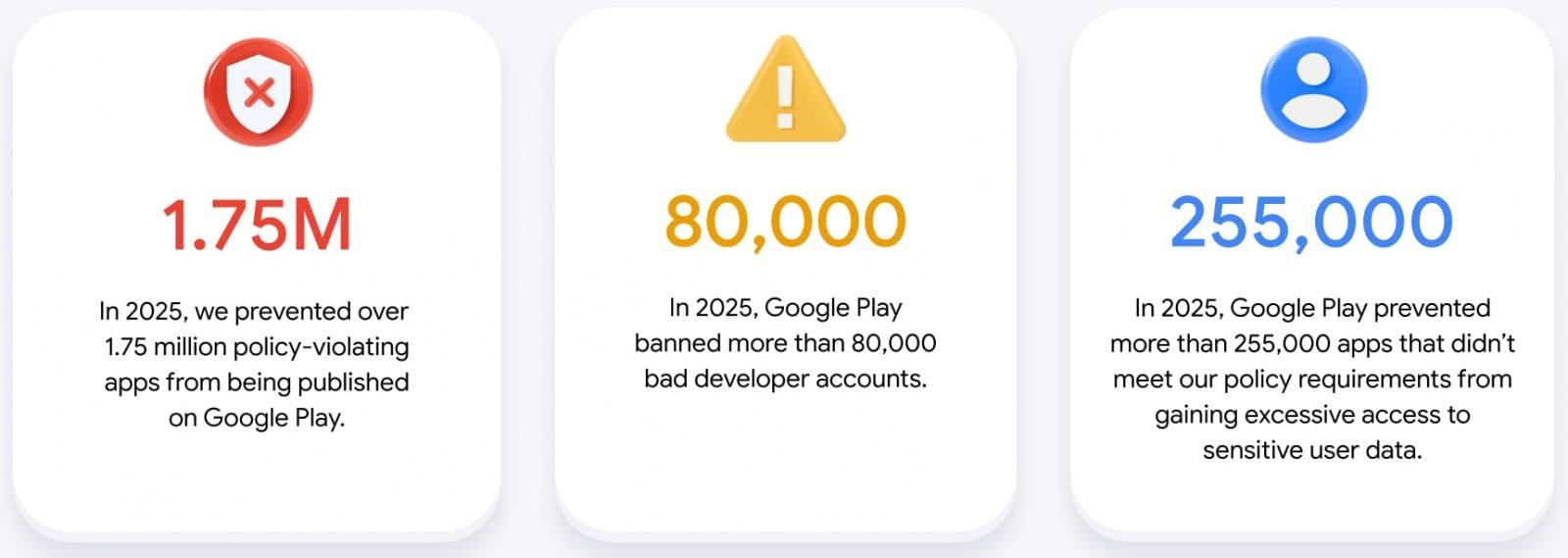
Google blocked over 1.75 million Play Store app submissions in 2025, according to the company's annual security review, highlighting the massive scale of threats facing Android's app ecosystem. The tech giant says it prevented more than 255,000 Android apps from obtaining excessive access to sensitive user data and rejected over 1.75 million apps from being published on Google Play due to policy violations.

"We're constantly improving our policies and protections to encourage safe, high-quality apps on Google Play and stop bad actors before they cause harm," Google stated in its report. The company implemented more than 10,000 safety checks on published apps and strengthened detection capabilities by integrating Google's latest generative AI models into the review process.
This AI integration enabled human reviewers to identify complex and evolving malicious patterns more quickly and accurately. The results were substantial: Google banned more than 80,000 "bad developer accounts," detected over 1.75 million policy-violating apps, and denied over 255,000 apps access to sensitive user data.
Spam ratings and inauthentic reviews represented another significant risk vector, as they can be used to manipulate user perception of an app. Google says it blocked 160 million ratings last year and prevented an average 0.5-star drop that apps targeted by "review bombing" would otherwise have suffered.
Android's built-in security suite, Play Protect, which now scans over 350 billion apps every day, has identified over 27 million malicious apps sideloaded from outside Google Play. The service's "enhanced fraud protection" was expanded to cover over 2.8 billion Android devices in 185 markets, blocking 266 million installation attempts from 872,000 unique risky apps.
The Play Integrity API service that app developers can use to protect their software against abuse and unauthorized access now processes over 20 billion checks every day. In 2025, new hardware-backed signals and in-app remediation prompts were added to strengthen this protection further.
Google also introduced built-in protections against "tapjacking attacks" with minimal developer effort in Android 16, released last June. These protections block hidden windows loading ads that are automatically tapped for fraudulent financial gains.
Looking ahead, Google says it will continue investing in AI-driven defenses, expand developer verification, and embed compliance tools directly into development workflows to prevent policy violations before apps are published.
The scale of Google's defensive efforts underscores the persistent and evolving nature of threats targeting mobile app ecosystems. As malware authors and bad actors develop increasingly sophisticated techniques, platform providers must continually adapt their detection and prevention mechanisms to maintain user trust and security.
Source: Google
The numbers reveal a troubling reality: for every legitimate app that makes it through Google's review process, multiple malicious or policy-violating submissions are blocked. This arms race between platform defenders and attackers shows no signs of slowing, with AI now playing a crucial role in helping Google stay ahead of emerging threats.
For developers, these enhanced protections mean stricter scrutiny but also greater protection against fraudulent competitors and abuse of their apps. For users, it translates to a safer app ecosystem, though the continued prevalence of sideloaded malware highlights the ongoing importance of sticking to official app stores and maintaining updated security software on Android devices.
Comments
Please log in or register to join the discussion