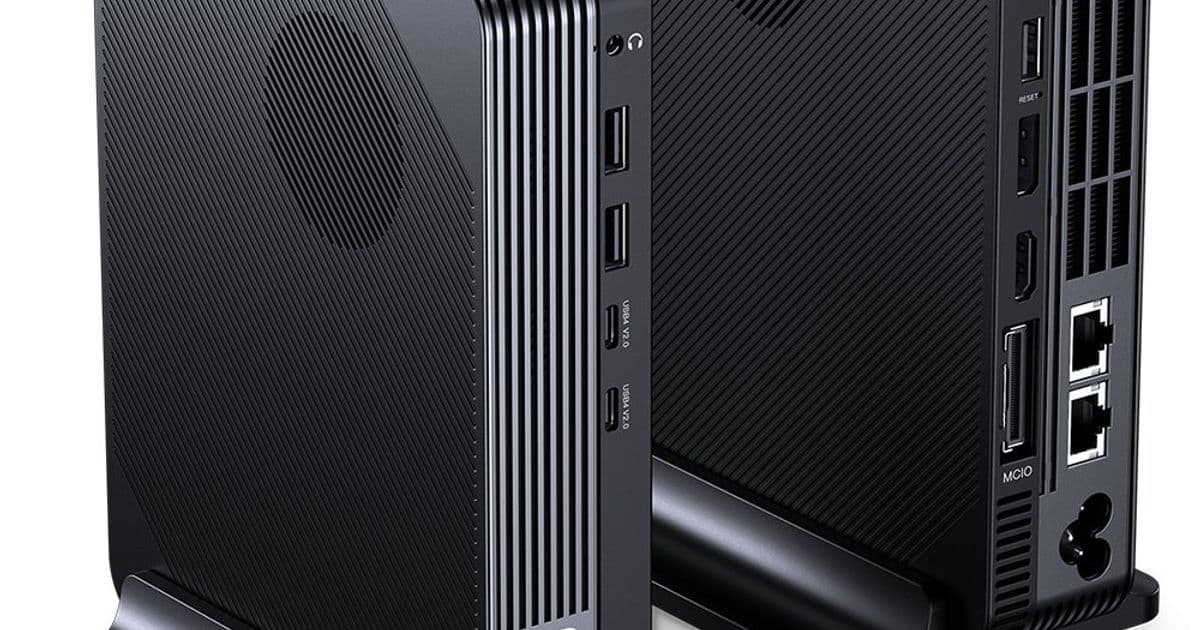
GPD has introduced the BOX mini PC featuring Intel's latest Panther Lake processors with an innovative optional MCIO 8i port that enables external PCIe 5.0 x8 connectivity, offering up to 256 Gbps bandwidth for GPU docks and high-speed peripherals.
GPD has unveiled its latest mini PC, the BOX, which brings Intel's newest Panther Lake processors to a compact form factor while introducing an innovative connectivity option that could change how developers and power users think about expandable mini systems.
At the heart of the GPD BOX are Intel's latest processors, with two configuration options available. The first model features an Intel Core Ultra X7 358H processor with 12-core Intel Arc B390 integrated graphics, offering performance comparable to entry-level discrete GPUs. The second model includes a Core Ultra 7 356H chip with 4-core integrated graphics. This dual-approach allows users to choose between better built-in graphics or the flexibility of external expansion.
The most notable feature of the GPD BOX is its optional MCIO 8i port, which functions as an external PCIe 5.0 x8 connector. This port provides up to 256 Gbps bandwidth, enabling connection to high-performance peripherals like GPU docks. According to GPD, this is sufficient to run an NVIDIA GeForce RTX 5090 in a GPD G2 graphics dock with only about a 2% performance hit compared to direct PCIe connection in a larger desktop.
MCIO 8i represents a significant advancement over the OCuLink ports that have become more common in mini PCs and handheld gaming devices in recent years. While OCuLink typically offers PCIe 4.0 x4 connectivity, MCIO 8i provides up to four times the bandwidth, making it a substantial leap forward for external connectivity in compact systems.
The decision to include the MCIO 8i port only on the Core Ultra 7 356H model appears strategic. Intel's Core Ultra X series chips, while offering better integrated graphics, provide only 12 PCIe lanes (4 x Gen 5 + 8 x Gen 4). In contrast, other Panther Lake chips offer up to 20 lanes (12 x Gen 5 + 8 x Gen 5), making them better suited for external expansion options like the MCIO 8i port.
Beyond the MCIO 8i innovation, both GPD BOX models come well-equipped for demanding tasks. They support up to 64GB of LPDDR5x-8533 onboard memory and include two M.2 2280 slots for storage—one PCIe 5.0 x4 and one PCIe 4.0 x2. Connectivity options include:
- 2 x USB4 v2 ports (80 Gbps theoretical speed)
- 4 x USB 3.2 Gen 2 Type-A (10 Gbps)
- 1 x DisplayPort 2.1
- 1 x HDMI 2.1
- 2 x 2.5 GbE LAN
- WiFi 6E and Bluetooth 5.3
The USB4 v2 ports are particularly noteworthy, offering theoretical speeds up to 80 Gbps, though they're limited to PCIe 4.0 x4 when used with graphics docks. This still provides substantial bandwidth for most external peripherals.
For cooling, the GPD BOX employs a dual-fan system with four heat pipes, allowing the processor to operate at up to 80 watts. The mini PC features an aluminum alloy body measuring 175 x 134 x 39.5mm (6.9" x 5.3" x 1.6") and includes a stand for vertical positioning, helping save desk space while potentially improving airflow.
A unique design element is the built-in 160W GaN power supply, eliminating the need for an external power brick. Users can connect the PC directly to a wall jack, reducing cable clutter and improving portability. The power button also includes an RGB backlight and integrated fingerprint sensor compatible with both Windows and Linux.
For developers and power users, the GPD BOX presents several compelling advantages. The MCIO 8i port opens possibilities for external GPU acceleration in development environments, potentially enabling more powerful workflows in a compact form factor. The high-speed USB4 v2 ports offer excellent connectivity for fast external storage and peripherals.
The availability of two distinct models allows users to tailor their system to specific needs. Those prioritizing integrated graphics for general development tasks might opt for the Core Ultra X7 358H, while those requiring maximum expandability would benefit from the Core Ultra 7 356H with its MCIO 8i port.
From a development perspective, the GPD BOX could serve as an excellent compact workstation for code compilation, virtualization, or lightweight content creation. The ability to connect high-performance external GPUs via MCIO 8i makes it particularly interesting for mobile developers who need to test applications across different performance tiers without maintaining multiple systems.
The inclusion of both DisplayPort 2.1 and HDMI 2.1 outputs supports multi-monitor setups, which can be crucial for development workflows. The 2.5 GbE LAN ports provide reliable wired networking, essential for development environments where consistent connectivity is important.
For developers working with virtual machines or containerized environments, the 64GB memory capacity and fast storage options ensure smooth operation of resource-intensive development setups. The compact size of the GPD BOX also makes it suitable for small office spaces or as a portable development workstation.
When considering migration to a system like the GPD BOX, developers should evaluate their specific needs. Those who rely heavily on GPU acceleration for tasks like machine learning, game development, or 3D rendering would benefit most from the MCIO 8i-enabled model. Meanwhile, those focused on general development, web development, or light virtualization might find the better integrated graphics of the X7 model sufficient.
The GPD BOX also represents an interesting option for developers who need a compact system that can double as a gaming or media device when not working. The combination of powerful integrated graphics and external GPU support provides flexibility for both productivity and entertainment.
As mini PCs continue to evolve, innovations like the MCIO 8i port demonstrate how manufacturers are pushing the boundaries of what's possible in compact computing. For developers maintaining applications across multiple platforms, having a powerful yet compact system that can handle various workloads without sacrificing performance could significantly improve productivity.
The GPD BOX is expected to be available soon, with pricing details to be announced. For more information, you can visit the official GPD product page.
In a computing landscape increasingly dominated by cloud services and remote work, devices like the GPD BOX offer an interesting middle ground—providing substantial local computing power in a form factor that doesn't compromise on expandability or connectivity. For developers who need to maintain local development environments while working from various locations, such compact yet powerful systems could become essential tools.
Comments
Please log in or register to join the discussion