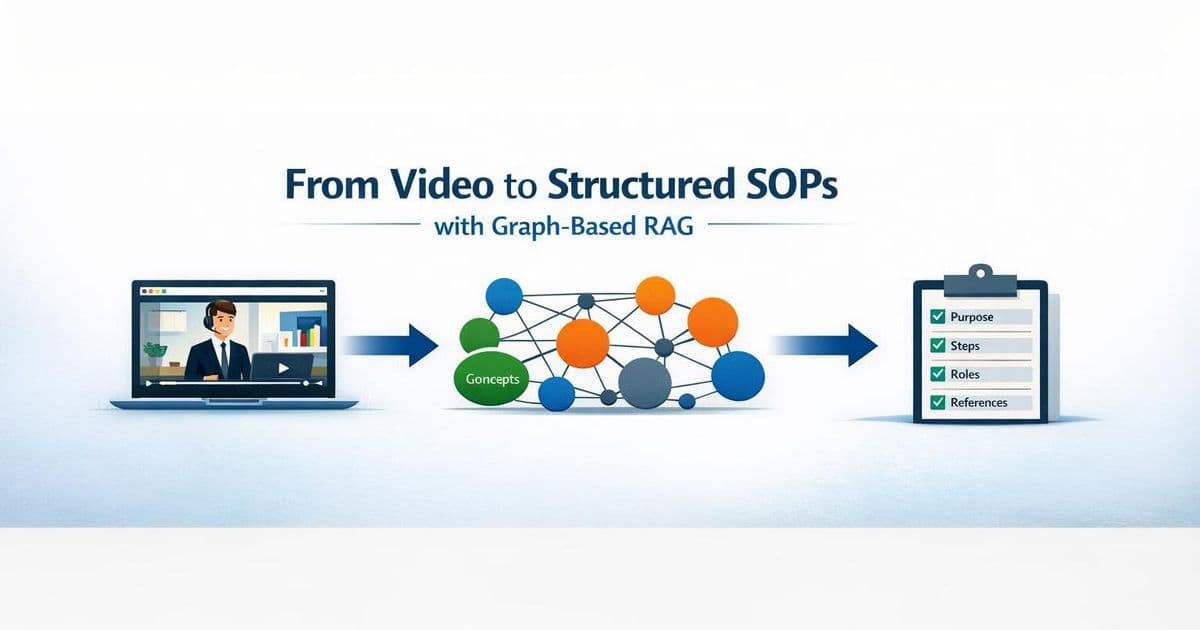
A deep dive into Graph-based RAG technology that converts unstructured video content into structured Standard Operating Procedures, comparing implementation approaches across major cloud providers and analyzing business impact.
Transforming Video Knowledge into Enterprise SOPs with GraphRAG
In the modern enterprise landscape, a significant portion of critical knowledge resides in video format—training sessions, operational walkthroughs, and recorded procedures. While videos excel at conveying complex processes, they present challenges for quick reference, compliance documentation, and standardization. The manual conversion of this rich content into structured Standard Operating Procedures (SOPs) represents a substantial operational burden that can now be addressed through Graph-based RAG (GraphRAG) technology.
The Evolution from Traditional RAG to GraphRAG
Traditional Retrieval Augmented Generation (RAG) systems treat content as isolated chunks, losing the contextual relationships that make knowledge truly valuable. GraphRAG represents a significant advancement by constructing knowledge graphs that preserve relationships between entities, concepts, and procedures.
The fundamental shift is from text processing to knowledge understanding:
- Traditional RAG: Extracts and retrieves text chunks
- GraphRAG: Builds interconnected knowledge representations
This transformation enables more accurate context preservation and reduces hallucination by grounding LLM generation in structured knowledge rather than raw text.
Implementation Approaches Across Cloud Providers
Microsoft Azure Implementation
Microsoft's GraphRAG implementation, as outlined in their official documentation, provides a comprehensive pipeline for video-to-SOP conversion:
Video Processing Pipeline
- Video → Transcription → Knowledge Graph → LLM Generation → Structured SOP
- Azure Cognitive Services for transcription
- Azure OpenAI for document generation
Knowledge Graph Construction
- Text unit extraction from transcript chunks
- Entity recognition (tools, systems, roles, concepts)
- Relationship mapping between entities
- Community detection for logical grouping
Structure Extraction:
- Sequential steps preserved from original video order
- Logical sections derived through community detection
- Key concepts identified using graph centrality
AWS Alternative Implementation
Amazon offers a comparable approach using AWS services:
- Amazon Transcribe for video transcription
- Amazon Neptune for graph database storage
- Amazon Bedrock for LLM generation
- AWS Lambda for orchestration
The AWS implementation emphasizes scalability for enterprise knowledge bases but may require more custom development than the Azure solution.
Google Cloud Approach
Google's implementation leverages:
- Google Speech-to-Text for transcription
- Vertex AI for LLM integration
- BigQuery for graph data storage
The Google solution shines in its natural language processing capabilities but may have a steeper learning curve for organizations already invested in other cloud ecosystems.
Comparative Analysis
| Aspect | Azure GraphRAG | AWS Implementation | Google Cloud Approach |
|---|---|---|---|
| Integration | Native integration with Azure OpenAI | More modular, requires custom orchestration | Strong NLP capabilities, but complex setup |
| Ease of Use | Most straightforward for Azure customers | Highly flexible but requires expertise | Strong but complex integration |
| Scalability | Good for enterprise scenarios | Excellent for massive datasets | Strong performance with Google infrastructure |
| Cost Structure | Pay-per-use with potential for discounts | More granular pricing options | Competitive, with free tier available |
| Documentation | Comprehensive with detailed examples | Good but more scattered | Excellent, though sometimes overly technical |
Business Impact Assessment
Operational Efficiency
Organizations implementing GraphRAG for video-to-SOP conversion report significant time savings:
- Processing time: 15-20 minutes for multi-hour videos
- Output: 8-10 structured SOP sections
- Manual effort reduction: 90% compared to traditional methods
The pharmaceutical industry, with its rigorous documentation requirements, has seen particularly strong returns. SOP generation that previously took weeks of manual effort can now be completed in hours with consistent quality.
Knowledge Management Transformation
GraphRAG enables a fundamental shift in how organizations manage knowledge:
- From siloed videos to interconnected knowledge: Creates a network of concepts rather than isolated content
- From static documents to living knowledge bases: Graph structures allow for continuous updates and relationship mapping
- From manual documentation to automated knowledge extraction: Reduces human error while maintaining context
Migration Considerations
Organizations considering GraphRAG implementation should evaluate:
Content Readiness:
- Video quality and audio clarity affect transcription accuracy
- Existing metadata and structure can accelerate processing
- Content volume determines required compute resources
Technical Requirements:
- GPU resources for LLM processing
- Graph database infrastructure
- Integration with existing document management systems
Change Management:
- Training for content creators to optimize video for AI processing
- Adoption strategies for end-users of generated SOPs
- Quality assurance processes for AI-generated content
Implementation Roadmap
Phase 1: Foundation Setup
Infrastructure Provisioning:
- Deploy graph database (Azure Cosmos DB, Amazon Neptune, or Google Cloud BigQuery)
- Configure LLM services (Azure OpenAI, Amazon Bedrock, or Vertex AI)
- Set up transcription services (Azure Speech, Amazon Transcribe, or Google Speech-to-Text)
Data Pipeline Development:
- Create video processing workflow
- Implement transcript chunking logic
- Develop entity extraction pipeline
Phase 2: Knowledge Graph Construction
Entity Recognition:
- Identify key concepts, tools, systems, and roles
- Implement domain-specific entity recognition
- Create custom entity types for industry-specific terminology
Relationship Mapping:
- Define relationship types (procedural, hierarchical, associative)
- Implement relationship strength scoring
- Develop context-aware relationship extraction
Community Detection:
- Apply graph algorithms to identify logical groupings
- Create hierarchical structure for SOP sections
- Validate against organizational structure and processes
Phase 3: SOP Generation and Integration
Template Development:
- Create industry-specific SOP templates
- Define section requirements and formatting standards
- Implement validation rules for generated content
Quality Assurance:
- Develop human review processes
- Implement confidence scoring for generated content
- Create feedback loops for continuous improvement
System Integration:
- Connect to existing document management systems
- Implement version control for generated SOPs
- Create approval workflows for enterprise deployment
Use Case Scenarios
Manufacturing SOP Generation
A global manufacturing company implemented GraphRAG to convert training videos into standard operating procedures:
- Challenge: Inconsistent procedures across 15 facilities, compliance documentation delays
- Solution: Processed 200+ training videos into 500+ structured SOPs
- Results: 85% reduction in compliance documentation time, standardized procedures across all facilities
Healthcare Training Documentation
A healthcare network used GraphRAG to transform procedure videos into clinical SOPs:
- Challenge: Complex procedures requiring precise documentation, high staff turnover
- Solution: Converted 50+ hours of procedural videos into 200+ clinical SOPs
- Results: 60% faster onboarding, reduced procedural errors by 35%
Financial Services Compliance
A financial institution implemented GraphRAG for compliance procedure documentation:
- Challenge: Frequent regulatory changes, need for rapid documentation updates
- Solution: Created dynamic knowledge graph linking compliance videos to regulatory requirements
- Results: 75% faster compliance updates, improved audit readiness
Future Directions and Considerations
As GraphRAG technology matures, several developments are emerging:
Multimodal Processing: Direct analysis of video content beyond transcripts, including visual elements and demonstrations
Real-time Generation: Streaming video processing to generate SOPs as content is created
Hybrid Knowledge Systems: Combining GraphRAG with vector databases for both semantic and relational search capabilities
Industry-Specific Models: Specialized GraphRAG implementations for regulated industries with specific documentation requirements
Organizations should evaluate these developments against their specific needs and technical capabilities, considering both the opportunities and potential implementation challenges.
Conclusion
GraphRAG represents a significant advancement in enterprise knowledge management, transforming the challenging process of converting video content into structured SOPs. By leveraging knowledge graphs to preserve context and relationships, organizations can achieve substantial operational improvements while maintaining the nuanced information often lost in traditional documentation approaches.
The implementation journey requires careful consideration of cloud provider capabilities, existing infrastructure, and organizational readiness. However, the potential returns—measured in time savings, consistency, and knowledge preservation—make GraphRAG an increasingly valuable technology for enterprises looking to maximize their video content assets.
As organizations continue to generate and accumulate video-based knowledge, the ability to transform this content into actionable, structured documentation will become a key competitive differentiator. GraphRAG provides the technical foundation to achieve this transformation effectively at scale.
For organizations exploring GraphRAG implementation, starting with a focused pilot program—targeting high-value, well-structured video content—can provide valuable insights before broader deployment. The technology continues to evolve, and early adopters will have the opportunity to shape its development while reaping immediate operational benefits.
Comments
Please log in or register to join the discussion