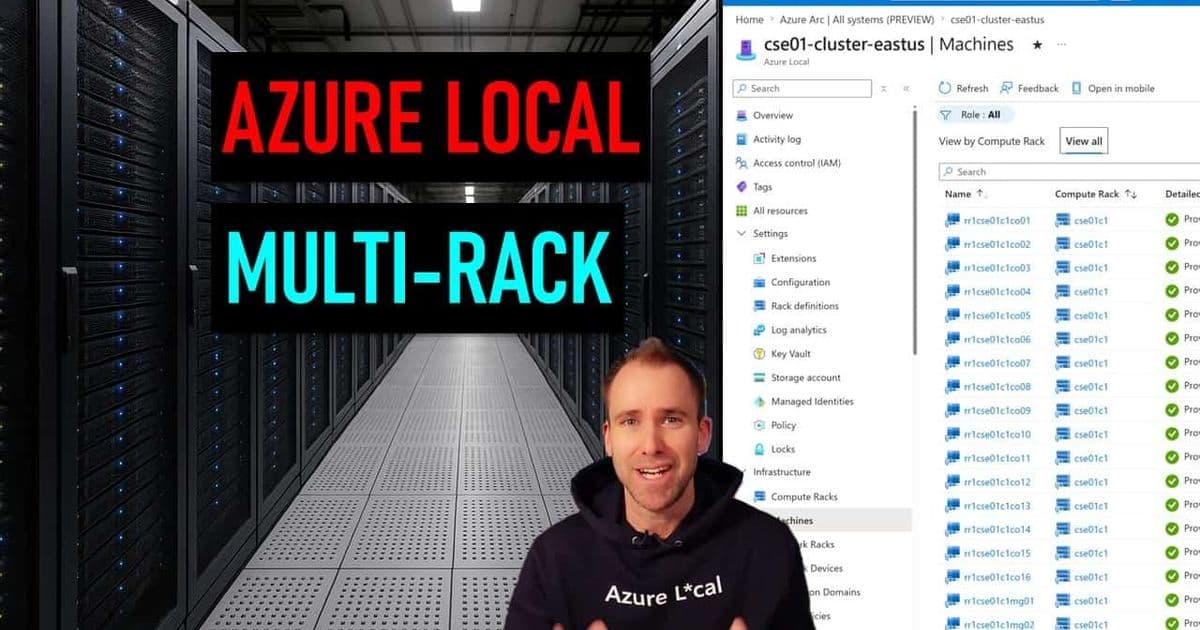
Microsoft extends Azure Local from small clusters to four-rack, SAN-backed deployments for enterprises that need Azure operations, local data control and rack-scale resilience.
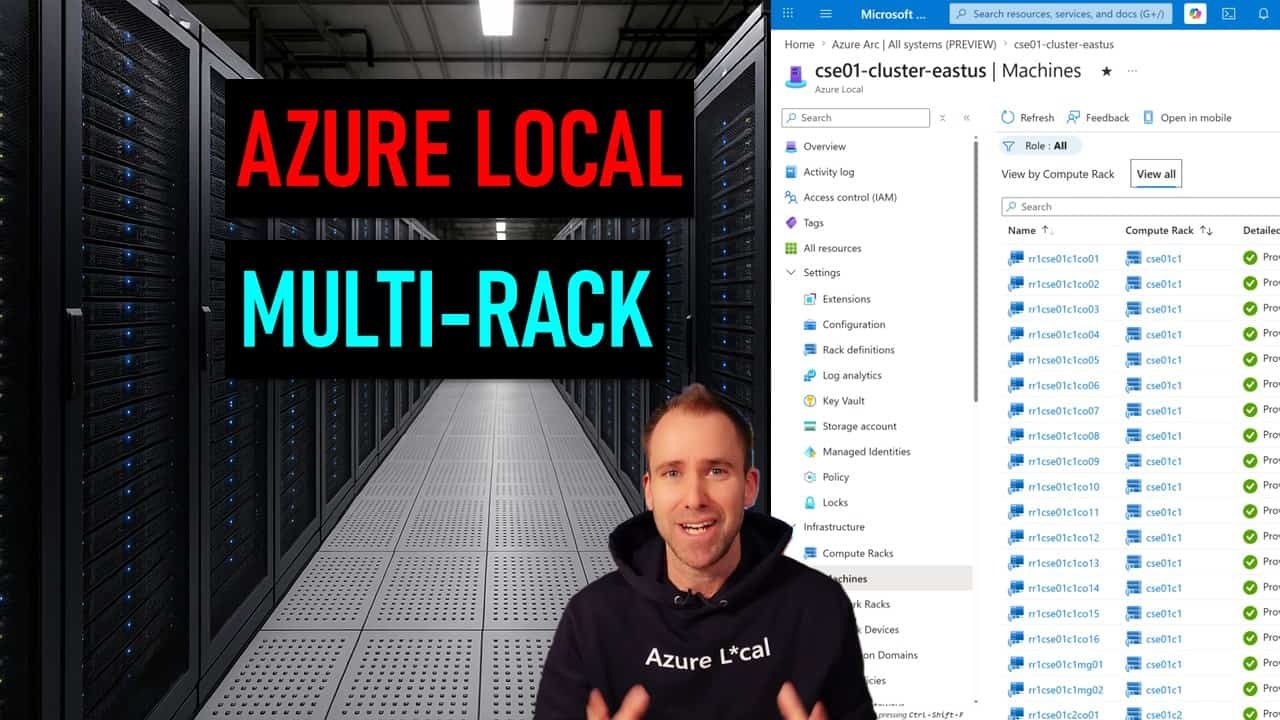
Microsoft's Thomas Maurer used a June 15 walkthrough to show how Azure Local now fits larger datacenter projects, including multi-rack deployments that scale to hundreds of servers in one instance. Microsoft aims the model at enterprises, governments and regulated industries that want Azure operations on infrastructure they own.
Change
Microsoft and hardware partners package Azure Local multi-rack deployments as integrated racks with compute, SAN storage and managed networking. The minimum footprint starts with four racks: one main rack for network aggregation and SAN storage, plus at least three compute racks.
Microsoft's Azure Local documentation describes the platform as an Azure Arc-enabled infrastructure layer for virtual machines, containers and selected Azure services. The multi-rack overview adds a larger architecture for customers that have outgrown the one-to-16-machine hyperconverged deployment.
The architecture changes the scaling model. Hyperconverged Azure Local relies on local cluster storage, while multi-rack deployments separate compute from SAN-backed storage. Architects can add compute racks without treating storage growth as the same project.
Microsoft also brings network devices under Azure management. Operators use Azure APIs, ARM templates, Azure CLI and the Azure portal to handle infrastructure tasks. Bare-metal machines appear as Azure resources, so operations teams can run lifecycle tasks from the same control plane they use for cloud governance.
Provider comparison
Microsoft now competes more squarely with AWS and Google in the on-premises cloud infrastructure market. Each provider sells a different operating model.
| Platform | Best fit | Cost model | Main trade-off |
|---|---|---|---|
| Azure Local multi-rack | Microsoft-heavy estates that use Azure RBAC, Azure Policy, Azure Monitor and Arc | Microsoft prices Azure Local on a per-physical-core basis for standard deployments. Its pricing page directs buyers to account teams for SAN-attach, larger-scale disaggregated storage and disconnected control-plane scenarios. | Buyers need a four-rack starting point and Microsoft partner hardware. |
| AWS Outposts | AWS workloads that need EC2, EBS, S3, EKS or RDS close to existing systems | AWS sells Outposts racks on three-year terms with all upfront, partial upfront or no upfront payment options. Pricing includes delivery, installation, service maintenance and patches. | Capacity comes in AWS rack shapes, and buyers must plan regional connectivity and service scope. |
| Google Distributed Cloud | Kubernetes-centered teams and air-gapped sovereignty projects | Google lists connected Google Distributed Cloud from $35 per vCPU per month, with a 96-vCPU minimum per site and a five-year commitment. Google quotes air-gapped deployments through sales. | Teams may need to adapt apps to a Kubernetes-first model. |
Azure Local's advantage shows up where Microsoft identity, security and governance have become operating standards. A team that uses Azure Policy for compliance, Defender for Cloud for posture management and Azure Monitor for telemetry can extend those practices into the datacenter without building a separate private cloud management stack.
AWS Outposts fits buyers that want AWS service proximity on premises. Google Distributed Cloud fits teams that standardize on Kubernetes and need connected or air-gapped edge sites. Azure Local multi-rack fits the Microsoft enterprise that wants SAN-backed scale, partner-supplied racks and Azure control across local infrastructure.
Business impact
CIOs should treat multi-rack Azure Local as a datacenter platform decision, not a cluster refresh. The four-rack entry point changes procurement, power planning and support ownership. Facilities teams need rack space, cooling and network paths ready before application teams start migration waves.
The pricing conversation also changes. Azure Local software uses a per-physical-core model, while partner hardware, SAN capacity, Windows Server guest rights and Azure service consumption sit in other cost buckets. Finance teams should compare the whole site cost against Outposts and Google Distributed Cloud, including term length and support model.
Sovereignty teams get a cleaner story. Microsoft already positions Azure Local for regulated environments, and the broader Azure Local portfolio includes disconnected operations and Microsoft 365 Local. Multi-rack deployments give those teams a path for larger on-premises estates where rack-level failure domains and shared SAN storage matter.
Migration plan
Architecture teams should start with workload placement. Put latency-bound applications near the systems they depend on. Keep chatty application and database pairs on the same Azure Local instance unless the network design proves otherwise.
Operations teams should map current runbooks to Azure actions before the first rack arrives. Power, image, health validation, network updates and VM provisioning need owner names, approval paths and rollback steps. Azure control does not remove local operating work; it changes where teams perform it.
Security teams should define policy inheritance early. Azure RBAC and Azure Policy can reduce duplicate governance work, but only if teams agree on subscriptions, resource groups, naming and policy scopes before migration. Multi-rack gives you cloud-style control; poor tenant design will still create audit pain.
Maurer's demo matters because it shows the operator experience, not just the hardware shape. Buyers should watch that flow with their virtualization, network and security leads in the room. The best fit will come from the operating model, the cost envelope and the workload map.
Comments
Please log in or register to join the discussion