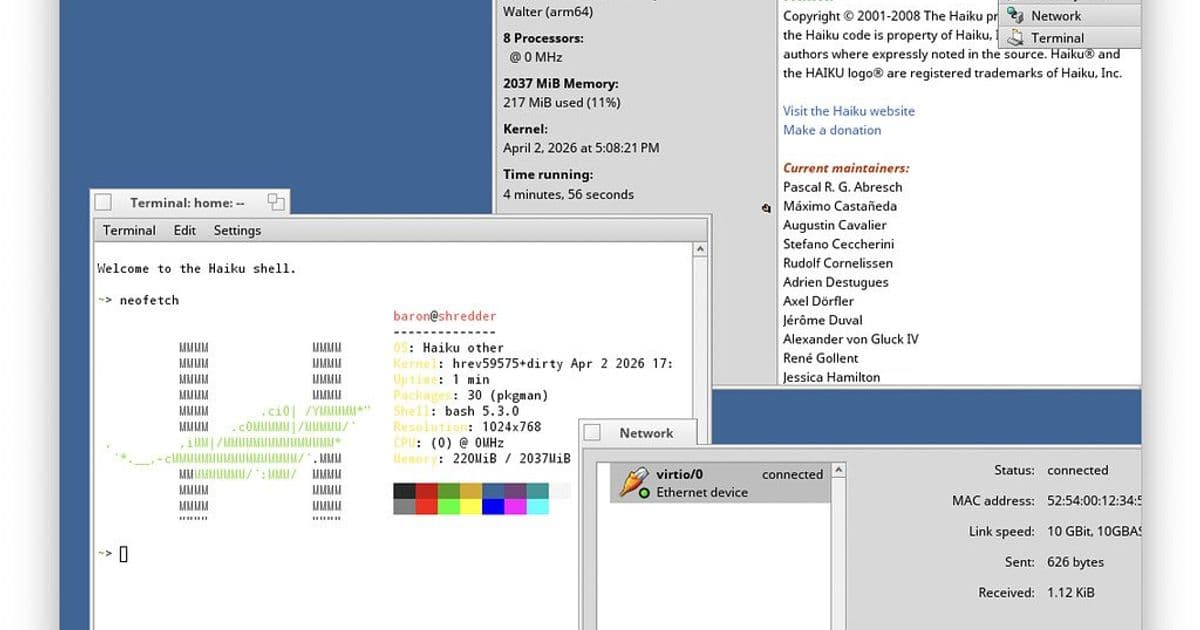
A Haiku contributor reports steady progress on the arm64 port, showcasing a QEMU build that runs on M1 hardware. While the port is mostly stable, kernel crashes and missing software packages keep the community cautious. The post sparks both excitement about expanding Haiku’s hardware reach and debate over the effort required to make the experience production‑ready.
A noticeable shift toward Apple Silicon
Over the past year the Haiku community has been quietly tracking the rise of ARM‑based laptops, especially Apple’s M‑series chips. The latest update from contributor smrobtzz (April 5) shows a functional arm64 build running under QEMU, complete with virtio SCSI, virtio networking, and xHCI USB support. The screenshot 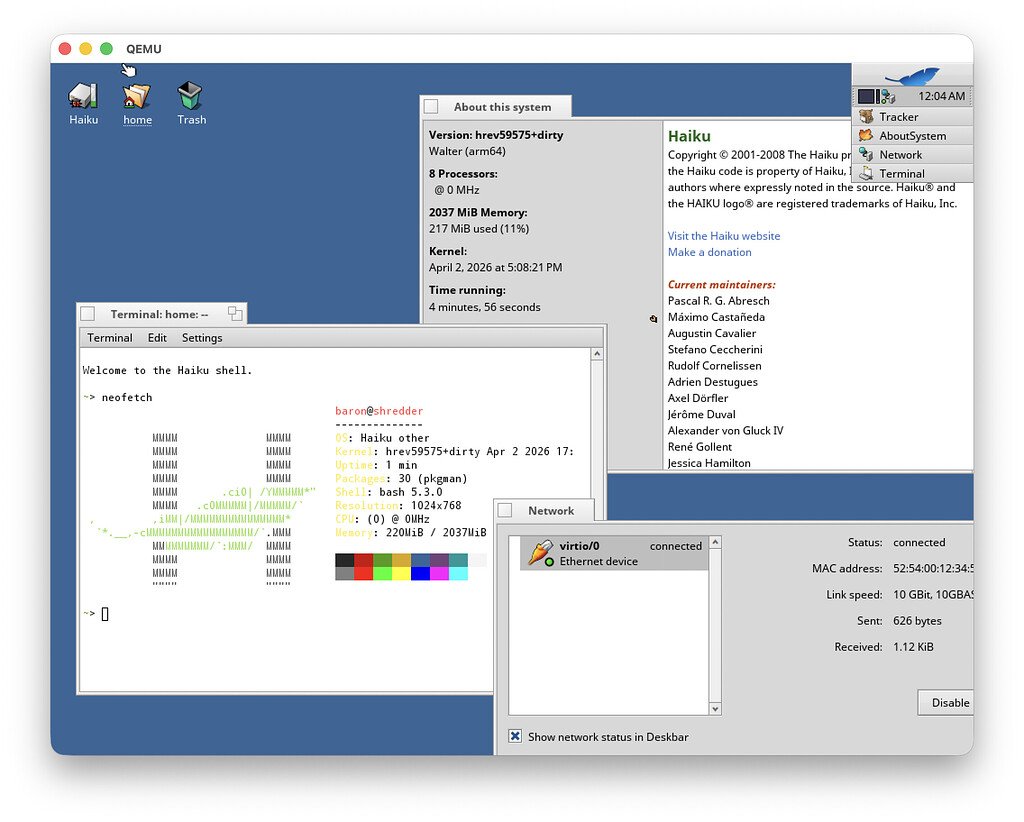 illustrates a bootable Haiku desktop on an emulated aarch64 platform, and a second image
 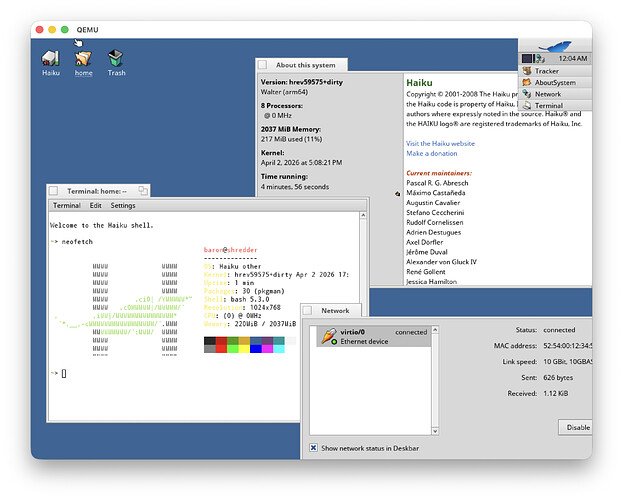 highlights the same system with a more complex workload.
The post signals a broader sentiment: developers see ARM64 as the next logical frontier for Haiku, hoping to broaden the OS’s appeal beyond legacy PowerPC and x86 hardware.
Evidence of progress – and of remaining work
Device support – All standard QEMU devices are recognized, and the kernel can schedule work across up to eight cores. This mirrors the stability level of Haiku’s x86 builds, suggesting the core kernel adaptations for arm64 are largely in place.
Crashes and memory bugs – The author mentions at least one kernel panic and a few double‑free errors. In the Haiku bug tracker these are logged as high priority because they can corrupt the entire system.
Software ports – Many Haiku packages still depend on pre‑compiled binaries that were built for x86. The post notes the need to bootstrap Haiku and rebuild those packages for arm64 before a usable system can be assembled.
Community reaction – The post has gathered 9.7 k views and 242 likes, indicating strong interest. Comments range from users offering to test the QEMU image to developers warning that a “real‑world” install on an M1 will require driver work that QEMU cannot emulate (e.g., Apple‑specific GPU and power‑management interfaces).
Counter‑perspectives and cautionary notes
While enthusiasm is high, several voices temper expectations:
Performance vs. emulation – Running Haiku in QEMU on an M1 provides a convenient testbed, but it does not reflect native performance. The Apple‑silicon GPU, for instance, is not exposed through standard virtio interfaces, meaning a future native port will need a custom driver stack.
Resource allocation – Some contributors argue that the Haiku team’s limited manpower should prioritize polishing existing x86 releases rather than spreading effort across a new architecture that may only attract a niche audience.
Long‑term maintenance – Even if a functional arm64 build lands, keeping it in sync with the rapidly evolving Haiku codebase could double the maintenance burden. The community has seen similar challenges with the PowerPC port, which stalled after initial enthusiasm.
What this means for the Haiku roadmap
If the arm64 work continues at its current pace, we can expect:
- A beta‑quality QEMU image within the next few months, allowing hobbyists to experiment without needing a physical M1 device.
- An official bootstrap script that rebuilds all binary packages for arm64, removing the current manual step.
- A roadmap milestone targeting a native build on Apple Silicon, likely slated for Haiku R2.0 or later, contingent on community contributions for GPU and power‑management drivers.
The discussion around this post underscores a classic open‑source tension: the desire to broaden platform support versus the practicalities of limited developer bandwidth. Whether Haiku will eventually run natively on an M1 MacBook Air remains an open question, but the current momentum suggests that the project is at least willing to explore the possibility.
For developers interested in trying the arm64 build, the original post includes a link to the QEMU image and a bootstrap guide. The Haiku source repository can be cloned from the official GitHub mirror.
Comments
Please log in or register to join the discussion