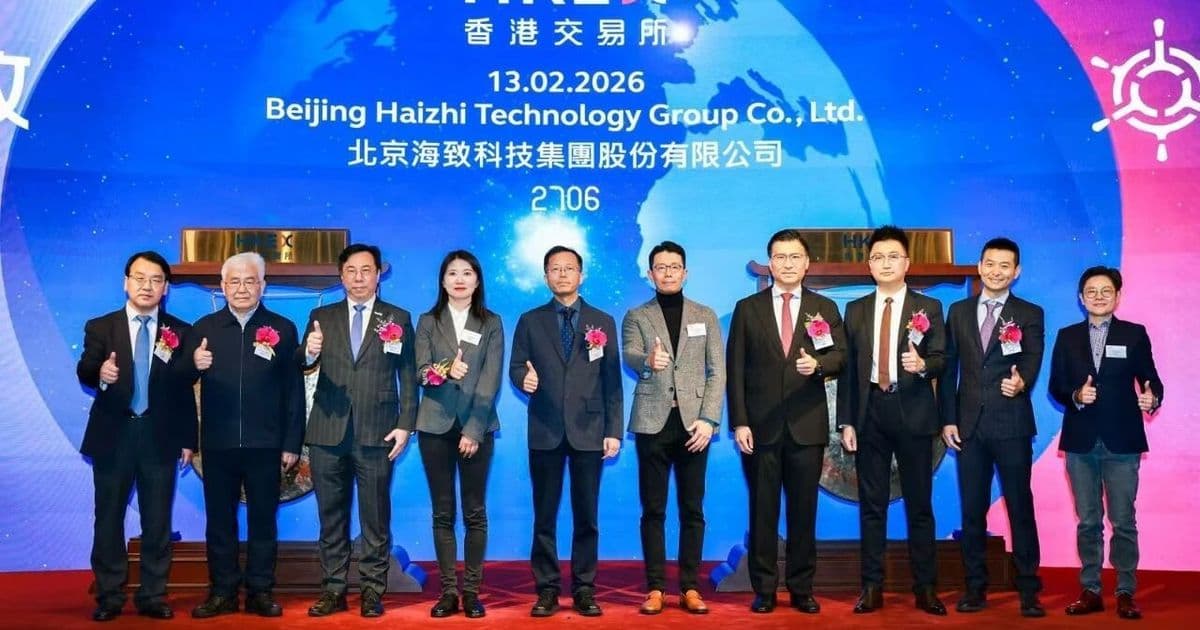
Beijing-based Haizhi Technology made its Hong Kong Stock Exchange debut with a remarkable 250% first-day gain, becoming the world's first publicly listed company focused on eliminating LLM hallucination through graph-model fusion technology.
Haizhi Technology, a Beijing-based artificial intelligence company specializing in graph computing and large language model (LLM) applications, made its debut on the Hong Kong Stock Exchange (HKEX) on February 13, 2026, under the ticker 2706.HK. The company's IPO was met with extraordinary investor enthusiasm, with shares opening at HK$94.90—a staggering 250% increase from the final offer price of HK$28—giving the company a market capitalization exceeding HK$38 billion.
Record-Breaking IPO Performance
The IPO comprised 28,030,200 H-shares and saw unprecedented demand. The Hong Kong public offering was oversubscribed by 5,065 times, while the international placing saw 8.39 times oversubscription. Cornerstone investors included JSC International (under Beijing Financial Holdings Group), Zhipu's Jingsheng Hengxing, Infini Capital, and Mega Prime (Greater Bay Area Homeland Investments), collectively subscribing US$15 million.
Graph-Model Fusion: A Novel Approach to LLM Hallucination
Founded in 2013, Haizhi has positioned itself as a pioneer in "graph-model fusion" technology—a methodology that combines LLM reasoning with knowledge graphs to enhance precision and interpretability. This approach directly addresses one of the most persistent challenges in AI: hallucination, where LLMs generate factually incorrect or nonsensical outputs.
According to the company, their technology integrates structured knowledge from graph databases with the reasoning capabilities of large language models, creating a hybrid system that can verify and ground AI-generated responses in factual data. This fusion aims to provide both the flexibility of LLMs and the accuracy of structured knowledge systems.
Commercial Traction and Market Position
Haizhi's technology has found adoption across 360+ enterprise clients and over 100 scenarios. The company's core offerings include the Atlas Graph Solution (comprising the DMC platform, Atlas knowledge graph platform, and AtlasGraph database) and Atlas Agents.
Market research from Frost & Sullivan provides validation of Haizhi's market position. The company ranked 5th among China's industrial AI agent providers by 2024 revenue and claimed the top position in graph-centric AI agents with approximately 50% market share.
Financial performance shows strong growth momentum. Revenue grew at a compound annual growth rate (CAGR) of 26.8% from 2022 to 2024, increasing from RMB 313 million to RMB 503 million. Atlas Agent revenue demonstrated particularly impressive growth, surging 872.2% year-over-year from RMB 8.9 million in 2023 to RMB 86.6 million in 2024.
Investor Backing and Corporate Structure
Haizhi has attracted significant investment from prominent venture capital firms. Legend Capital, the largest institutional shareholder, has backed the company since 2016. BAI Capital led the A+ round in 2013, while Hillhouse, which first invested in 2014, holds 3.71% pre-IPO—marking its sixth portfolio IPO in early 2026.
Other notable shareholders include IDG Capital, E-Town Capital, and China Internet Investment Fund. This diverse investor base reflects confidence in both the technology and the market opportunity.
The Hallucination Problem and Market Opportunity
The focus on LLM hallucination is particularly timely. As enterprises increasingly deploy AI systems for critical applications, the reliability and accuracy of these systems become paramount. Hallucinations can lead to misinformation, poor decision-making, and erosion of trust in AI systems.
Haizhi's graph-model fusion approach represents one of several strategies being developed to address this challenge. By grounding LLM outputs in structured knowledge graphs, the company aims to provide verifiable, accurate responses while maintaining the flexibility and reasoning capabilities that make LLMs valuable.
Challenges and Considerations
Despite the impressive IPO performance and technological promise, Haizhi faces several challenges. The company remains unprofitable, a common situation for high-growth technology companies but one that requires continued investor patience and capital.
The competitive landscape in AI is rapidly evolving, with both established tech giants and nimble startups developing solutions for the hallucination problem. Haizhi's success will depend on its ability to maintain technological leadership and expand its commercial footprint.
Additionally, the company's heavy reliance on the Chinese market—while currently a strength given its market leadership position—could present risks if it seeks international expansion in an increasingly complex geopolitical environment.
Market Implications
Haizhi's successful IPO and strong first-day performance signal continued investor appetite for AI-related companies, particularly those addressing fundamental technical challenges. The company's focus on a specific, well-defined problem (LLM hallucination) with a clear technological approach (graph-model fusion) appears to have resonated with investors.
The listing also highlights Hong Kong's growing role as a venue for technology IPOs, particularly for Chinese companies that may face challenges listing in other markets. The strong oversubscription rates suggest robust local and international interest in innovative AI companies.
Looking Forward
As the first publicly listed company focused specifically on eliminating LLM hallucination through graph-model fusion, Haizhi occupies a unique position in the AI landscape. The company's ability to execute on its technological vision while scaling its commercial operations will be critical to justifying its current valuation.
The next few quarters will be crucial as investors assess whether Haizhi can maintain its growth trajectory, expand beyond its current customer base, and continue to innovate in the rapidly evolving field of AI reliability and accuracy.
For the broader AI industry, Haizhi's approach represents an interesting hybrid model that combines the strengths of different AI paradigms. Whether graph-model fusion becomes a dominant approach to addressing LLM limitations remains to be seen, but the company's successful debut suggests that investors see significant potential in this direction.
The strong market reception of Haizhi's IPO also underscores the importance investors place on solving fundamental AI challenges. As enterprises move from AI experimentation to production deployment, technologies that enhance reliability and accuracy are likely to see increasing demand.
Haizhi's journey from a 2013 startup to a multi-billion-dollar public company in just over a decade reflects both the rapid evolution of the AI industry and the market's willingness to reward companies that tackle core technical challenges with innovative solutions. Whether this valuation is sustainable will depend on the company's execution in the coming years, but its debut marks an important milestone in the commercialization of AI reliability technologies.
Comments
Please log in or register to join the discussion