Google has released a major upgrade to Gemini 3 Deep Think, its specialized AI reasoning mode designed for scientific research and engineering challenges. The update brings improved performance on academic benchmarks and practical applications, with availability through the Gemini app for Ultra subscribers and early API access for researchers.
Google has unveiled a significant upgrade to Gemini 3 Deep Think, its specialized AI reasoning mode engineered to tackle complex scientific, research, and engineering challenges. The update, released on February 12, 2026, represents Google's most focused effort yet to bridge the gap between theoretical AI capabilities and practical scientific applications.
From Theory to Practice: Deep Think's Scientific Focus
The updated Deep Think mode was developed in close collaboration with scientists and researchers who face problems that often lack clear guardrails or single correct solutions, where data is frequently messy or incomplete. This marks a departure from traditional AI applications that thrive on well-defined problems with abundant training data.
"By blending deep scientific knowledge with everyday engineering utility, Deep Think moves beyond abstract theory to drive practical applications," Google stated in its announcement. The company emphasized that this isn't just another incremental model update, but a fundamental shift toward solving real-world scientific challenges.
Early Applications Show Promise
Early testers have already demonstrated Deep Think's potential across various scientific domains:
At Rutgers University, mathematician Lisa Carbone used Deep Think to review a highly technical mathematics paper in a field with minimal existing training data. The AI successfully identified a subtle logical flaw that had previously passed through human peer review unnoticed.
Duke University's Wang Lab leveraged Deep Think to optimize fabrication methods for complex crystal growth, potentially leading to new semiconductor materials. Deep Think designed a recipe for growing thin films larger than 100 μm, achieving a precise target that previous methods struggled to hit.
Anupam Pathak, an R&D lead in Google's Platforms and Devices division and former CEO of Liftware, tested Deep Think to accelerate the design of physical components, demonstrating its utility in engineering workflows.
Benchmark Performance: Setting New Standards
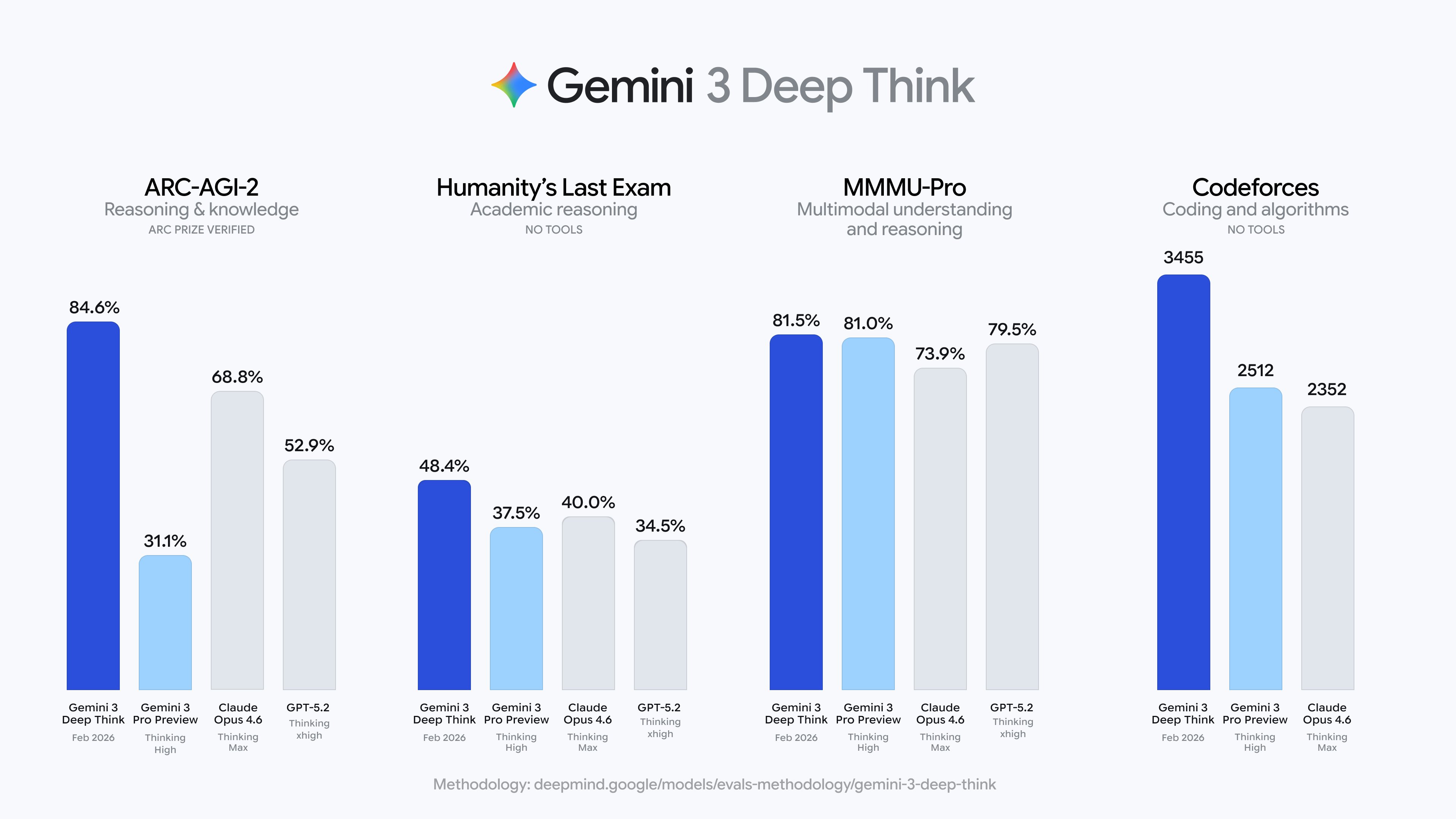
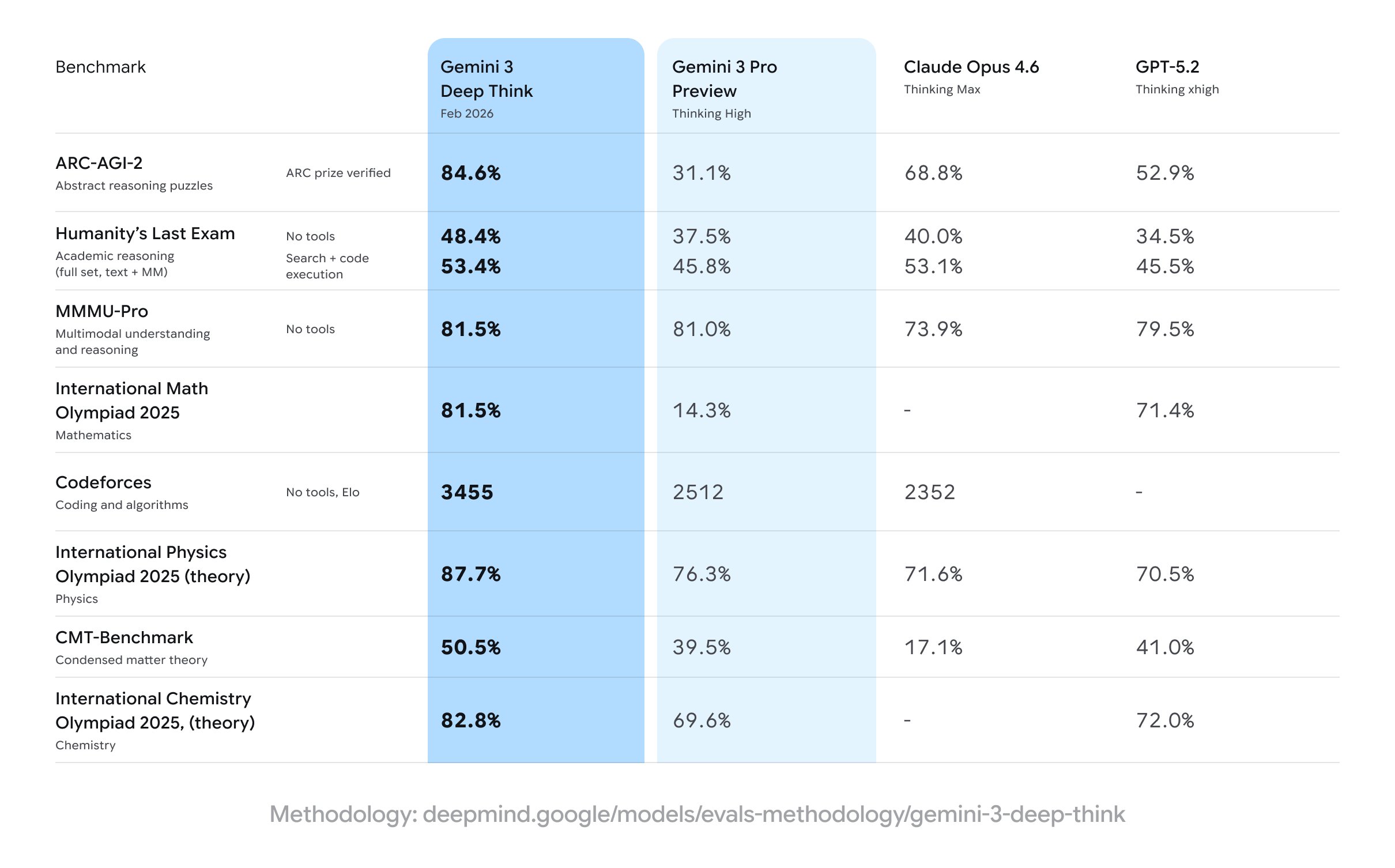
The updated Deep Think mode has achieved remarkable results across some of the most rigorous academic benchmarks:
- Humanity's Last Exam: 48.4% accuracy without tools, setting a new standard for this benchmark designed to test the limits of modern frontier models
- ARC-AGI-2: 84.6% accuracy, verified by the ARC Prize Foundation
- Codeforces: Elo rating of 3455, demonstrating competitive programming excellence
- International Math Olympiad 2025: Gold-medal level performance
- International Physics Olympiad and Chemistry Olympiad: Gold medal-level results on written sections
- CMT-Benchmark: 50.5% score in advanced theoretical physics
These results position Deep Think as not just a general-purpose AI model, but a specialized tool capable of competing at the highest levels of academic and competitive problem-solving.
Practical Engineering Applications
Beyond academic benchmarks, Deep Think demonstrates practical engineering capabilities. One particularly impressive feature allows users to convert sketches into 3D-printable files. The system analyzes hand-drawn designs, models complex shapes, and generates files ready for 3D printing, effectively turning conceptual drawings into physical objects.
This capability represents a significant step toward AI-assisted design and manufacturing, where the barrier between idea and implementation becomes dramatically lower.
Availability and Access
Google is making the updated Deep Think mode available through multiple channels:
- Gemini App: Available immediately to Google AI Ultra subscribers
- Gemini API: Early access program for select researchers, engineers, and enterprises
The company has opened an early access program for those interested in testing Deep Think via the API, recognizing that scientific and engineering communities need direct access to these capabilities for integration into their workflows.
The Broader Context
This release comes at a time when AI companies are increasingly focusing on specialized capabilities rather than general-purpose improvements. While models like GPT-4 and Claude have demonstrated broad competence across many domains, Deep Think represents a strategic bet that the next frontier of AI advancement lies in deep specialization for specific fields.
The emphasis on scientific reasoning and engineering applications also reflects Google's broader strategy to position itself as the AI partner of choice for research institutions and enterprise engineering teams. By focusing on domains where data is scarce and problems are ill-defined, Google is targeting areas where traditional AI approaches often struggle.
Looking Ahead
The success of Deep Think will ultimately be measured not by benchmark scores but by its impact on scientific discovery and engineering innovation. If researchers can indeed use it to identify flaws in mathematical proofs, optimize material fabrication processes, or accelerate component design, it could become an indispensable tool in scientific workflows.
However, the true test will be whether Deep Think can consistently deliver value in real-world scientific settings where the stakes are high and the problems are genuinely novel. The early examples are promising, but widespread adoption will depend on its reliability, ease of integration, and the extent to which it can augment rather than replace human expertise.
The release of Gemini 3 Deep Think represents Google's most ambitious attempt yet to create an AI system that doesn't just answer questions but actively contributes to the process of scientific discovery and engineering innovation. Whether it achieves this goal remains to be seen, but the foundation appears solid and the early results encouraging.

Comments
Please log in or register to join the discussion