After two decades, a pre-production ROM for the Apple Network Server 700 finally surfaces, allowing it to boot Mac OS 9.1 with some quirks. Meanwhile, a late-stage Windows NT ROM reveals fascinating technical details about Apple's abandoned multi-OS ambitions, including little-endian PowerPC execution and a missing Hardware Abstraction Layer.
The Apple Network Server is one of Apple's most notorious white elephants—a massive, PowerPC-based server that ran IBM's AIX and was discontinued shortly after Steve Jobs' return. But a long-lost prototype ROM, found in a box of parts from 2003, has finally been tested, and it works. Sort of.
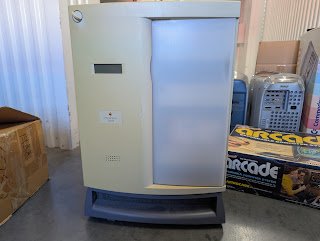
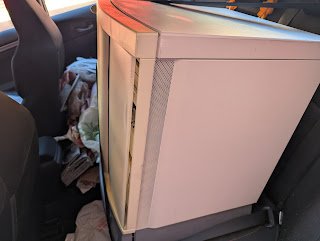
The machine in question is "holmstock," my Network Server 700, a ship-of-Theseus assembly built from two thrashed units in 2003. It serves as the perfect testbed for risky ROM experiments, as my beloved primary ANS 500, "stockholm," is too precious to risk. The ROM in question is a 1.1.20.1 pre-production version, discovered at the bottom of a box of parts sourced from Apple Austin in 2003. This ROM was used internally to demonstrate Mac OS on the ANS before its release, and it's the earliest known version that supports booting the classic Mac OS.
The Hardware: A Fridge-Sized Power Mac 9500
The ANS 700 weighs about 85 pounds and is roughly the size of a dorm fridge. It shares its core architecture with the Power Macintosh 9500 but is heavily modified. Key differences include:
- Unique SCSI Controllers: Two Symbios Logic 53C825A controllers provide two internal Fast Wide SCSI busses at 20MB/s, far faster than the typical Power Mac MESH controller (10MB/s). These are unique to the ANS and appear in no other Apple product.
- Unique Video Chip: A Cirrus Logic 54M30 handles onboard VGA output, also ANS-exclusive.
- Logic Board Layout: Eight RAM DIMM slots (vs. 12 on the 9500), consolidated connectors, and a CPU daughtercard that supports up to a 200MHz 604e. The bus speed is 50MHz with the 150MHz and 200MHz CPUs.
- Parity RAM Requirement: The system requires 60ns parity RAM for optimal performance. If any DIMM lacks parity, the entire system drops to 70ns timing—a significant performance hit.
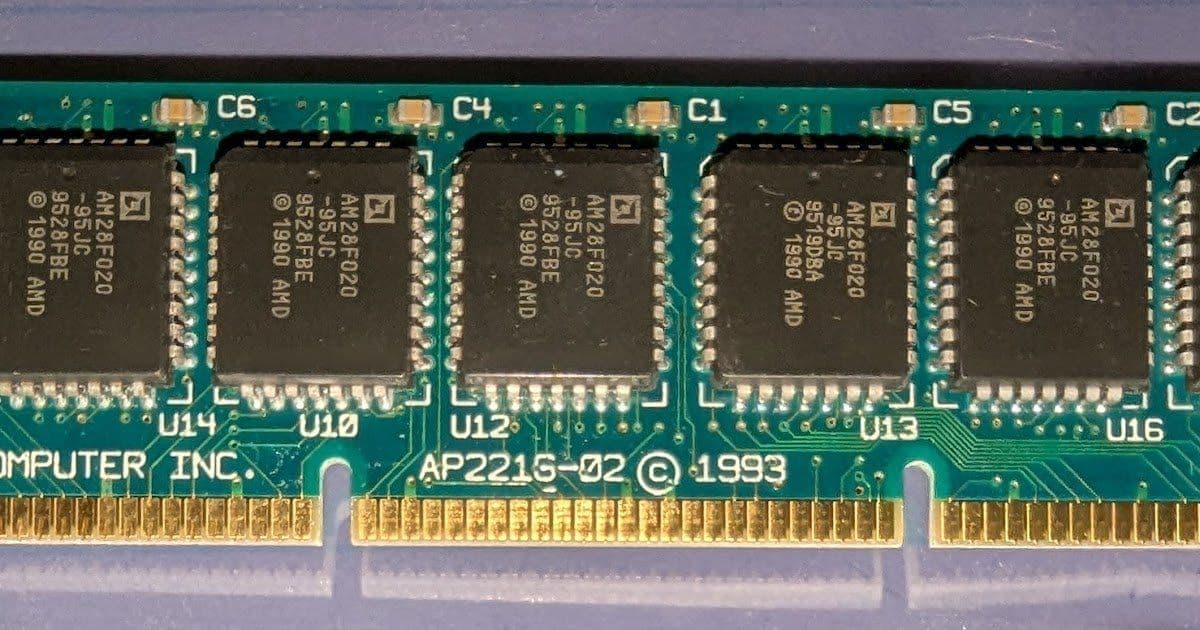
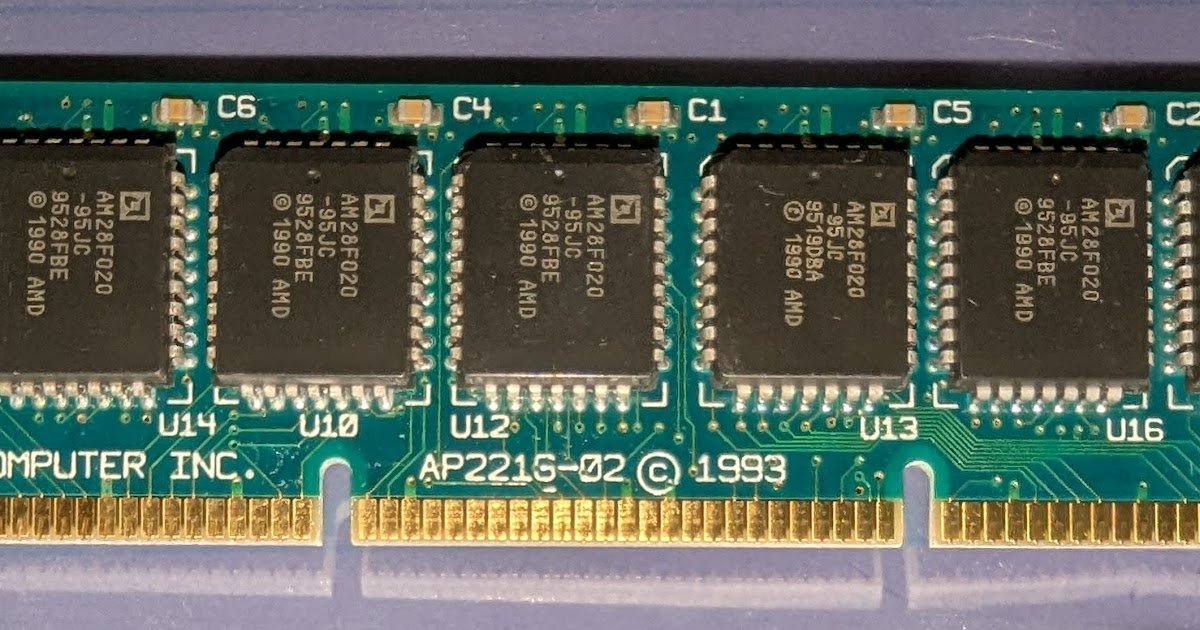
The ROM slot accepts a standard Power Mac ROM DIMM. Production ROMs (1.1.22) only boot AIX, but the pre-production 1.1.20.1 ROM is designed to boot Mac OS, albeit with limitations.
Testing the Pre-Production ROM
After refurbishing holmstock—cleaning desiccated lubricant from the slide rails, reseating the CPU card, and verifying hardware with the Network Server Diagnostic Utility (NSDU)—the machine was ready for ROM testing.
Initial Boot and Open Firmware
With the 1.1.20.1 ROM installed, the system boots to an Open Firmware prompt. Unlike production ROMs, this version doesn't block Mac OS booting. However, the ROM lacks drivers for the internal SCSI and video controllers. Mac OS doesn't know what these devices are, as they've never been used in any prior Apple product.
The solution is to add a PCI video card. I installed an IMS Twin Turbo 128MA, a top-tier 2D card for the 9500. With the card in place, typing bye at the Open Firmware prompt boots Mac OS 7.6 from an external BlueSCSI dongle.
Mac OS 9.1: Success with a Caveat
Mac OS 9.1 installs and runs, but with a critical bug. The OS mistakenly identifies the ANS as a Power Mac 9500 (Gestalt ID 67) and patches Open Firmware variables accordingly. Specifically, it sets the input and output devices to the serial port (ttya), which the ANS's Open Firmware actually obeys—unlike a real 9500, where Open Firmware is invisible to the user. This results in a black screen on both the onboard VGA and the PCI video card.
The fix involves using Paul Mackerras' Boot Variables control panel to reset the Open Firmware settings. After disabling the NVRAMRC and setting the console back to kbd and screen, the system boots normally. However, the bug reappears on every shutdown or reboot, requiring manual intervention or a custom script.
Despite this quirk, Mac OS 9.1 runs well. The onboard MACE Ethernet (via AAUI) is non-functional, but a DEC Tulip-based Apple Ethernet PCI card specific to the ANS works perfectly, enabling network connectivity.
Rhapsody and Beyond
Attempts to boot Mac OS X Server v1.2 (Rhapsody) failed with a CLAIM failed error, indicating memory mapping issues. The same error occurred when trying to boot a NetWare kernel. It's likely that the 1.1.20.1 ROM lacks the necessary support for these operating systems, or they require specific patches that weren't included in this pre-production version.
The Windows NT ROM: Little-Endian PowerPC
In parallel, I received the 2.26NT ROM, a late-stage prototype for running Windows NT 4.0 on the ANS. This ROM is fascinating for several reasons:
- Little-Endian Execution: The ROM configures the PowerPC CPU to run in little-endian mode, a first for a Power Mac. Windows NT on PowerPC always ran little-endian, and this ROM enables that at the firmware level.
- PE/COFF Loader: The ROM includes a
pe-loaderpackage in Open Firmware, capable of loading Windows NT's Portable Executable format. - NT-Specific Variables: Forth words like
nt-gen-configsandinit-nt-varsallocate NVRAM space for NT configuration.
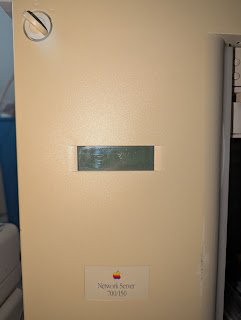
However, booting Windows NT 4.0 directly from the CD fails with a CLAIM failed error. The ROM is missing two critical components:
- ARC Console: Windows NT requires an Advanced RISC Computing (ARC) console for system specification. The ANS likely used a floppy or CD-based ARC console, which isn't present in the ROM.
- Hardware Abstraction Layer (HAL): The HAL is a low-level driver that interfaces between the OS and hardware. The ANS would need a custom HAL (
halbandit), which hasn't been found.
Without these, Windows NT cannot boot. The ROM is a near-production-ready prototype, but the project was canceled before completion.
Other ROM Versions and Future Work
The known ANS ROM versions are:
| Version | Purpose | Notes |
|---|---|---|
| 1.1.20.1 | Pre-production Mac OS/AIX | Boots Mac OS with external video and SCSI. |
| 1.1.22 | Production AIX | Only boots AIX (and NetBSD/Linux). |
| 2.0 | Prototype Mac OS | Includes drivers for internal SCSI/video. Not in my possession. |
| 2.26NT | Prototype Windows NT | Little-endian, PE loader, but missing ARC and HAL. |
The 2.0 ROM would solve the internal device support issue and likely enable booting Rhapsody or early Mac OS X. If you have any of these ROMs or related artifacts (ARC console, HAL, NetWare bootloader), please contact me at ckaiser at floodgap dawt com.
Conclusion
The Apple Network Server remains a fascinating piece of Apple history. With the 1.1.20.1 ROM, it can finally boot Mac OS 9.1, albeit with some firmware quirks. The Windows NT ROM reveals Apple's ambitious attempt to make the ANS a multi-OS server, a plan cut short by Steve Jobs' return. While not fully functional, these ROMs offer a glimpse into what could have been—a PowerPC server capable of running AIX, Mac OS, and Windows NT.
For homelab builders and vintage computing enthusiasts, the ANS is a unique platform. It's a Power Mac 9500 on steroids, with better SCSI, unique hardware, and a story that reflects Apple's most experimental era. If you have one, consider experimenting with these ROMs—just be prepared for some tinkering.
Links and Resources:
- Apple Network Server Technical Notes (archived)
- NetBSD/macppc ANS Support
- Boot Variables Control Panel (from NetBSD archives)
- Tinker Different Forum Thread (for ROM dumps)
Special thanks to the former Apple employees who contributed to this article. Without you, this wouldn't have been possible.
Comments
Please log in or register to join the discussion