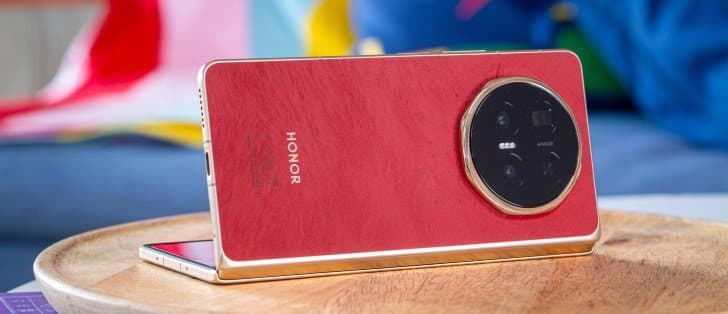
Honor's latest book-style foldable squeezes the largest battery in the category, a full Snapdragon 8 Elite Gen 5, and dual IP68/IP69 ratings into a 4mm body, while leaning harder into iOS and macOS connectivity.
Honor has unfolded its latest flagship, and the Magic V6 reads like a checklist of everything that used to be a compromise on book-style foldables. The new model keeps the familiar silhouette of last year's Magic V5 but addresses the durability, battery, and software gaps that kept these devices a half-step behind conventional slab phones.
What Honor announced
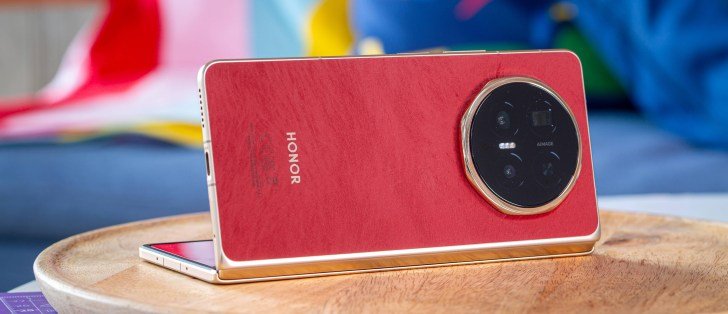
The Magic V6 is a horizontal foldable with a 7.95-inch inner display and a 6.52-inch cover screen. Honor's pitch centers on a tougher build, a redesigned hinge, and the largest battery yet fitted to a foldable. The body measures 156.7 x 145.6 x 4.0mm and weighs 219g, which is remarkable for a device packing two LTPO 2.0 AMOLED panels and a 6,600mAh cell. The phone ships in four colors with different rear finishes, and the review unit arrived in a red and gold configuration with a matching kickstand case in the box.
The headline durability upgrade is dual IP68 and IP69 certification. IP68 covers dust resistance and immersion up to 1.5 meters for 30 minutes, while IP69 adds protection against high-pressure, high-temperature water jets. That combination is still rare on foldables, where the hinge mechanism has historically been the weak point for water ingress. Honor pairs this with a stronger hinge and improved drop resistance, plus a less visible crease on the main display.
Key features
The interior 7.95-inch panel runs at 120Hz with a 2172x2352 resolution, 403ppi, and a peak brightness of 5,000 nits. It uses an anti-reflective coating to cut glare, a meaningful change for a large folding surface that catches light from every angle. The cover display grew to 6.52 inches this year, also LTPO 2.0, with a sharper 6,000-nit peak and the same anti-reflective treatment over Honor's NanoCrystal Shield glass. Both screens support stylus input.
Under the hood sits Qualcomm's Snapdragon 8 Elite Gen 5, built on a 3nm process. Honor went out of its way to use the complete 8-core version of the chip, drawing a direct contrast with Oppo's Find N6, which ships with a cut-down 7-core variant. Buyers can choose 12GB or 16GB of LPDDR5X RAM and storage tiers from 256GB up to 1TB on UFS 4.1. A vapor chamber handles cooling, which is standard fare for a chipset in this class but still necessary given the thin chassis.
The camera hardware carries over largely unchanged from the Magic V5. The rear array consists of a 50MP f/1.6 main sensor with OIS, a 64MP f/2.5 telephoto offering 3x optical zoom, and a 50MP ultrawide that doubles for macro work. Two 20MP selfie cameras sit behind each screen. Video tops out at 4K 60fps in 10-bit on the rear cameras.
Battery is where the V6 makes its loudest argument. The 6,600mAh cell is a sizable jump from the V5's 5,820mAh pack, and it supports 80W wired and 66W wireless charging, along with reverse wireless and 5W reverse wired output. Honor quotes up to 24 hours of use on the large display. Chinese-market versions go even further with 6,850mAh and 7,150mAh cells depending on storage tier, a regional split that has become common as battery chemistry like silicon-carbon allows higher density than what some certification regimes elsewhere permit.
Ecosystem context
The Magic V6 boots Android 16 with MagicOS 10 on top, and Honor is promising up to seven major Android upgrades, matching the long support windows now offered by Samsung and Google. MagicOS 10 adopts a translucent, iOS-inspired interface and, more interestingly, leans into cross-platform communication aimed squarely at Apple's ecosystem. Honor is positioning improved interoperability with iOS and macOS as a selling point, an acknowledgment that many premium buyers live in mixed-device households and that ecosystem lock-in cuts both ways. The on-device AI suite comes preloaded rather than as an add-on.
Connectivity is current across the board: 5G, eSIM, Wi-Fi 7, Bluetooth 6.0 with aptX HD, NFC, and an increasingly rare infrared port. The fingerprint reader is side-mounted, and there are stereo speakers.
One ownership detail worth planning around: the EU retail package omits a charger. To hit the full 80W wired speed, you will need one of Honor's own chargers rated at 66W or higher, and Honor specifically warns that older adapters with USB-A ports will not pair correctly with the bundled USB-C to USB-C cable. Buy the newer USB-C version of the brick if you are sourcing it separately.
On paper, the Magic V6 closes most of the remaining gaps between a foldable and a conventional flagship: it is thin, water resistant, fast charging, and runs the full-power silicon. Whether the camera tuning, hinge feel, and real-world endurance hold up to the spec sheet is the question that a full review has to answer, but Honor has clearly aimed this generation at buyers who want a foldable without the usual asterisks. You can read GSMArena's ongoing coverage at gsmarena.com and more about the device on Honor's official site.
Comments
Please log in or register to join the discussion