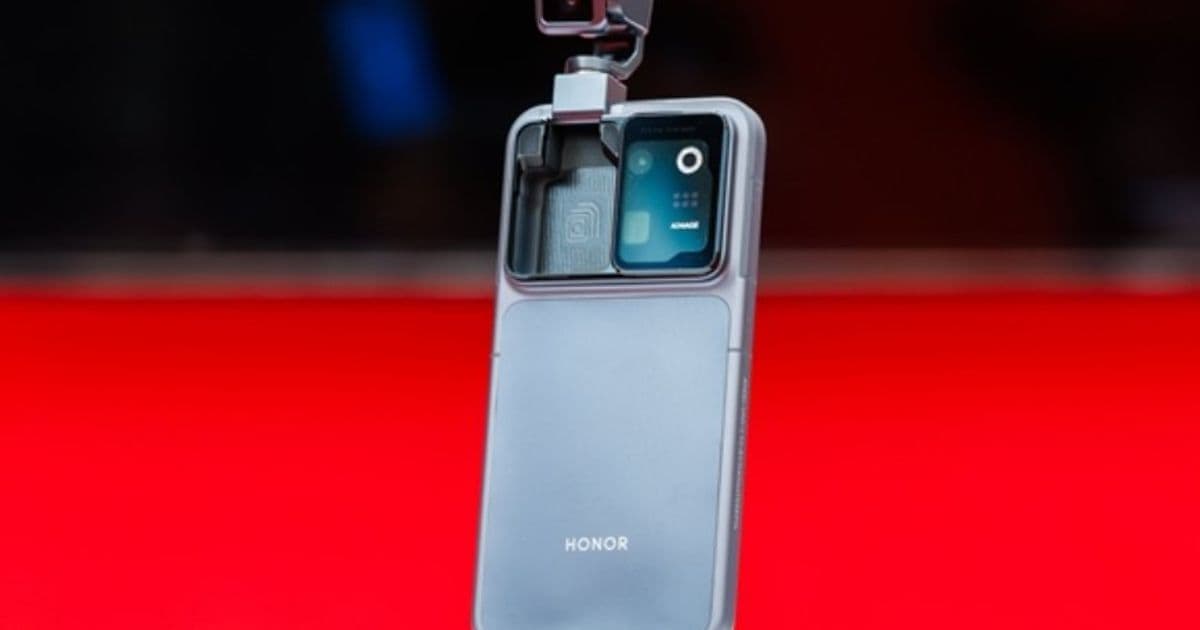
Honor debuts the world's first smartphone with a physical robotic arm that transforms mobile photography and videography, powered by Qualcomm's latest Snapdragon chipset and embodied AI capabilities.
At Qualcomm's Snapdragon Fans anniversary party, Honor revealed a device that challenges our conventional understanding of what a smartphone can be: the Honor Robot Phone. This isn't just another incremental improvement in mobile technology—it's a reimagining of how smartphones can interact with their physical environment.
The centerpiece of this innovation is a hidden robotic-arm gimbal system that physically extends from the phone's body when activated. Unlike traditional electronic stabilization systems that rely purely on software and tiny internal motors, Honor's approach gives the phone agency in physical space. With a single tap, the robotic arm extends outward, allowing the smartphone to physically move while delivering fully automatic framing, subject tracking, and advanced stabilization.
This physical capability represents a significant leap forward in mobile photography. Current smartphone stabilization systems work by counteracting small movements using internal mechanisms, but they fundamentally remain passive devices. Honor's Robot Phone becomes an active participant in the photography process, capable of making deliberate movements to capture the perfect shot.
The technological backbone of this system is Qualcomm's flagship Snapdragon chipset, which provides the necessary on-device embodied AI capabilities and powerful computing performance to drive this autonomous robotic camera system. This approach moves beyond traditional AI that processes images or recognizes patterns—this is AI that can make physical decisions and movements in real-time.
The potential applications extend beyond casual photography. For content creators, this technology could revolutionize how vlogs and videos are shot, eliminating the need for additional camera equipment or crew. For live streamers, it could enable dynamic camera movements that were previously impossible without a dedicated operator. In video calls, it could automatically keep the subject centered and properly framed, even as they move around.
This innovation comes at a time when smartphone manufacturers are increasingly looking for ways to differentiate their products in a mature market. With physical design reaching diminishing returns, software improvements becoming harder for consumers to notice, and camera capabilities plateauing, Honor's approach represents a bold attempt to create a new category of device.
The timing of this announcement is significant. Qualcomm's Snapdragon Fans event suggests this technology leverages the latest advancements in mobile processing power. The Snapdragon chipset's AI capabilities are crucial for processing visual information, making real-time decisions about framing and movement, and executing those movements with precision.
From a practical standpoint, several questions remain about how this technology will perform in everyday use. The mechanical complexity of a retracting robotic arm raises concerns about durability, battery consumption, and potential points of failure. Additionally, the added bulk and weight when the arm is extended may impact the phone's usability as a conventional communication device.
The Honor Robot Phone is scheduled for an official launch in the third quarter of this year. If successful, this could signal a new direction for smartphone innovation—one where devices are not just passive tools but active participants in our digital and physical lives.
For consumers, the question will be whether the novelty translates to meaningful improvements in their photography and videography workflows. For the industry, Honor's experiment with embodied AI in smartphones could open new possibilities for how mobile devices interact with the world around them.
Comments
Please log in or register to join the discussion