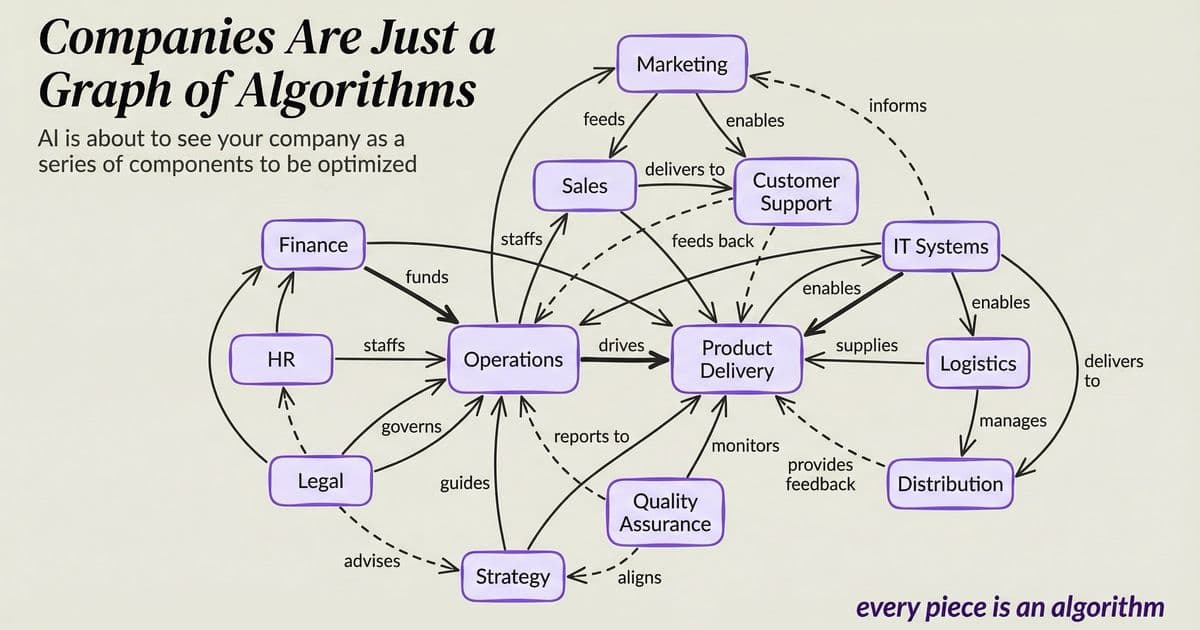
The article argues that companies can be viewed as graphs of algorithms - collections of processes and steps that can be broken down, analyzed, and optimized. With AI's ability to understand these complex workflows, businesses will undergo significant optimization, leading to greater efficiency but also job displacement. The author emphasizes that understanding this perspective is crucial for both business owners and employees to prepare for the coming changes.
The central premise of Daniel Miessler's article is that companies are fundamentally graphs of algorithms - interconnected processes that can be systematically analyzed and optimized. This perspective reveals that what we perceive as complex business operations are merely sequences of steps that can be broken down, examined, and improved.
Consider the example of a photo processing service called Memories. The workflow appears straightforward: upload images, scan and repair them, apply stylistic transformations, add captions, and deliver the final product. Yet each of these steps represents its own algorithmic process, which can be further decomposed into sub-processes. This algorithmic decomposition continues recursively - "algorithms all the way down," as Miessler puts it.
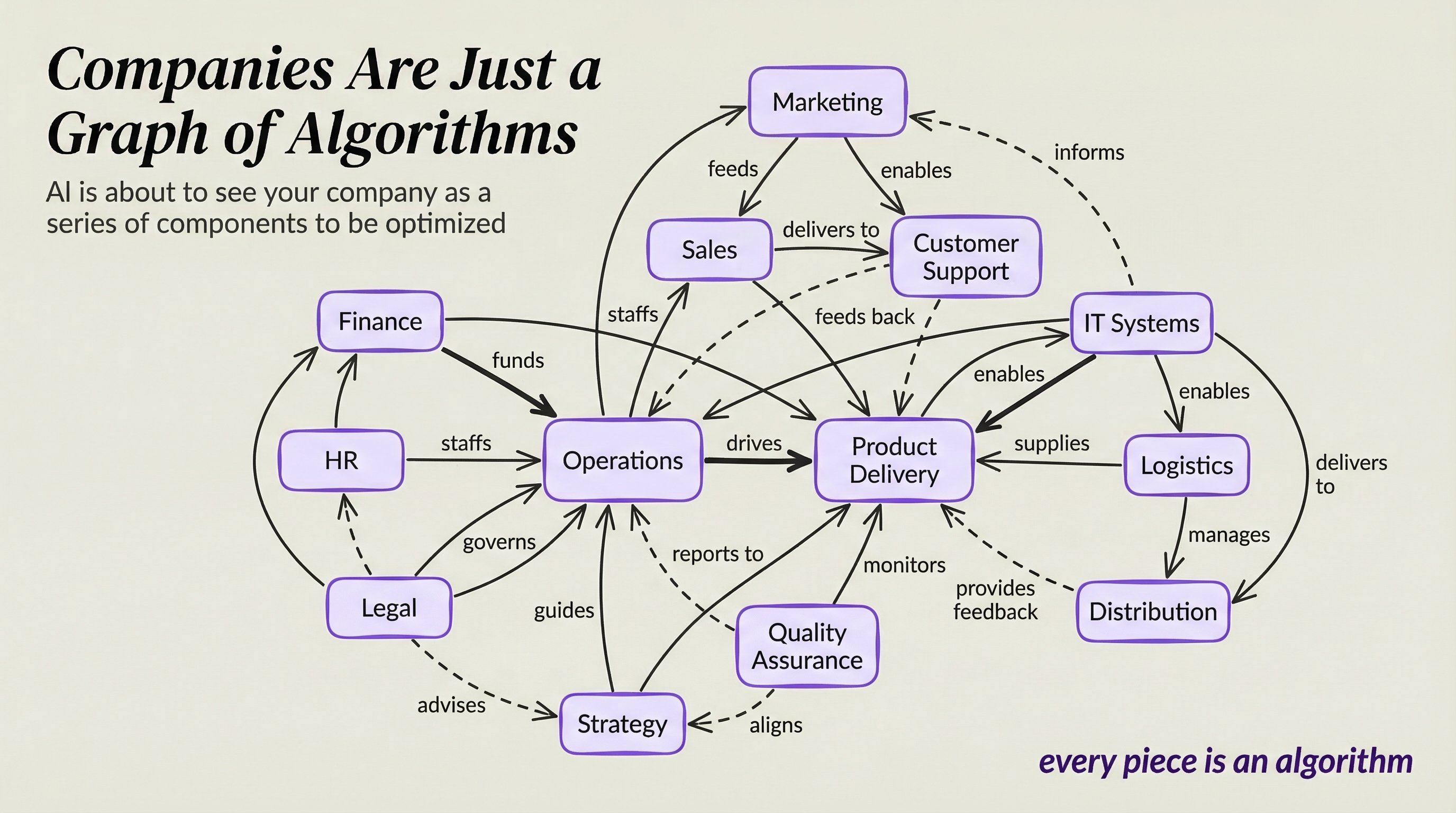
Beyond customer-facing workflows, a company's complete graph includes administrative functions: hiring, taxation, infrastructure management, marketing, and support. When visualized as a graph, these components reveal their interconnections and dependencies.
The transformative potential emerges when AI is applied to this graph representation. Unlike humans, AI can simultaneously comprehend the entire graph and its individual components, identifying redundancies, inefficiencies, and optimization opportunities that would remain invisible to human analysts. This capability explains why consultancies like Accenture, KPMG, and McKinsey are positioning themselves to offer AI-driven business optimization services.
The proposed optimization process follows a pattern:
- Map all workflows within the organization
- Identify automated versus human-performed tasks
- Locate process waste and redundancies
- Determine ineffective teams or departments
- Eliminate or consolidate unnecessary processes
This analysis doesn't occur once but becomes continuous. AI systems will constantly interrogate business components, asking questions like: Why are humans performing tasks that could be automated? Where are unnecessary delays occurring? What steps can be consolidated or eliminated?
The implications extend across all business functions. Marketing departments, for example, consist of multiple algorithmic steps: idea generation, campaign planning, copy creation, email distribution, lead capture, and performance monitoring. Each represents an opportunity for AI optimization.
This perspective applies universally regardless of industry complexity. Larger or more specialized businesses merely have more complex graphs, not fundamentally different structures. The scalability of AI analysis means that even the most intricate business operations can be examined and optimized.
The article acknowledges the disruptive potential of this transformation. While businesses will become more efficient and productive, many routine human jobs will be displaced. However, Miessler suggests viewing this as an inevitable evolution rather than a threat. The increased efficiency could lower barriers to entrepreneurship and enable new types of businesses to emerge.
The key takeaway is that viewing companies as algorithmic graphs provides a framework for understanding how AI will transform business operations. Organizations that proactively analyze their own algorithmic graphs and identify optimization opportunities will be better positioned to adapt to this new reality. Similarly, employees who understand which components of their work are most susceptible to algorithmic optimization can prepare for the changing nature of work.
For more insights from Daniel Miessler, you can visit his official blog where he regularly publishes technical tutorials and essays on AI, security, and technology trends.
Comments
Please log in or register to join the discussion