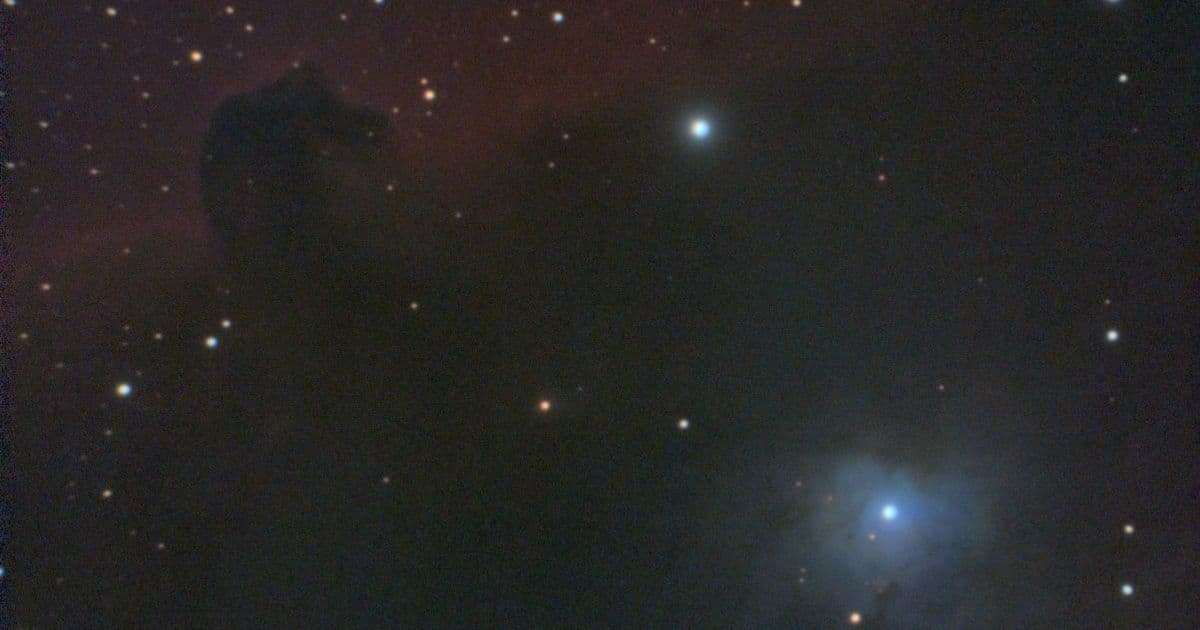
A detailed post-mortem of capturing the iconic Horsehead Nebula (B33) under challenging conditions, exploring the technical hurdles of amateur deep-sky imaging, from mount alignment to post-processing trade-offs.
The Horsehead Nebula is one of the most recognizable deep-sky objects, a dark dust cloud silhouetted against the bright emission nebula IC 434. Capturing it requires precision, patience, and a bit of luck. In this 2026 attempt, the conditions were far from ideal, but the resulting image and analysis provide a valuable look at the real-world challenges of astrophotography.
Equipment and Setup
The imaging train was built around a Celestron C9.25 SCT, a popular choice for deep-sky work due to its long focal length (2350mm) and aperture. A 0.63x focal reducer was used to bring the effective focal length down to approximately 1480mm, widening the field of view and reducing exposure times. The camera was an ASI533 MC, featuring the Sony IMX533 sensor—a 9MP color sensor with 3.75μm pixels, known for its excellent quantum efficiency and low read noise, making it a solid choice for nebula imaging.
The mount is a Sky-Watcher EQ6-R, a robust equatorial mount capable of carrying substantial payloads. For deep-sky imaging, precise polar alignment is critical to minimize field rotation during long exposures. In this case, Polaris was not visible due to the viewing location (over the roof of a house), forcing a "memory-based" alignment—a risky approach that often leads to tracking errors and star trails.
The Imaging Session: A Cascade of Compromises
The session was plagued by a series of technical and environmental issues:
Backfocus and Collimation: The author notes "messed up backfocus and collimation." In telescope imaging, backfocus—the distance from the focal plane to the camera sensor—must be precise (often 55mm for Celestron SCTs) to achieve optimal sharpness. Collimation, the alignment of the telescope's optical elements, is equally critical. Both errors lead to soft, distorted stars and reduced resolution.
Poor Seeing Conditions: The image was taken through thin clouds and with "bad seeing," exacerbated by the telescope's position over a warm roof. Atmospheric turbulence (seeing) limits the resolution achievable, often measured as the Full Width at Half Maximum (FWHM) of stars. The author reports 5 arcseconds FWHM—suboptimal for a C9.25, which can theoretically resolve below 1 arcsecond under perfect conditions.
Cloud Interruption: Every single 5-second frame was affected by clouds. This is a major issue for deep-sky imaging, as clouds not only reduce signal but also introduce gradients and noise. The author managed only 27 minutes of integration time (319 frames × 4 seconds each), which is minimal for a faint object like the Horsehead. Typically, 2-4 hours of data is recommended for a clean image.
Mount Alignment: Without Polaris, the mount's alignment was based on memory. This often results in periodic error and field rotation, especially over longer exposures. The EQ6-R is capable of autoguiding, but without a guide camera and software, the mount's inherent tracking errors become apparent in the final stack.
The Result: A Study in Post-Processing Trade-offs
The final image is a heavily noise-reduced version. The author admits it looks "a little better" but is "missing a lot of the details." This is a common dilemma in astrophotography: aggressive noise reduction (using tools like PixInsight's MultiscaleLinearTransform or Topaz DeNoise AI) can smooth out fine details like the delicate tendrils of the Horsehead's dust structure or the faint stars within the nebula.
The raw stacks (compressed FITS files) contain the original data, which likely shows significant noise, gradients, and tracking artifacts. Processing such data requires careful calibration (darks, flats, bias frames) and iterative stretching to bring out faint details without introducing artifacts.
Broader Context: The Reality of Amateur Astrophotography
This attempt highlights a universal truth in amateur astrophotography: perfect conditions are rare. The Horsehead Nebula is a challenging target due to its low surface brightness and the need for a dark sky. Even experienced imagers often struggle with it.
Key takeaways for fellow imagers:
- Equipment Setup: Double-check backfocus and collimation before imaging. Use a laser collimator or a Cheshire eyepiece for accuracy.
- Mount Alignment: If Polaris isn't visible, consider using a polar alignment app (like SharpCap or NINA's polar alignment routine) that uses star patterns for alignment.
- Weather and Timing: Check weather forecasts and moon phases. The Horsehead is best imaged in winter when Orion is high in the sky.
- Integration Time: More data is always better. Aim for at least 2 hours of integration, even under poor conditions, to stack out noise.
- Post-Processing: Balance noise reduction with detail preservation. Use tools like PixInsight, Astro Pixel Processor, or Siril for calibration and stacking.
Conclusion
This 2026 attempt at the Horsehead Nebula, while imperfect, serves as a realistic case study in the challenges of deep-sky imaging. The combination of optical misalignment, poor seeing, and environmental interference resulted in a compromised dataset. Yet, the very act of capturing and analyzing the image—despite the obstacles—underscores the enthusiast's drive to push equipment to its limits and learn from each session.
For those interested in the raw data or processing techniques, the author has shared compressed FITS files, allowing others to experiment with the same challenging dataset. It's a reminder that even under suboptimal conditions, there's value in the attempt—both for the resulting image and the lessons learned.
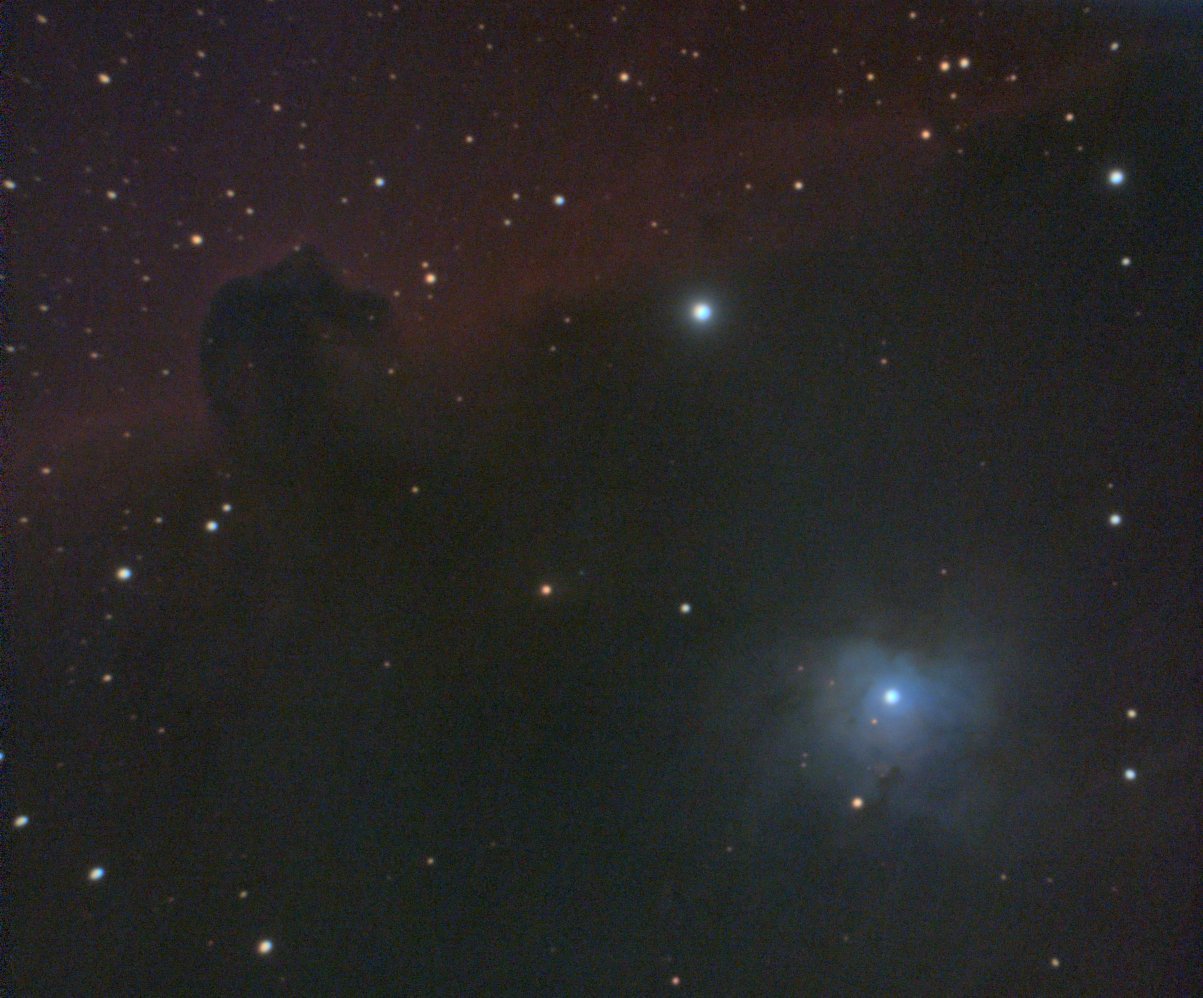
Image: The Horsehead Nebula (B33) and surrounding region, processed to reduce noise. The faint dust structures are visible but lack fine detail due to aggressive noise reduction.
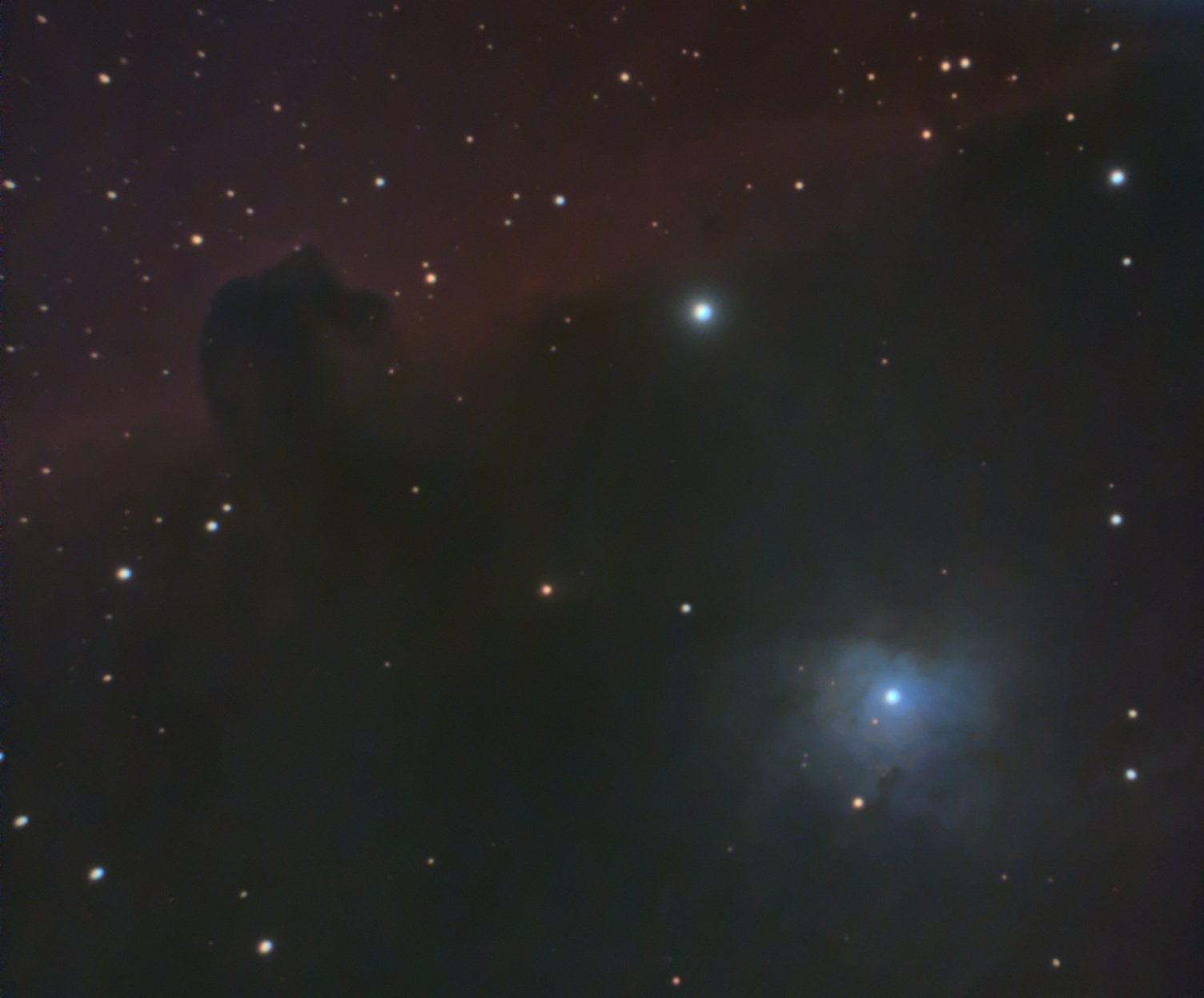
Image: A denoised version of the same data, showing improved contrast but potentially lost detail in the nebula's intricate dust lanes.
Comments
Please log in or register to join the discussion