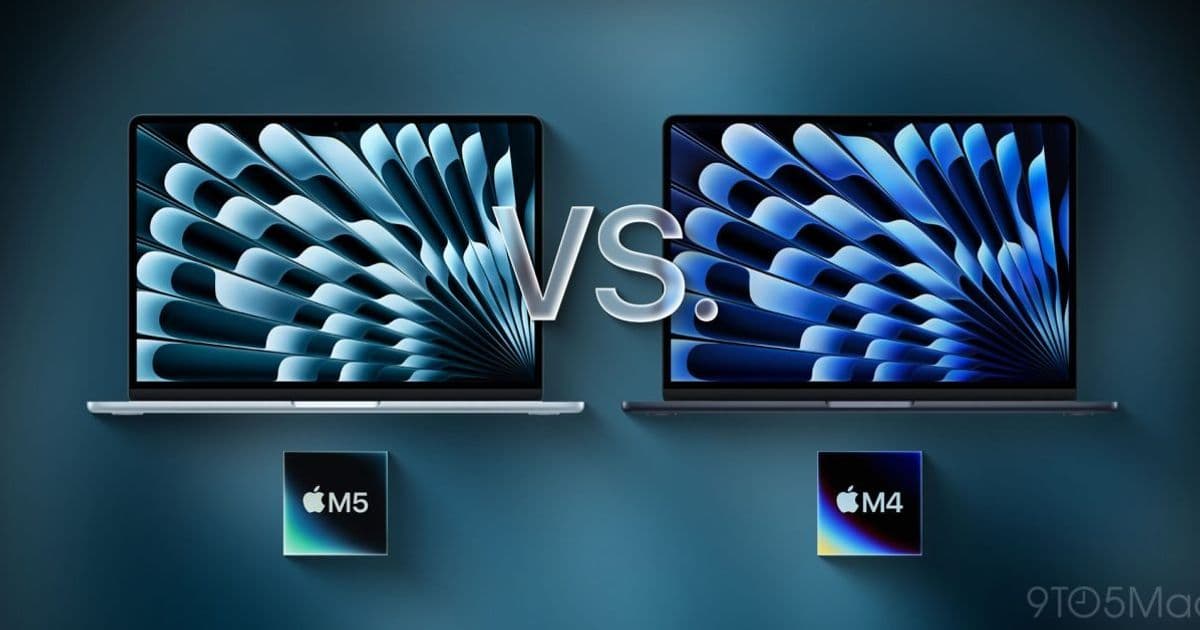
Apple's new M5 MacBook Air brings meaningful upgrades for users with older models, but current M4 owners won't find compelling reasons to upgrade.
Apple has unveiled the new M5 MacBook Air, bringing several notable improvements over last year's M4 model. While the changes aren't revolutionary, they represent meaningful upgrades for users with older MacBooks, particularly those still using M1 or earlier models.
The M5 chip: Performance gains that matter
The headline feature of the new MacBook Air is undoubtedly the M5 chip. According to Apple's press release, the M5 delivers "incredible performance for everything users want to tackle, from everyday productivity to creative workflows."
Key M5 specifications include:
- 10-core CPU with "the world's fastest CPU core"
- Up to 10-core GPU
- Neural Accelerator in each core
- Up to 4x faster AI performance than M4
- Up to 9.5x faster than M1 MacBook Air
While these numbers sound impressive, the reality is that M4 MacBook Air owners won't see a compelling reason to upgrade. The M5 represents solid year-over-year improvements, but the performance gains are incremental rather than transformative for most users.
Where the M5 truly shines is for owners of older models. Those still using an M1 MacBook Air will experience a significant leap in performance, particularly for AI tasks and creative workflows. The M5's enhanced Neural Engine makes it an "incredibly capable platform for AI," whether you're using Apple Intelligence across apps and system experiences or running large language models on device in enterprise environments.
Storage: Double the capacity, double the speed
One of the most practical upgrades comes in the form of storage. The M5 MacBook Air starts at $1,099, which is $100 more than the M4's $999 starting price. However, this price increase comes with substantial benefits:
- Standard 512GB storage (double the previous 256GB)
- Up to 4TB maximum configuration (double the previous 2TB limit)
- 2x faster read/write performance compared to the previous generation
This change addresses one of the most common complaints about the MacBook Air lineup. The previous 256GB starting configuration often proved insufficient for many users, especially those working with photos, videos, or large creative projects. Now, the base model offers more practical storage for everyday use.
Wireless connectivity: N1 chip brings Wi-Fi 7 and Bluetooth 6
Apple's new N1 wireless chip, which debuted in the iPhone 17 lineup, makes its way to the MacBook Air. This custom silicon replaces the third-party wireless solutions used in the M4 model and brings several important upgrades:
- Wi-Fi 7 (802.11be) support, replacing Wi-Fi 6E (802.11ax)
- Bluetooth 6, replacing Bluetooth 5.3
- Improved performance and reliability for cross-platform features like AirDrop and Personal Hotspot
The Wi-Fi 7 upgrade is particularly noteworthy, as it offers significantly higher throughput, lower latency, and better performance in congested environments. While the full benefits of Wi-Fi 7 require compatible routers, the M5 MacBook Air is now future-proofed for the next generation of wireless networking.
Charger upgrade: More power in the box
In a rare move, Apple has actually improved the included charger. The M5 MacBook Air ships with a 40W Dynamic Power Adapter with 60W Max, up from the 30W USB-C Power Adapter included with the M4 model. This means faster charging times and more flexibility for power-hungry tasks.
The new adapter can be purchased separately, though many users will appreciate having a more capable charger included in the box without additional cost.
What hasn't changed
Despite these upgrades, much of the M5 MacBook Air remains identical to its predecessor:
- Same industrial design and form factor
- Same color and size options
- 18-hour battery life
- 12MP Center Stage camera
- General feature set
This consistency is actually a strength of the MacBook Air lineup. Apple has refined the design to the point where it doesn't need annual overhauls, allowing the company to focus on meaningful internal upgrades instead.
Who should upgrade?
The M5 MacBook Air is clearly positioned for users with older models, particularly those still using M1 or earlier MacBooks. The performance gains, storage improvements, and wireless upgrades represent a significant leap forward for these users.
However, current M4 MacBook Air owners should think twice before upgrading. The improvements, while nice, don't justify the cost of replacing a machine that's only a year old. The M4 remains an incredibly capable laptop that will serve most users well for years to come.
For those in the market for a new MacBook Air, the M5 model offers compelling value, especially considering the doubled storage at the base configuration. The combination of better performance, more storage, faster wireless connectivity, and a more powerful charger makes it an attractive option for anyone looking to purchase a new MacBook Air.
As Apple continues to refine its silicon and wireless technologies, we can expect to see the N1 chip spread to more devices in the coming years. The M5 MacBook Air represents another step in Apple's vertical integration strategy, bringing more components under its own silicon umbrella for better performance and efficiency.
The question isn't whether the M5 MacBook Air is a good laptop—it clearly is. The real question is whether the upgrades are significant enough to justify an upgrade from your current machine. For M4 owners, the answer is likely no. For everyone else, the M5 MacBook Air is worth serious consideration.
Comments
Please log in or register to join the discussion