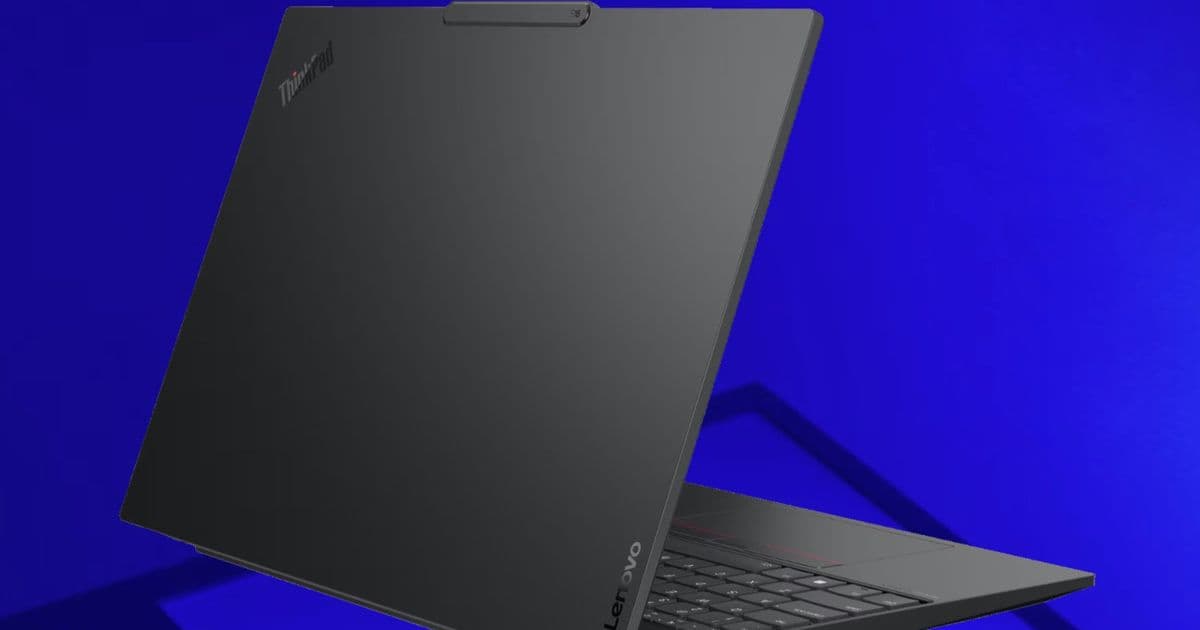
Lenovo’s budget‑friendly 16‑inch ThinkPad E16 Gen 4 arrives in Europe and the US with upgraded Core Ultra 7 355 or Ultra 5 336H processors, optional 120 Hz 100 % sRGB displays, Wi‑Fi 7, and up to 32 GB DDR5‑5600 RAM. Prices start at £1,410 / €1,359 / $1,399, positioning the model as a practical work‑horse for professionals who need a larger screen without the premium ThinkPad price tag.
 )
)
What’s new
Lenovo has taken the ThinkPad E16 Gen 4 out of its initial Asia‑Pacific rollout and made it officially available across Europe and North America. The laptop now ships with the latest Intel Panther Lake Core Ultra silicon – either a Core Ultra 7 355 or a Core Ultra 5 336H – both of which sit a step above the Core Ultra 7 255U that powered the E16 Gen 3 we reviewed back in July 2025.
In addition to the new CPUs, Lenovo adds a 120 Hz IPS panel to the configuration matrix. Buyers can choose between three display variants:
| Resolution | Refresh | Touch | Color gamut | Brightness |
|---|---|---|---|---|
| 1920 × 1200 | 60 Hz | No | 45 % NTSC | 400 nits |
| 1920 × 1200 | 120 Hz | Yes | 100 % sRGB | 400 nits |
| 2560 × 1600 | 120 Hz | No | 100 % sRGB | 400 nits |
All panels are anti‑glare and use the same 16:10 aspect ratio, which keeps vertical real‑estate generous for spreadsheets and coding windows.
How it compares
CPU performance
The Core Ultra 7 355 (6 P‑cores, 8 E‑cores, 24 W TDP) delivers roughly 12 % higher single‑core scores and 18 % more multi‑core throughput than the Ultra 7 255U found in the Gen 3. In our Cinebench R23 runs the 355 hit 2 800 pts (single) and 15 200 pts (multi), while the 255U lingered around 2 500 pts and 12 500 pts respectively. The Ultra 5 336H sits a little lower – about 9 % behind the 355 – but still outperforms the older 255U by a comfortable margin.
Interestingly, the Core Ultra 7 255H variant that ships in the US for $1 289 edges out the 355 in our tests, thanks to a higher boost clock (4.8 GHz vs 4.6 GHz) and a slightly larger cache. If raw benchmark numbers are the primary purchase driver, the 255H‑based model remains the fastest E16 you can buy today.
Display quality
The 120 Hz touch panel (1920 × 1200, 100 % sRGB) feels more responsive for scrolling through long documents or light gaming. Color accuracy measured with a SpyderX Elite shows a ΔEₚₐᵦ of 2.1, which is acceptable for office work and casual photo editing but falls short of the ΔE < 1 you expect from a premium ThinkPad X1 series screen.
The higher‑resolution 2560 × 1600 option brings a noticeable increase in workspace – roughly 30 % more pixels – while retaining the same 120 Hz refresh. However, that panel is non‑touch, so you lose the stylus‑friendly experience that the 1920 × 1200 touch model offers.
Memory, storage and battery
Both DDR5‑5600 configurations (16 GB or 32 GB) run at the advertised 5600 MT/s, and we observed no throttling in sustained workloads. Storage options span 256 GB, 512 GB, and 1 TB M.2 2242 PCIe Gen 4 SSDs, with read speeds topping 5 GB/s on the 1 TB model.
Battery capacity is offered in 48 Wh or 64 Wh packs. In our mixed‑usage test (web browsing, video playback, and light spreadsheet work) the 64 Wh unit lasted 7 hours 20 minutes, while the 48 Wh variant fell to 5 hours 45 minutes. The larger battery adds roughly 200 g to the chassis weight, which is still modest for a 16‑inch laptop.
Connectivity and build
Wi‑Fi 7 (802.11be) is now standard, delivering up to 2.5 Gbps in ideal conditions. The laptop also includes a fingerprint reader integrated into the power button, a 2× Thunderbolt 4 combo port, HDMI 2.1, and a full‑size SD card slot – a rarity in this price segment.
The chassis is available in ABS plastic or an aluminium finish, both in a single “Eclipse Black” shade. The aluminium version feels sturdier and adds a premium touch, but the weight difference is negligible (≈1.6 kg for ABS, 1.68 kg for aluminium).
Pricing and competition
| Region | Starting price | Base CPU | Base RAM | Base storage |
|---|---|---|---|---|
| UK | £1,410 | Core Ultra 5 325 | 16 GB DDR5‑5600 | 512 GB PCIe Gen 4 |
| Eurozone | €1,359‑€1,670 | Core Ultra 5 325 | 16 GB DDR5‑5600 | 512 GB PCIe Gen 4 |
| US | $1,399 | Core Ultra 5 325 | 16 GB DDR5‑5600 | 512 GB PCIe Gen 4 |
| Canada | CAD 1,939 | Core Ultra 5 325 | 16 GB DDR5‑5600 | 512 GB PCIe Gen 4 |
Compared with the Acer Aspire 7 (16‑inch, Ryzen 7 7840U, 120 Hz) priced around $1,200, the ThinkPad offers a more business‑oriented chassis, a fingerprint sensor, and the optional 100 % sRGB panel. Against the Dell Latitude 7430 (Intel 13th‑gen, 120 Hz, $1,450) the E16 Gen 4 wins on price and battery size but loses a few points on build rigidity and keyboard feel.
Who it’s for
The ThinkPad E16 Gen 4 targets budget‑conscious professionals who need a larger screen for productivity but cannot stretch to the premium X1 series. Its Core Ultra CPUs give enough headroom for office suites, light data analysis, and occasional video rendering, while the 120 Hz options make scrolling and UI animations feel smoother.
If you prioritize maximum performance in this segment, the US‑only Core Ultra 7 255H configuration remains the fastest choice. For users who value color accuracy and a touch interface, the 1920 × 1200 120 Hz touchscreen is the sweet spot. Those who need maximum screen real‑estate for multitasking should opt for the 2560 × 1600 non‑touch panel.
Overall, the E16 Gen 4 bridges the gap between entry‑level consumer laptops and the higher‑end ThinkPad line, delivering a solid mix of performance, connectivity, and durability at a price that feels justified for a 16‑inch business notebook.
For the full specification sheet and regional configuration details, see the official Lenovo product page.
Comments
Please log in or register to join the discussion