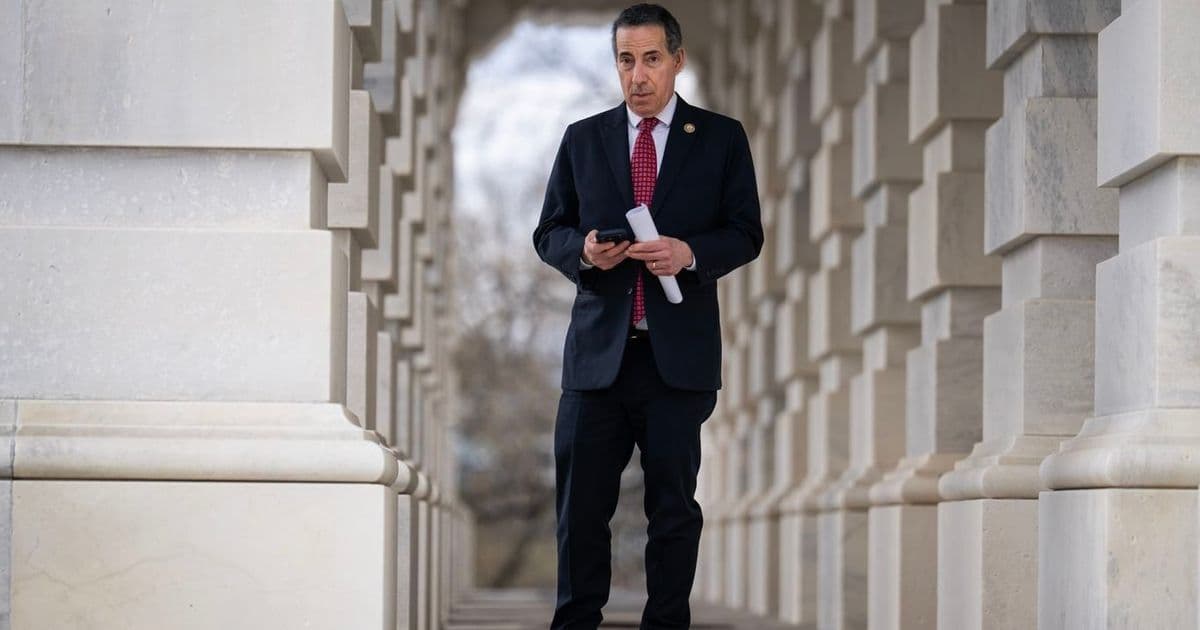
House Democrats have introduced legislation to establish a permanent commission to evaluate presidential fitness under the 25th Amendment, a move seen as a political statement against President Trump.
House Democrats have filed legislation to establish a permanent commission that would evaluate presidential fitness under the 25th Amendment, marking the latest attempt to create a formal mechanism for determining whether a sitting president is capable of carrying out their duties.
The bill, introduced by Rep. Jamie Raskin (D-Md.) and co-sponsored by 20 other Democrats, would create the "Commission on Presidential Capacity to Discharge the Powers and Duties of Office." The commission would consist of 11 members - four physicians, four psychiatrists, and three retired high-ranking executive branch officials.
Under the proposal, the commission would have the authority to conduct an examination of the president when requested by a majority of the Cabinet or by Congress. The examination would assess the president's physical or mental health and ability to discharge the powers and duties of the office.
The 25th Amendment, ratified in 1967 following the assassination of President John F. Kennedy, provides procedures for replacing the president or vice president in the event of death, removal, resignation, or incapacitation. Section 4 of the amendment allows the vice president and a majority of the Cabinet to declare a president unfit for office, temporarily transferring power to the vice president.
Raskin's bill would essentially create a permanent body to fulfill the role currently assigned to the Cabinet under Section 4. The legislation has been introduced multiple times since 2017 but has never advanced beyond committee.
Political context
The timing of this latest introduction comes amid ongoing tensions between congressional Democrats and the Trump administration over various policy disputes and investigations. While the bill's sponsors acknowledge the long odds of passage in a Republican-controlled House, they frame it as a necessary safeguard for constitutional governance.
"The 25th Amendment is all about the stability of the presidency and the continuity of government," Raskin said in a statement. "This bill allows us to set up the process by which we can determine ability to serve."
Critics argue the legislation is politically motivated rather than a genuine attempt to address presidential fitness. The White House has not formally responded to the bill, but Republican leaders in Congress have dismissed it as a partisan stunt.
Historical precedent The 25th Amendment has been invoked six times in U.S. history, all for routine medical procedures where presidents temporarily transferred power to their vice presidents. No president has ever been removed from office under Section 4.
The amendment's text specifically contemplates the possibility of a permanent body being established by law to assist in determining presidential incapacity, stating that such a determination can be made by "such other body as Congress may by law provide."
Legislative prospects
The bill faces significant hurdles in the current Congress. With Republicans holding a narrow majority in the House and Democrats controlling the Senate by an even slimmer margin, the legislation would need bipartisan support to advance. Given the political polarization surrounding Trump, such support appears unlikely.
Even if the bill were to pass both chambers, it would require presidential signature to become law - a prospect that seems remote given that it would apply to the current administration.
What this means
The introduction of this legislation serves multiple purposes for House Democrats. Beyond its stated goal of establishing a constitutional safeguard, it signals continued Democratic opposition to Trump's presidency and keeps questions about presidential fitness in the political conversation.
The bill also highlights the tension between the original design of the 25th Amendment, which relies on the president's own Cabinet to initiate removal proceedings, and contemporary concerns about Cabinet loyalty in highly partisan environments.
While the legislation is unlikely to become law, it contributes to the ongoing debate about presidential accountability and the mechanisms available to address concerns about executive capacity. The discussion touches on fundamental questions about the balance between democratic legitimacy and the need for effective governance.
As the 2024 election approaches, this bill may serve as a marker of Democratic priorities and concerns, even if it never advances to a vote. It also raises questions about how future Congresses might approach the issue of presidential fitness, particularly in an era of heightened political polarization.
The debate over presidential fitness and the mechanisms for addressing it remains a contentious issue in American politics, reflecting broader concerns about the concentration of power in the executive branch and the challenges of ensuring effective governance in a divided political environment.
Comments
Please log in or register to join the discussion