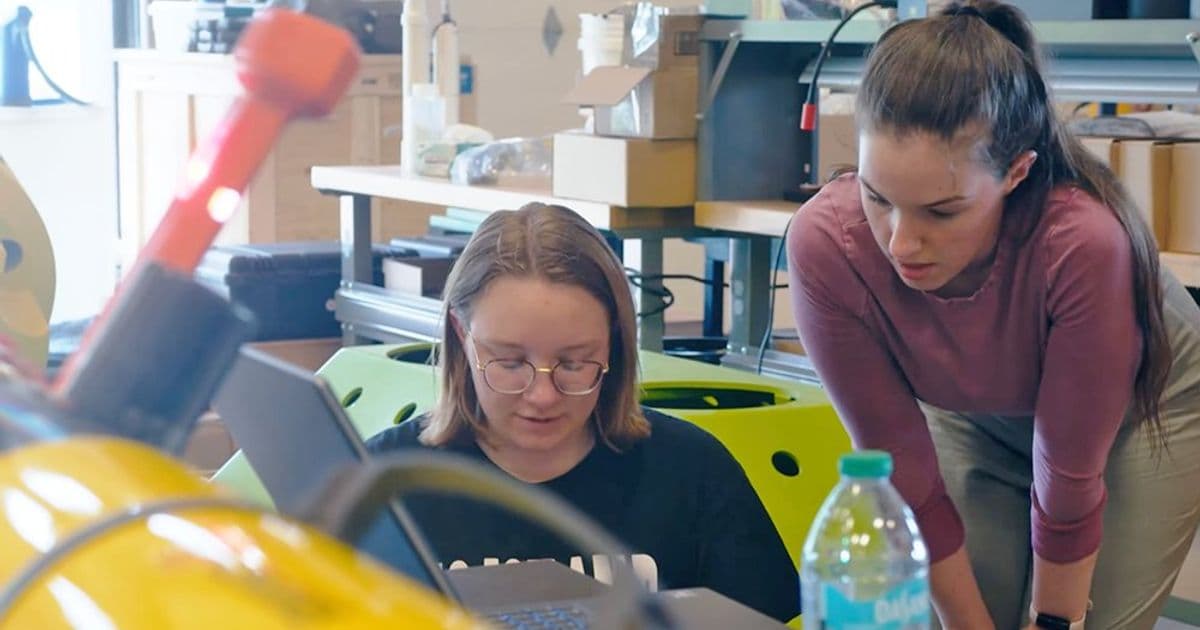
Undergraduate robotics engineering student Ivy Mahncke developed and tested algorithms for collaborative underwater navigation between human divers and robotic vehicles during her internship at MIT Lincoln Laboratory, gaining hands-on experience in field testing across multiple water bodies.
During a summer internship at MIT Lincoln Laboratory, Ivy Mahncke, an undergraduate student of robotics engineering at Olin College of Engineering, took a hands-on approach to testing algorithms for underwater navigation. She first discovered her love for working with underwater robotics as an intern at the Woods Hole Oceanographic Institution in 2024. Drawn by the chance to tackle new problems and cutting-edge algorithm development, Mahncke began an internship with Lincoln Laboratory's Advanced Undersea Systems and Technology Group in 2025.
Mahncke spent the summer developing and troubleshooting an algorithm that would help a human diver and robotic vehicle collaboratively navigate underwater. The lack of traditional localization aids — such as the Global Positioning System, or GPS — in an underwater environment posed challenges for navigation that Mahncke and her mentors sought to overcome. Her work in the laboratory culminated in field tests of the algorithm on an operational underwater vehicle.
Accompanying group staff to field test sites in the Atlantic Ocean, Charles River, and Lake Superior, Mahncke had the opportunity see her software in action in the real world. "One of the lead engineers on the project had split off to go do other work. And she said, 'Here's my laptop. Here are the things that you need to do. I trust you to go do them.' And so I got to be out on the water as not just an extra pair of hands, but as one of the lead field testers," Mahncke says. "I really felt that my supervisors saw me as the future generation of engineers, either at Lincoln Lab or just in the broader industry."
Says Madeline Miller, Mahncke's internship supervisor: "Ivy's internship coincided with a rigorous series of field tests at the end of an ambitious program. We figuratively threw her right in the water, and she not only floated, but played an integral part in our program's ability to hit several reach goals."
Lincoln Laboratory's summer research program runs from mid-May to August. Applications are now open.
Video by Tim Briggs/MIT Lincoln Laboratory | 2 minutes, 59 seconds
The Challenge of Underwater Navigation
Underwater environments present unique challenges for autonomous systems. Unlike terrestrial or aerial vehicles that can rely on GPS signals, underwater vehicles must operate without this critical navigation aid. The water's surface blocks radio waves, making traditional satellite-based positioning impossible.
This limitation forces engineers to develop alternative navigation strategies. Common approaches include:
- Acoustic positioning systems that use sound waves to measure distances
- Inertial navigation systems that track movement from a known starting point
- Visual odometry using cameras to track environmental features
- Dead reckoning that estimates position based on velocity and time
The algorithm Mahncke worked on likely combines multiple approaches to achieve reliable underwater navigation, though specific technical details weren't disclosed in the available information.
From Lab to Field: The Testing Process
Mahncke's experience highlights the importance of field testing in robotics development. While algorithms can be simulated in laboratory settings, real-world conditions often reveal unexpected challenges:
- Variable water conditions (clarity, temperature, currents)
- Hardware-software integration issues
- Environmental interference with sensors
- Communication delays between systems
The testing locations mentioned—Atlantic Ocean, Charles River, and Lake Superior—represent diverse environments that would test the algorithm's robustness across different conditions. From the relatively controlled environment of a river to the vast expanse of the Atlantic, each location provides unique data points for algorithm refinement.
The Future of Underwater Robotics
Collaborative systems that allow human divers and robotic vehicles to work together represent an important frontier in underwater robotics. Such systems could enable:
- Extended dive times by allowing robots to handle routine tasks
- Enhanced safety through robotic assistance in hazardous situations
- Improved data collection through coordinated exploration
- More efficient underwater construction and maintenance
The technology developed during Mahncke's internship contributes to this broader field, potentially enabling new applications in ocean research, offshore energy, underwater archaeology, and defense.
Educational Impact
Mahncke's experience demonstrates the value of hands-on research opportunities for students. Her progression from Woods Hole Oceanographic Institution to MIT Lincoln Laboratory shows how early exposure to specialized fields can shape career trajectories.
For students interested in robotics and autonomous systems, internships like this provide:
- Practical experience with real-world engineering challenges
- Exposure to cutting-edge research and development
- Professional networking opportunities
- Insight into potential career paths
The trust placed in Mahncke to lead field testing operations, even when senior engineers were reassigned, speaks to the confidence her supervisors had in her abilities—a confidence likely earned through demonstrated competence and initiative.
Related Research at MIT
The article mentions related MIT projects that provide context for Mahncke's work:
- SeaPerch: A program that introduces students to underwater robotics through hands-on construction and operation of remotely operated vehicles
- Surface-based sonar systems: Technology for rapid ocean floor mapping at high resolution
- Special subjects for first-year students: Educational initiatives that provide early exposure to underwater vehicle technology
These programs collectively demonstrate MIT's commitment to advancing underwater robotics through both research and education.
Technical Context
While the specific algorithm details aren't provided, underwater navigation systems typically face several technical challenges:
- Sensor fusion: Combining data from multiple sensors (sonar, inertial measurement units, cameras) to create accurate position estimates
- Uncertainty management: Accounting for the accumulation of errors over time in dead reckoning systems
- Communication constraints: Operating in environments where high-bandwidth communication is limited or impossible
- Energy efficiency: Balancing computational requirements with limited onboard power
- Environmental adaptation: Functioning across varying water conditions and temperatures
The collaborative aspect—enabling both human divers and robotic vehicles to navigate together—adds another layer of complexity, requiring the system to understand and adapt to human behavior while maintaining its own navigation accuracy.
Looking Forward
As underwater robotics technology continues to advance, we can expect to see:
- More sophisticated human-robot collaboration systems
- Improved energy efficiency enabling longer missions
- Enhanced sensor technologies for better environmental perception
- Greater autonomy in complex underwater tasks
- Expanded applications in scientific research, industry, and exploration
Interns like Mahncke represent the next generation of engineers who will drive these advancements, bringing fresh perspectives and new approaches to longstanding challenges in underwater robotics.
For those interested in pursuing similar work, the combination of strong fundamentals in robotics engineering, hands-on experience through internships, and exposure to cutting-edge research provides an excellent foundation for contributing to this exciting field.
Comments
Please log in or register to join the discussion