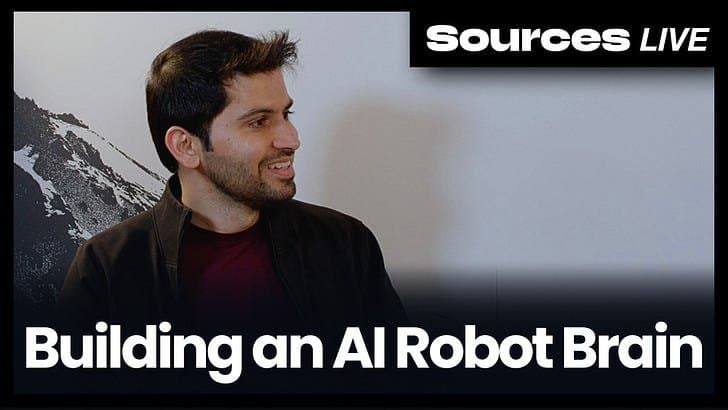
Deepak Pathak discusses Skild AI's approach to creating versatile robotic intelligence, differentiating from big tech's efforts, and the road to artificial general intelligence.
Deepak Pathak has spent 15 years trying to solve one of the hardest problems in AI: getting machines to move through and manipulate the physical world. As CEO of Skild AI, he's now leading a startup that aims to build what he calls a "general-purpose brain" for robots—a single, adaptable AI system that could power everything from industrial arms to humanoid assistants.
The Pittsburgh-based company, founded in 2023, has already raised $300 million at a $1.5 billion valuation from investors including Lightspeed Venture Partners, Coatue, SoftBank, and Jeff Bezos. But Pathak isn't interested in building specialized robots for narrow tasks. Instead, Skild AI is pursuing a "foundation model" approach for robotics, similar to how large language models work for text.
The Foundation Model Approach
"We're trying to build one model that can control any robot, in any environment, doing any task," Pathak explains. "Right now, most robotics companies build custom software for each specific robot and application. It's incredibly inefficient."
The core of Skild AI's technology is a neural network trained on massive amounts of robotic data—millions of hours of robots performing tasks, failing, and learning. This model, called Skild Brain, can then be fine-tuned for specific applications without starting from scratch.
This approach stands in stark contrast to how most robotics companies operate. Boston Dynamics, for instance, builds incredibly capable robots but programs each movement meticulously. "They're amazing at what they do," Pathak says, "but their robots can't easily learn new tasks without extensive reprogramming."
Standing Out Among Big Tech
While giants like Google, Amazon, and Tesla pour billions into robotics, Pathak believes Skild AI's focused approach gives it an edge. "Big tech companies are trying to do everything—self-driving cars, warehouse automation, home robots. We're just focused on the intelligence layer."
This specialization allows Skild AI to move faster and be more adaptable. The company has already demonstrated its technology controlling various robot types, from industrial arms to quadruped robots navigating rough terrain.
Pathak points to a key advantage: data. "We've accumulated more diverse robotic training data than anyone else, and we're continuing to grow that dataset exponentially. This is what allows our model to generalize across different robot types and tasks."
The Path to AGI
When asked about artificial general intelligence, Pathak doesn't shy away from the topic. "I believe robotics is the true path to AGI," he says. "Language models are impressive, but they're still just manipulating symbols. A truly intelligent system needs to interact with the physical world."
He argues that the challenges of robotics—dealing with uncertainty, adapting to new environments, manipulating objects—are far more complex than those faced by current AI systems. "If we can solve robotics, we'll have solved many of the core problems that define intelligence."
However, Pathak is careful to distinguish between different definitions of AGI. "Some people think AGI means human-level intelligence in all domains. I think a more practical definition is a system that can learn and adapt to new tasks with minimal human intervention. By that definition, we're getting closer every day."
The Business Model
Skild AI isn't building its own robots. Instead, it's creating an AI platform that other companies can license. This "Android for robotics" approach means Skild AI can focus purely on the intelligence layer while partners handle hardware.
Potential applications span industries: manufacturing, logistics, healthcare, agriculture, and eventually consumer applications. "The same core model could power a robot that assembles cars, one that harvests crops, and eventually one that helps around the home," Pathak explains.
Challenges Ahead
Despite the progress, significant hurdles remain. Current robotic AI systems still struggle with complex manipulation tasks that humans find trivial. Battery life, sensor limitations, and the "sim-to-real" gap (transferring skills learned in simulation to the physical world) all pose challenges.
There's also the question of safety and reliability. "When a language model makes a mistake, the worst that happens is a bad response," Pathak notes. "When a robot makes a mistake, it could cause physical damage or injury."
The Future of Work
Pathak acknowledges concerns about automation and job displacement but takes an optimistic view. "Historically, automation has freed humans from dangerous, repetitive work and allowed us to focus on more creative, meaningful tasks. I believe that pattern will continue."
He points to aging populations in many countries as a driver for robotic assistance. "We're going to need robots to help care for elderly populations and perform tasks that are becoming difficult to staff."
Why Now?
The convergence of several trends makes this the right moment for Skild AI's approach, according to Pathak. Computing power has increased dramatically, robotic hardware has become more capable and affordable, and the success of foundation models in other domains has proven the approach's viability.
"Five years ago, the technology wasn't ready," he says. "Ten years ago, people would have thought we were crazy for trying this. But now we can see a clear path forward."
The Long Game
Pathak's 15-year commitment to this problem reflects his belief in its importance. "This isn't about building a cool demo or getting acquired by a big company," he says. "This is about creating a fundamental technology that could transform how we interact with the physical world."
The road ahead is long, but Pathak seems undeterred. "We're still in the early days," he admits. "But I've never been more confident that we're on the right path. The progress we're seeing now suggests that general-purpose robotic intelligence isn't just possible—it's inevitable."
For a field that's been promising revolutionary robots for decades, that's a bold claim. But if Pathak and Skild AI succeed, they might finally deliver on that long-standing promise.
Comments
Please log in or register to join the discussion